
Outside Drain Blocked With Silt or Mud: How to Clear It
Written by the Urgent Drainage Solutions teamPublished 9 min read
Checked by Eren Birinci (Gino), Founder & Lead Drainage Engineer on
Quick answer
An outside drain blocked with silt or mud has to be emptied, not flushed. Lift the grid, bail out the water and dig the silt out of the gully by hand. If water still stands, the pipe is silted and needs high-pressure jetting. Silt that keeps returning, or arrives with stones, points to a broken pipe.
- Silt and mud wash in from flower beds, gravel, driveways and building work, or fall in through a cracked pipe.
- Dig the gully out by hand first: a hose usually moves fine silt a short way and leaves it packed further down the pipe.
- If the gully is clean but water still stands, the silt is in the pipe and needs jetting or vacuum removal.
- Silt that returns quickly, or comes with stones and sunken ground, points to a broken pipe and needs a CCTV survey.
- Approved Document H says silt and grit should be kept out of paved-area drainage by gully pots of suitable size or catchpits.
An outside drain blocked with silt or mud has to be emptied, because fine sediment does not flush away the way leaves or paper do. Lift the grid, bail out the water and dig the silt out of the gully by hand. If water still stands once the gully is clean, the pipe beyond it is silted and needs high-pressure drain jetting to move it. Silt that comes back within weeks, or arrives with stones in it, usually means soil is getting into a broken pipe.
This guide covers silt and mud specifically. For rods, chambers and other blockages, see how to unblock an outside drain.
Where do the silt and mud come from?
From the ground around the drain, or from the ground around the pipe. Silt is fine mineral sediment. Metro Rod describes it building up when materials "such as sand, clay, or quartz" enter the system through drains or gutters "and settle as sediment at the bottom of the pipe". The usual routes in are:
- Gardens. Soil washes off flower beds, bare borders and sloping lawns in heavy rain, and compost spills from pots stood next to a gully.
- Driveways and paths. Gravel, grit, jointing sand from block paving and mud off car tyres all end up at the lowest point, which is where the gully is.
- Roofs. Moss and the fine grit from roof tiles come down the downpipe. Our guide to a blocked downpipe covers that end.
- Building and landscaping work. Excavated soil, sand, plaster and the washings from tools and mixers are a common cause of a drain that silts up suddenly. Cement and mortar washings are the worst, because they set.
- Broken pipes. A cracked pipe or open joint below ground lets the surrounding soil in from the outside. This silt never passes through the gully at all.
It collects in outside drains because these drains are built to catch it. A gully is a small chamber with a water-filled bend at the outlet, and its base sits below the outlet so heavy material settles there. Approved Document H says of paved-area drainage: "Provision should be made to prevent silt and grit entering the system, either by provision of gully pots of suitable size or by catchpits." A gully full of silt has done its job. It only becomes a blockage when nobody empties it.
Is the silt in the gully or in the pipe?
Empty the gully first, then test it with a bucket of water. Where the water goes tells you where the silt is.
| What you find | Where the silt is | What to do |
|---|---|---|
| Gully packed with mud; drains freely once dug out | Gully only | Dig it out and deal with the source |
| Gully clean, but a bucket of water stands or drains very slowly | In the outlet bend or the pipe just beyond | Jetting |
| Drain rod meets soft, gritty resistance and comes back coated in mud | Along the pipe | Jetting |
| A layer of silt in the channel of the next inspection chamber | Along the whole run | Jetting, with vacuum removal for large amounts |
| Stones, lumps of clay or pieces of pipe in the silt | Coming in through a break | CCTV survey, then repair |
| Silt back within weeks of being cleared, with no source at the surface | Coming in through a break | CCTV survey, then repair |
| Gully and pipe clear, but water backs up in prolonged rain | A silted soakaway | See our blocked soakaway guide |
If you cannot find a chamber, or the cover is heavy or stuck, leave it. The gully test alone tells you most of what you need.
How do you dig silt out of a gully by hand?
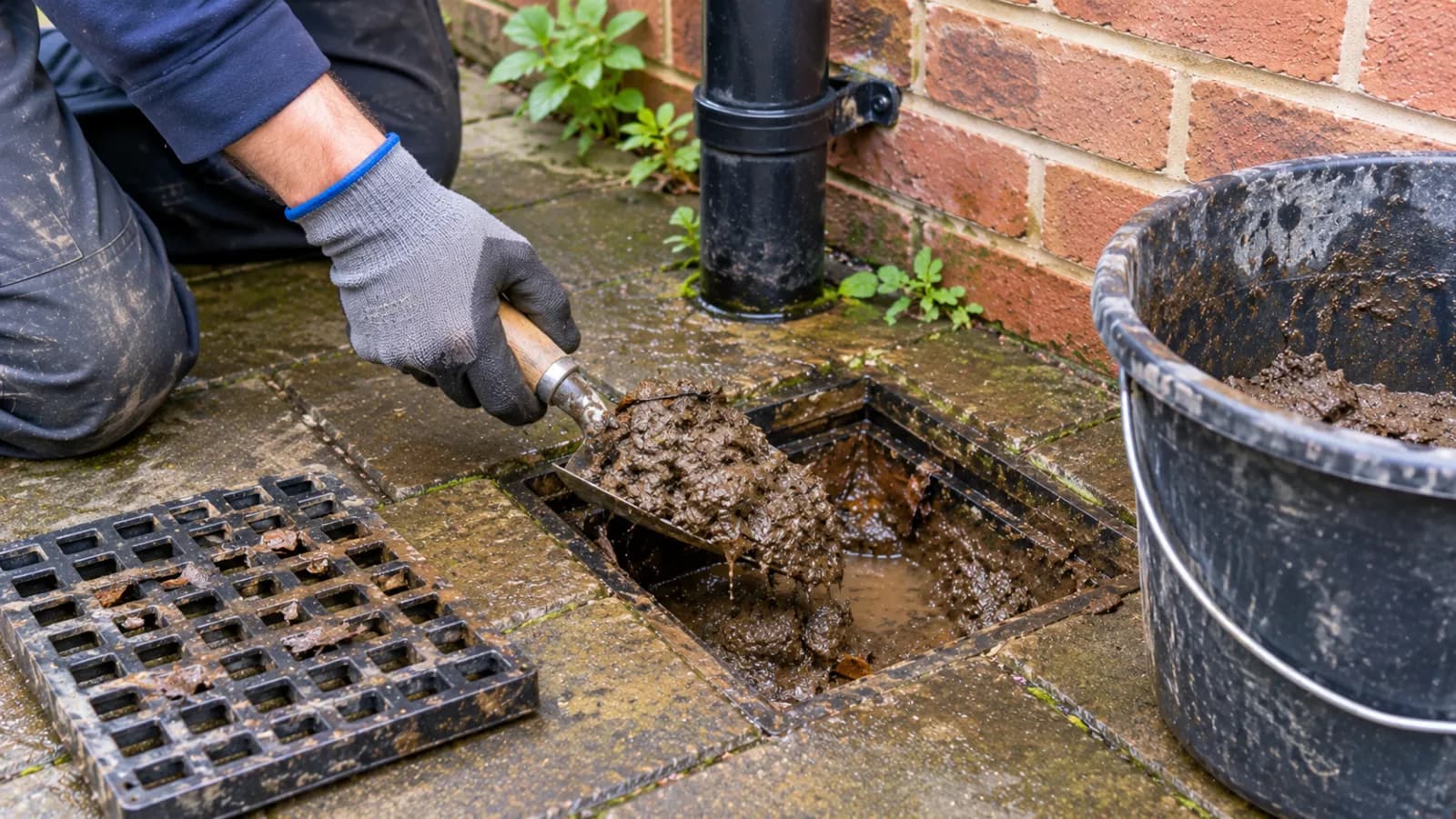
Scoop it out until you reach the firm base and can see the outlet. It is a dirty job but a simple one. You need rubber gloves, a garden trowel or an old ladle, a small container for bailing and a bucket.
- Lift the grid and clear anything matted on top of it.
- Bail out the standing water into a bucket. You cannot see what you are doing through muddy water, and stirring it only moves the silt about.
- Scoop the silt out a trowel at a time. Keep going past the soft top layer. JDP advises removing the silt at the bottom of a gully even when it is not yet causing a blockage.
- Find the outlet. It is in the side of the gully, usually facing away from the house. Clear the silt from its mouth with the trowel. Do not put your hand into the pipe.
- Pour in a bucket of clean water. It should drop away quickly and leave the gully holding its normal level of water.
- Deal with the spoil. Clean garden soil can go back on a border well away from the drain. Bag anything greasy or foul-smelling for the bin. Do not tip it into another drain.
- Wash your hands and tools thoroughly.
Stay at ground level throughout. The HSE's confined spaces guide lists enclosed drains and sewers as confined spaces and warns that poisonous gas can build up in sewers and manholes. Never climb into a chamber, and leave covers in the road or pavement alone.
Why does a hose often make silt worse?
Because a hose has enough flow to stir silt up but not enough to carry it away. The loosened sediment travels a short distance and settles again at the first bend or flat stretch, and as the water drains through it the silt packs down tighter than before. A soft blockage that was within reach in the gully becomes a firm plug that is out of reach in the pipe.
The same goes for pushing a plunger-headed drain rod into mud, which compresses it. A domestic pressure washer with a drain attachment is not the answer either. Metro Rod says domestic pressure washers "lack the power to remove tough blockages effectively".
A hose is useful after the digging, not before. Once the gully is empty and draining, running water through it for a few minutes confirms the pipe is clear.
What do jetting and vacuum removal do?
Jetting breaks the silt up and carries it along the pipe on a strong flow of water. Vacuum removal lifts it out of the drain altogether. They are often used together.
Metro Rod describes jetting as water "pumped through the hose at high pressure, breaking down obstructions and flushing them through the system". The engineer works along each run to an inspection chamber, where the silt is collected and lifted out so it is not simply moved on to the next section. Our guide to what drain jetting is explains the equipment.
Where there is a lot of silt, a hose from a tanker sucks it out. Metro Rod says of desilting: "In other cases, we may need to vacuum the silt out using a tanker", and describes jet vac tankers as combining "high-pressure jetting with vacuum suction". For one silted gully and a few metres of pipe at a house, a van-mounted jetter is normally enough. Long runs, large yard gullies and soakaway chambers are where vacuum removal earns its place. If you think yours is that kind of job, ask us when you call.
When does silt mean a cracked or collapsed pipe?
When there is no way for it to have come in from the top. A sound pipe only receives what passes through the gully. If a run is carrying soil, stones or lumps of clay that could not have come through the grid, the ground is getting in through a crack, a displaced joint or a collapse.
The signs that point to a break are:
- the drain silts up again within weeks of being properly cleared;
- stones, clay or fragments of pipe come out with the silt;
- the ground or paving over the line of the drain has dipped;
- the drain has no obvious source of mud at the surface.
It works in both directions. Soil goes into the pipe, and water leaks out of it and washes more soil away. Drainfast notes that a pipe leaking into the surrounding soil can cause "a visible indent in the ground", and advises that if a problem persists after regular unblocking you should get the pipes checked.
That check is a camera. A CCTV drain survey, from £149 + VAT, shows where the break is and how bad it is. Jetting should come first, as the camera cannot see through silt, but it should be done with care, because heavy jetting can make a fractured pipe worse. Our guide to the signs of a blocked or collapsed drain lists other clues.
What if the drain runs to a soakaway?
Then the silt may have gone further than the pipe. Many rainwater gullies drain to a soakaway instead of a sewer, and everything that washes through the gully ends up in it. If the gully and the pipe are clear but water still backs up in long spells of rain, the soakaway itself is probably silted. That is a different problem with different fixes, covered in our guide to a blocked soakaway.
How do you stop silt and mud coming back?
Stop it at the surface, and give whatever gets past somewhere to settle that you can empty.
- Gully grids. Keep a grid on every gully and replace broken or missing ones. A grid will not stop fine silt, but it keeps out the stones and leaves that silt builds up around.
- Emptying the gully. Scoop it out regularly, and again after any landscaping work. JDP also suggests sweeping the area around a gully so debris does not wash in.
- Edging and levels. Keep soil and gravel below the level of paving that drains to a gully, with an edging between a border and the grid. Move pots and compost bags away from it.
- Silt traps and catch pits. These are chambers fitted on the pipe with a sump below the outlet. JDP explains that silt settles in the sump "below the invert of the pipe" while cleaner water leaves through the outlet. Smaller units have a lift-out silt bucket. They only work if they are emptied, and JDP is blunt about that: "A poorly maintained silt trap will cease to be effective."
- Building work. Cover gullies near any digging, and never wash tools, barrows or mixers out into a drain. The government's pollution prevention guidance for businesses is a good rule for households too: "Surface water drains discharge directly to the environment", so only clean water should go into them.
- Gutters. Clean them, because roof moss and grit are a steady supply. See how often gutters should be cleaned.
Who clears a silted drain outside your house?
You do, if it is a gully or pipe inside your boundary serving only your home. Gullies in the road are the council's, and pipes shared with neighbours are generally the water company's. Our guide to who is responsible for blocked drains sets out where the lines fall.
When to call a professional
Call a drainage engineer if the gully is clean but water still stands, if rods come back coated in mud, if the silt returns soon after you have cleared it, or if the ground over the drain has sunk. Call sooner if cement, mortar or plaster washings have gone down, because they harden and are much harder to remove once set.
We clear and jet silted gullies and drains across Nottingham, Nottinghamshire, Derbyshire, Leicestershire and Lincolnshire. Blocked drain clearance starts from £120 + VAT with no call-out fee. Drain jetting for heavily silted runs is quoted individually, and we agree a fixed price before work starts. If the silt points to a broken pipe, a CCTV survey from £149 + VAT will confirm it. Our engineers work 7 days a week from 6am to 8pm, with emergency call-outs 365 days a year. Call 07300 600 950 or book online.
Sources
- Approved Document H: Drainage and waste disposal (gov.uk)
- HSE: Confined spaces, a brief guide to working safely (INDG258)
- Pollution prevention for businesses (gov.uk, updated 12 February 2026)
- JDP: What is a silt trap and why do you need one?
- JDP: How do you clear blocked gullies?
- Metro Rod: Drain desilting and silt removal
- Metro Rod: Drain jetting
- Drainfast: How do you know if you have a collapsed drain?
Frequently Asked Questions
Cite this guide: “Outside Drain Blocked With Silt or Mud: How to Clear It”, Urgent Drainage Solutions, 13 November 2026. https://urgentdrainagesolutions.co.uk/blog/outside-drain-blocked-with-silt-or-mud