
How Often Should Gutters Be Cleaned?
Written by the Urgent Drainage Solutions teamPublished Updated 6 min read
Quick answer
Most UK homes should have their gutters cleaned twice a year: in late autumn once the leaves have fallen, and again in spring to clear moss, seeds and grit. Homes under or near trees, or with mossy roofs, may need three or four cleans a year. Clean straight away if water spills over in rain.
- Twice a year, in late autumn and spring, suits most UK homes.
- Overhanging trees, mossy roofs, valley gutters and past overflows all justify more frequent cleaning.
- SPAB advises clearing gutters every autumn and again in spring, and checking for leaks in heavy rain.
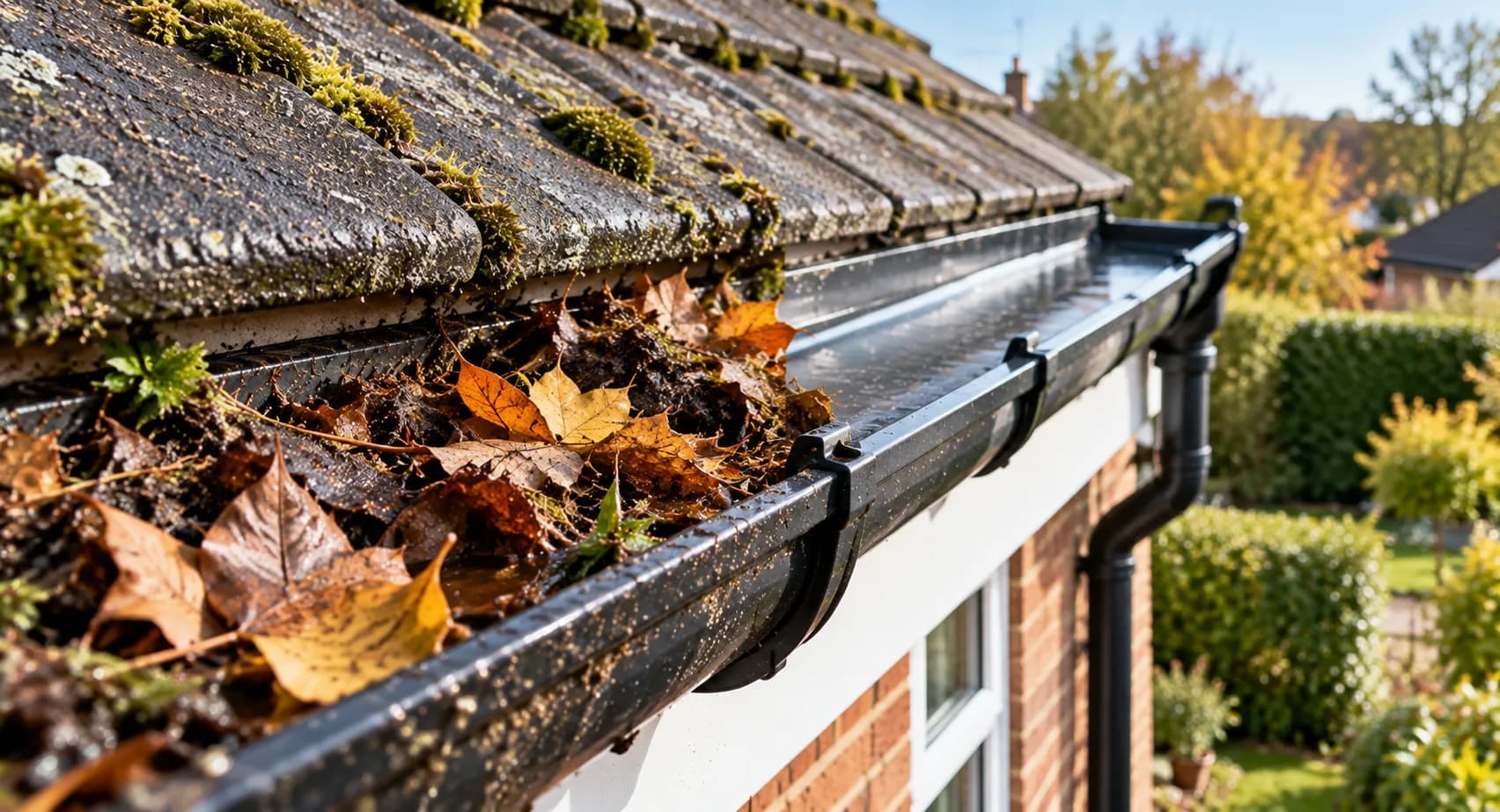
- Water spilling over the front edge, plants in the gutter and damp patches on walls are signs a clean is overdue.
- Our gutter cleaning starts from £120 + VAT, including flushing the downpipes.
Most UK homes should have their gutters cleaned at least twice a year: once in late autumn after the leaves have fallen, and once in spring to clear moss, seeds and grit washed off the roof over winter. Homes under or near trees, or with mossy roofs, may need cleaning three or four times a year. If water is spilling over the gutter in the rain, a clean is due now, whatever the calendar says. Our gutter cleaning service starts from £120 + VAT and includes flushing every downpipe.
Below is a frequency table you can use for your own house, the warning signs to look for, and how to clean gutters safely if you do it yourself.
How often should gutters be cleaned in the UK?
Twice a year suits most houses. The Society for the Protection of Ancient Buildings (SPAB) advises that "every autumn" you clear plants, leaves and silt from gutters, hopperheads and drainage channels, and that "it's a good idea to do this in spring too" (SPAB Maintenance Week). Fantastic Services' 2026 guide also recommends "twice a year for most homes — once in spring and once in autumn after the leaves fall" (Fantastic Services). MyJobQuote says gutters "should be cleaned at least once a year" (MyJobQuote), which is the bare minimum.
How often your house needs it depends mainly on trees and roof type. Use this table as a starting point:
| Your house | Suggested cleans per year | When |
|---|---|---|
| No trees nearby, newer roof, no past problems | 1–2 | Late autumn, plus spring if possible |
| Typical house with some trees in the street | 2 | Late autumn and spring |
| Trees overhanging the roof or within a few metres | 3–4 | October, late November, spring, and after storms |
| Mossy roof or older tiles that shed grit | 2–3 | Late autumn, spring, and a check in late summer |
| Valley, parapet or box gutters, or flat roofs | 2–4 | Autumn, spring and after heavy leaf fall |
| Gutters that have overflowed before | At least 2, plus a check in heavy rain | Autumn and spring |
| Gutters feeding a soakaway or water butt | 2 | Autumn and spring, to keep silt out |
These are practical rules of thumb, not a regulation. The right frequency for your house is whatever stops water spilling over. A simple way to find it is to check the gutters in the first heavy rain after each clean: if water spills over within a few months, add a visit; if the gutters are still almost empty at the next clean, you can probably stretch the gap.
What is the best month to clean gutters?
Late November or early December usually catches most of the leaf fall, so the gutters are clear before the wettest winter weather. A second clean in April or May removes moss, blossom and seed cases. If you only do one clean a year, make it late autumn.
SPAB runs its annual Maintenance Week, ending with National Gutters Day, as a reminder to get buildings ready for winter. It suggests checking gutters and downpipes in heavy rain, when leaks and overflows are easiest to spot. Our guide to preventing drain flooding in heavy rain has a full pre-storm checklist.
What are the signs your gutters need cleaning?
| Sign | What it usually means |
|---|---|
| Water spilling over the front edge in rain | A blocked gutter or outlet, or a gutter that has sagged |
| Plants or moss growing in the gutter | Silt and debris have built up |
| Damp patches or mould on inside walls | Water running down the brickwork |
| Green or dark streaks on outside walls | Repeated overflow at the same spot |
| Sagging or pulling-away sections | The weight of wet debris, or failing brackets |
| Dripping joints | Debris holding water against the seals |
| A downpipe that gurgles or does not flow | A blockage in the downpipe or the drain below |
| Water pooling at the base of a wall | Overflow, a blocked downpipe or a failing soakaway |
SPAB also suggests using a hand mirror to look behind downpipes, because splits and cracks in old cast iron and aluminium often appear on the side facing the wall.
Why do blocked gutters matter?
Gutters carry a lot of water off a roof in a heavy shower. When they block, that water runs down the walls or pools next to the house instead. Over time that can cause:
- penetrating damp, stained plaster and mould inside;
- damaged render, pointing and brickwork;
- rotten fascias and soffits;
- saturated ground beside the foundations;
- extra strain on gullies, drains and soakaways.
Rainwater needs to be carried well away from the building. Approved Document H says infiltration devices such as soakaways should not be built within 5 m of a building or road (para 3.25), and our guide to soakaways explains why a silted one makes overflow problems worse.
Can you clean gutters yourself?
You can, if you can do it safely, and on many houses that is a big if. The Health and Safety Executive says ladders "can be a sensible and practical option for low-risk, short-duration tasks, although they should not automatically be your first choice" (HSE). Its guidance is written for workplaces, but the basics apply at home:
- only use a ladder for short, simple jobs, on firm and level ground;
- have someone foot the ladder, or secure it;
- do not overreach; climb down and move the ladder instead;
- do not lean the ladder against plastic guttering;
- stay well clear of overhead power lines;
- never climb onto the roof or a conservatory.
Wear gloves, scoop debris into a bucket rather than washing it down the downpipe, then run a hose along the gutter to check the water flows to the outlet. Two- and three-storey houses, conservatories and flat-roof extensions are usually best left to a professional with ground-based gutter vacuum equipment.
Are gutter guards worth it?
Gutter guards (mesh, brush or foam inserts) cut down the number of large leaves that get in, but they are not maintenance-free:
- fine debris, seeds and moss can still build up on or under them;
- they have to be lifted or brushed off to clean the gutter;
- badly fitted guards can make water shoot over the gutter in heavy rain.
They make most sense under deciduous trees, and can stretch the gap between cleans, but you will still need to check the gutters at least once a year.
How much does gutter cleaning cost?
Our gutter cleaning starts from £120 + VAT, including flushing the downpipes, and the final price depends on the length, height and access. National price guides vary: MyJobQuote's August 2026 guide gives an average of £125. Our full gutter cleaning cost guide breaks prices down by house type and explains what pushes them up. If you would rather not have to remember, our maintenance plans can include twice-yearly cleans.
Gutters and your drains
Gutters and downpipes feed the gullies, drains or soakaways around your house, so a problem at ground level can look like a gutter problem. If a downpipe still backs up after the gutter has been cleared, the blockage may be in the gully or the pipe underground. High-pressure drain jetting clears that pipe, and our guide to unblocking an outside drain covers the simple fixes.
When to call a professional
Call a professional if your gutters are above single-storey height, overflow again soon after cleaning, sag or leak at the joints, or if water pools at the foot of a downpipe. We offer gutter cleaning and repairs across Nottinghamshire, Derbyshire, Leicestershire and Lincolnshire, including Derby, Leicester, Lincoln and West Bridgford, with downpipe flushing and checks of the gullies below.
There is no call-out fee and the price is agreed before we start. Book online or call 07300 600 950. We work 7 days a week, 6am to 8pm.
Sources
Frequently Asked Questions
Cite this guide: “How Often Should Gutters Be Cleaned?”, Urgent Drainage Solutions, 6 October 2026. https://urgentdrainagesolutions.co.uk/blog/how-often-should-gutters-be-cleaned

Need A Drainage Engineer?Book Online Today