
What Is a Soakaway? How to Build One, How Deep It Should Be and How to Fix a Blocked One
Written by the Urgent Drainage Solutions teamPublished Updated 7 min read
Quick answer
A soakaway is an underground pit, filled with rubble or plastic crates, that collects rainwater from roofs and paving and lets it soak into the surrounding ground. It only works in free-draining soil, should be sized from a BRE 365 infiltration test and, under Approved Document H, should not be within 5 m of a building or road.
- A soakaway takes rainwater only; foul water from toilets, sinks and appliances must never go into one.
- BRE Digest 365 sizes a soakaway from a trial pit dug to the soakaway's own depth and filled three times.
- Approved Document H says infiltration devices should not be within 5 m of a building or road, or where the water table reaches the base.
- For roofs of 25 m² or less, Approved Document H allows a design rainfall of 10 mm in 5 minutes, about 250 litres for 25 m².
- A blocked soakaway can sometimes be jetted, but a clogged rubble pit or ground that will not drain usually means a rebuild.
A soakaway is an underground pit, filled with rubble or plastic crates, that collects rainwater from roofs and paving and lets it seep into the surrounding ground. It only works where the soil drains freely, so it should be sized from an on-site infiltration test using BRE Digest 365, and Approved Document H says it should not be built within 5 m of a building or road. If yours is overflowing or needs replacing, our soakaway installation service designs and builds them to suit the ground.
This guide covers how soakaways work, how deep they go, how many crates you need, how to build one and how to fix one that has stopped draining.
What is a soakaway and what does it do?
A soakaway disposes of surface water (rain) on your own land instead of sending it into a sewer. Downpipes, patio drains or driveway channels feed a buried chamber, and the water soaks out through the sides and base of that chamber into the soil.
Soakaways are for rainwater only. Foul water from toilets, sinks, showers and washing machines must never go into one; it needs a connection to the public sewer or a properly designed treatment system. Approved Document H of the Building Regulations deals with foul drainage (H1) and rainwater drainage (H3) separately for exactly this reason. Our guide to foul water and surface water drainage explains the difference.
What are the main types of soakaway?
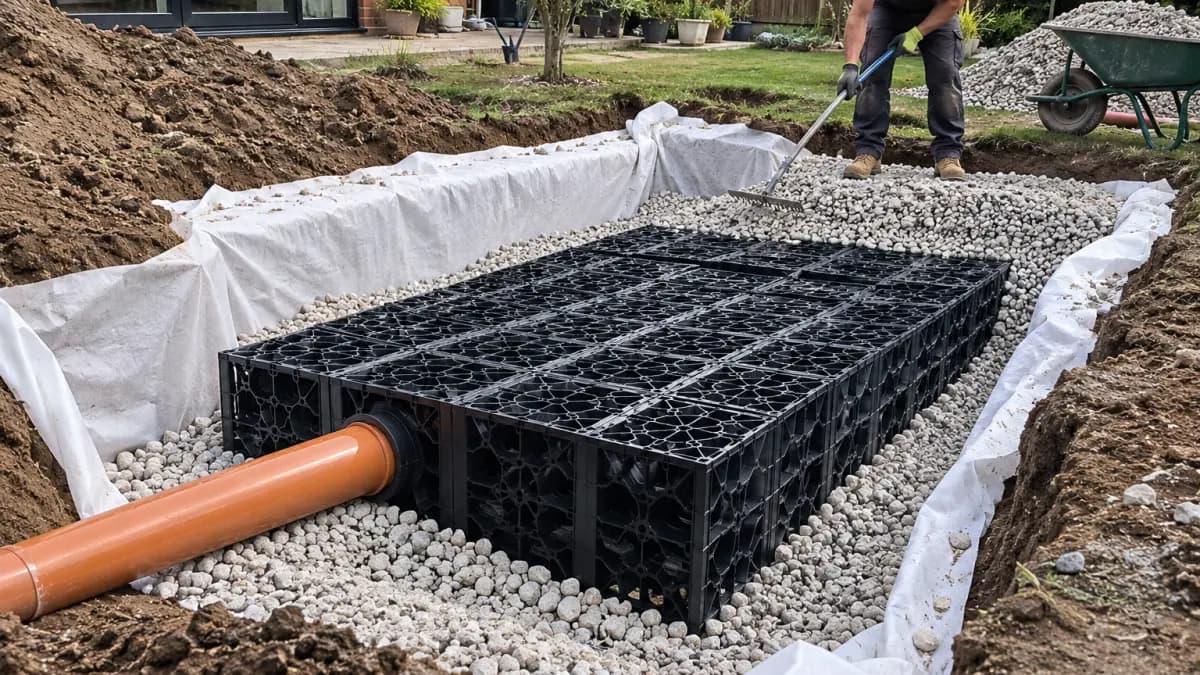
Approved Document H (para 3.26) says soakaways for areas under 100 m² are generally square or circular pits filled with rubble, or lined with dry-jointed masonry or perforated ring units. Most new domestic soakaways now use plastic crates wrapped in geotextile, which hold far more water for the same size of hole.
| Type | How it works | Typical drawbacks |
|---|---|---|
| Rubble-filled pit | Water fills the gaps between stones or brick | The fill takes up much of the volume, and silt gradually clogs the gaps |
| Crate (cellular) system | Open plastic cells wrapped in geotextile store water while it drains away | Needs correct sizing, wrapping and cover depth, especially under driveways |
| Perforated ring or chamber | Perforated rings or a chamber with an access cover | Heavier to install, but can be inspected and cleaned |
Whatever the type, a silt trap or catchpit upstream helps stop leaves and grit reaching the soakaway.
How deep should a soakaway be?
There is no single correct depth. A soakaway has to sit below the pipe that feeds it, so that water can run into it by gravity, but its base must stay above the highest groundwater level. Approved Document H (para 3.25) says infiltration devices should not be built "in ground where the water table reaches the bottom of the device at any time of the year".
In practice the depth is set by three things:
- the invert (bottom) of the incoming pipe, which fixes the top of the storage;
- the winter water table, which limits how deep the base can go;
- the layer of soil that drains best, which the trial pit reveals.
That is why BRE 365 tests the ground at the soakaway's own depth. Hastings Borough Council's guidance summarises the rule: the trial pit "should be excavated to the same depth of the anticipated full-size soakaway below the invert of the drain". A test in summer should allow for higher winter groundwater.
How is the ground tested for a soakaway?
A soakaway should be sized from the rate at which water actually drains into the soil on your site, not from a rule of thumb. The standard method is BRE Digest 365, Soakaway design (2016 edition):
| Step | What BRE 365 describes |
|---|---|
| Trial pit | 0.3–1 m wide and 1–3 m long, dug to the depth of the proposed soakaway |
| Test | Filled with water and allowed to drain three times to near empty |
| Infiltration rate | Worked out from the time the water takes to fall from 75% to 25% of the effective depth |
| Performance | The finished soakaway must drain from full to half-full within 24 hours, ready for the next storm |
If the trial pit barely drains, that is your answer: a soakaway will not work there, however large you make it.
You may also come across the percolation test in Approved Document H2. That one is for drainage fields serving septic tanks: a 300 mm square hole is filled and the time for the water to fall 150 mm gives a figure called Vp, which must average between 12 and 100. It is a different test for a different purpose.
How many soakaway crates do I need?
It depends on the area draining to it and how fast your ground drains. For small areas, Approved Document H (para 3.27) gives a shortcut: for soakaways serving 25 m² or less, "a design rainfall of 10mm in 5 minutes may be assumed to give the worst case". Larger areas should be designed with BRE 365.
Polypipe gives its Polystorm crates a 95% void ratio (Polypipe), so a common 1 m × 0.5 m × 0.4 m crate (0.2 m³) holds about 0.19 m³, or 190 litres. Check the datasheet for the crate you buy. The table below ignores any water soaking away during the storm, which makes it cautious:
| Area draining to the soakaway | Rain to store (10 mm) | Crates at about 0.19 m³ each |
|---|---|---|
| 10 m², e.g. a small shed or porch | 0.10 m³ (100 litres) | 1 |
| 15 m², e.g. a garage roof | 0.15 m³ (150 litres) | 1 |
| 20 m², e.g. a small extension | 0.20 m³ (200 litres) | 2 |
| 25 m², the limit for this shortcut | 0.25 m³ (250 litres) | 2 |
A typical house roof is well over 25 m², so a whole-house soakaway needs a proper BRE 365 calculation using your infiltration rate. The design should also follow Approved Document H's one-in-ten-year return period.
How do you build a soakaway?
- Test the ground with a BRE 365 trial pit at the planned depth and position.
- Size it from the test result and the area draining to it.
- Check the position: at least 5 m from buildings and roads, clear of drainage fields and other soakaways, and away from buried services.
- Fit a silt trap or catchpit on the incoming pipe so leaves and grit are caught before the soakaway.
- Excavate to the design depth, keeping clear of unsupported trench sides.
- Line the hole with geotextile, place the crates or rubble, and wrap the membrane over the top.
- Connect the inlet pipe to a laid fall, and add an inspection point if the system allows one.
- Backfill with suitable material and the cover depth the crate maker specifies, especially under a driveway.
New drainage work usually needs building control approval, so check before you start (gov.uk).
Why do soakaways fail?
Most soakaways fail gradually. Silt, leaves and fine soil wash in over the years and coat the surfaces the water should drain through, until the chamber stays full between storms. Others were undersized from the start, built on clay or a high water table, or crushed by vehicles.
Signs your soakaway is struggling:
- water backing up and overflowing from gullies or downpipe shoes during rain;
- standing water or a boggy patch on the lawn above or near the soakaway;
- downpipes that gurgle or spill at the joints in heavy rain;
- problems getting worse after a wet spell, when the ground is already saturated.
How do you fix a blocked soakaway?
Work from the house outwards:
- Clear the gutters and gully grates that feed it, as our gutter cleaning guide explains.
- Check the pipe. A blocked or broken pipe between the house and the soakaway causes the same symptoms. A CCTV drain survey shows whether it is a blockage, a collapse or tree roots.
- Jet the inlet pipe and any chamber with an access point. MyJobQuote's July 2026 data puts soakaway jetting at £100–£400 (MyJobQuote).
- Test the ground again if the soakaway still stays full. If a rubble soakaway is completely clogged, or the ground simply does not drain, cleaning only buys time.
- Rebuild or replace it, larger or in a better position, or switch to attenuation storage that releases water slowly to an approved outlet.
For a lawn that stays wet even without a soakaway nearby, see our guide to French drains.
How much does a soakaway cost?
MyJobQuote's July 2026 guide puts a typical domestic soakaway at about £850, with crate systems ranging from £660 for 190 litres to £1,210 for 950 litres. It lists a percolation test at £150–£300 and a building control application at £200–£400. These are national figures from another company, not our prices. We quote every soakaway after a site visit, and the price is agreed before any digging starts.
When to call a professional
Call a drainage contractor if water is backing up from your gullies, the lawn is waterlogged over the soakaway, or you are planning an extension that needs new surface-water drainage. We can jet and camera-inspect the existing pipework, carry out BRE 365 testing, and design or rebuild a soakaway through our soakaway installation service. If a run just needs clearing, see drain jetting. Non-statutory national standards for sustainable drainage, published on 19 June 2025, are also worth reading for larger projects.
We cover Nottinghamshire, Derbyshire, Leicestershire and Lincolnshire, with no call-out fee. Get a quote or call 07300 600 950.
Sources
- Approved Document H: Drainage and waste disposal (gov.uk)
- BRE Digest 365: Soakaway design (2016)
- Hastings Borough Council: Soakaway advice note
- Polypipe: Polystorm geocellular system
- gov.uk: When you don't need building regulations approval
- gov.uk: National Standards for Sustainable Drainage Systems
- MyJobQuote: Soakaway installation costs
Frequently Asked Questions
Cite this guide: “What Is a Soakaway? How to Build One, How Deep It Should Be and How to Fix a Blocked One”, Urgent Drainage Solutions, 1 October 2026. https://urgentdrainagesolutions.co.uk/blog/soakaways-explained

Need A Drainage Engineer?Book Online Today