
What Is a Downpipe? Parts, Sizes and Where It Drains
Written by the Urgent Drainage Solutions teamPublished 9 min read
Checked by Eren Birinci (Gino), Founder & Lead Drainage Engineer on
Quick answer
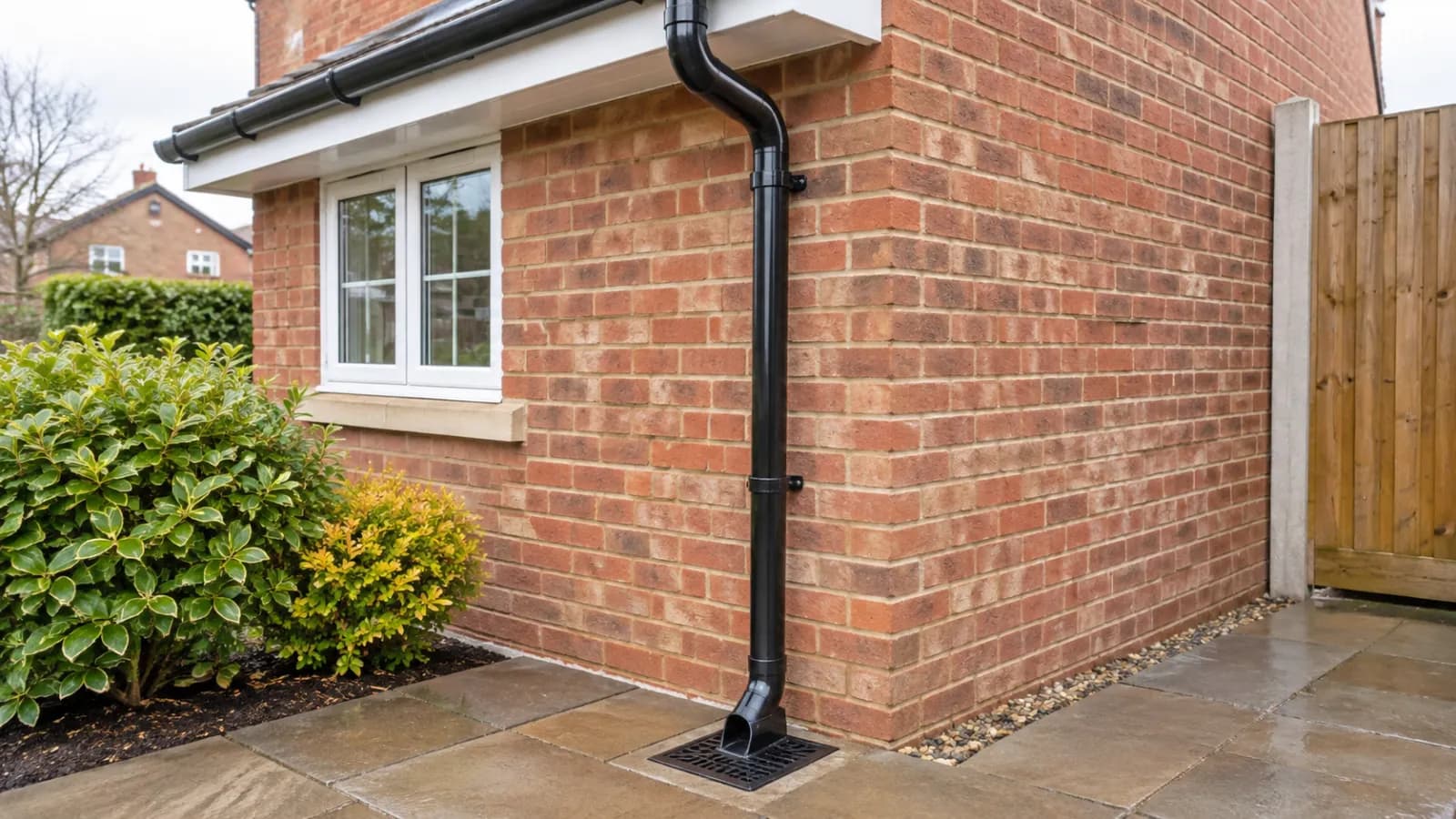
A downpipe is the vertical pipe that carries rainwater from the gutter down to a gully, drain or soakaway. On most UK houses it is 68mm round or 65mm square PVC-U. Older and larger buildings use cast iron or bigger pipes of 80mm, 100mm or 110mm. Building Regulations call it a rainwater pipe.
- A downpipe, or rainwater pipe, takes roof water from the gutter outlet to a gully, drain or soakaway at ground level.
- Standard domestic PVC-U downpipes are 68mm round and 65mm square; 80mm and 110mm pipes serve larger roofs.
- Approved Document H says a rainwater pipe should be at least the size of the gutter outlet it serves.
- Rainwater should go to a soakaway first, then a watercourse, then a sewer, and not into a separate foul sewer without the water company's approval.
- Loose brackets, cracked pipes, leaking joints and a missing shoe are repairs; our gutter repairs start from £230 + VAT.
A downpipe is the vertical pipe on the outside of a building that carries rainwater from the gutter down to ground level, where it empties into a gully, a drain or a soakaway. Building Regulations call it a rainwater pipe, and you will also hear drainpipe or rainwater downpipe. On most UK houses it is a 68mm round or 65mm square plastic pipe. If yours is cracked, loose or leaking, our gutter repair service replaces downpipes in uPVC and cast iron.
This guide explains the parts of a downpipe, the sizes sold in the UK, where the water is allowed to go and the faults that need fixing.
What does a downpipe do?
A downpipe gets roof water away from the building. The gutter collects rain running off the roof and falls gently towards an outlet. The downpipe takes the water from that outlet to the drainage at ground level, so it does not run down the wall or soak the ground beside the foundations.
Approved Document H, the official guidance to Part H of the Building Regulations, sets the test for the whole system. A rainwater drainage system should carry the flow from the roof to an outfall, minimise the risk of blockage or leakage, and be accessible for clearing blockages.
What are the parts of a downpipe?
A downpipe is a run of straight pipe with a fitting at each change of direction. From top to bottom, these are the parts you will see on a typical house.
| Part | What it is | What goes wrong |
|---|---|---|
| Gutter outlet | The fitting in the gutter with a spigot that drops into the pipe. A running outlet sits mid-run; a stop-end outlet sits at the end | Moss and leaves mat over it and the gutter overflows |
| Swan neck (offset) | Two offset bends, with or without a short length of pipe, that step the pipe back from the eaves to the wall | Debris catches in the bends; joints pull apart |
| Hopper head | An open-topped funnel that collects water from one or more pipes before it enters the downpipe | Fills with leaves; overflows down the wall |
| Pipe and sockets | Straight lengths joined by sockets | Cracks, splits and leaking joints |
| Clips or brackets | Fix the pipe to the wall | Work loose, so the pipe rattles or leans |
| Branch | A Y-shaped fitting that joins a second pipe into the first | Leaks at the joint |
| Shoe | The angled spout at the bottom that throws water into a gully or onto a drained surface | Goes missing or gets knocked off, so water hits the wall |
| Drain connector | An adaptor that takes the pipe straight into the underground drain instead of a shoe | Hidden blockages below ground |
FloPlast's 2026 rainwater brochure, a typical UK manufacturer's guide, says downpipes should be supported below any offset and at intervals of no more than 1.8 metres, with a 6mm gap left at the top of the pipe for expansion. Missing clips are one of the most common reasons a plastic downpipe comes away from the wall.
What size is a standard downpipe?
The standard downpipe on a UK house is 68mm round or 65mm square PVC-U. Bigger roofs use 80mm or 110mm round pipe, and cast iron comes in its own sizes. A downpipe is sized to match the gutter it serves, so the two are sold as a system.
| Downpipe size and shape | Usual gutter | Where you see it | Roof area one end outlet drains (level gutter) |
|---|---|---|---|
| 50mm round PVC-U | 76mm mini half-round | Garden buildings, garages, bay windows | Not in the end-outlet table |
| 68mm round PVC-U | 112mm half-round | Most houses | 44 m² |
| 65mm square PVC-U | 114mm square | Most houses | 81 m² |
| 68mm or 80mm round PVC-U | 115mm high-capacity | Larger house roofs | 98 m² (68mm) or 108 m² (80mm) |
| 110mm round PVC-U | 170mm commercial | Industrial and commercial buildings | 206 m² |
| 65mm, 75mm or 100mm round cast iron | Cast iron half-round or ogee | Period and listed buildings | Depends on the gutter |
The PVC-U sizes and roof areas come from the performance table in FloPlast's 2026 rainwater brochure. They are that manufacturer's maximum flow figures for a gutter fixed level with one outlet at the end of the run, and the same table gives slightly lower design figures calculated to BS EN 12056-3. Other brands publish their own tables. The cast iron sizes are those listed by the supplier Roof 2 Floor Drains, which also lists 150mm round and square and rectangular sections from 75mm x 75mm upwards.
Two points are worth knowing before you buy a replacement length:
- The sizes are nominal. FloPlast gives the actual outside diameter of its 68mm pipe as 68.48mm and its 110mm pipe as 110.2mm. Pipes and fittings from different brands do not always fit each other, so take an offcut with you or stay with one make.
- The gutter is the limit, not the pipe. FloPlast says downpipe sizing "is not a normal design consideration" because its downpipes have flow capacities about ten times greater than the gutters they drain. If water pours over the gutter in heavy rain and nothing is blocked, a bigger downpipe alone will rarely cure it.
How many downpipes does a roof need?
There is no fixed number. It depends on the effective area of roof draining to each gutter outlet, and each outlet needs its own downpipe.
Approved Document H gives a simple method. Work out the effective roof area by multiplying the plan area of the slope by 1.29 for a 30° pitch, 1.50 for 45° or 1.87 for 60°. Then compare it with Table 2 of the document, which lists the largest area each size of gutter should drain. The table assumes a half-round gutter laid level with a sharp-edged outlet at one end.
| Largest effective roof area | Gutter size | Outlet size |
|---|---|---|
| 18 m² | 75mm | 50mm |
| 37 m² | 100mm | 63mm |
| 53 m² | 115mm | 63mm |
| 65 m² | 125mm | 75mm |
| 103 m² | 150mm | 89mm |
Take a roof slope 7 metres long that measures 4 metres from eaves to ridge on plan, at a 30° pitch. Its effective area is 7 × 4 × 1.29, which is about 36 m². That is just inside the 37 m² limit for a 100mm gutter with one end outlet, so one downpipe will do. A longer or steeper slope needs a bigger gutter, a second downpipe, or the outlet moving to the middle of the run. FloPlast's table shows why the last option works: its half-round gutter drains 44 m² through an end outlet and 86 m² through a centre outlet.
Approved Document H also says the rainwater pipe should be at least the size of the gutter outlet, and that a downpipe serving more than one gutter should be big enough for the whole area draining to it.
What are downpipes made of?
Most modern downpipes are PVC-U, usually sold as uPVC. It is light, cheap and easy to cut, and FloPlast's brochure lists its downpipes as made to BS EN 12200-1. Black, white, brown and grey are the usual colours, along with textured "cast iron effect" finishes.
Cast iron is found on Victorian, Edwardian and many listed buildings. It is heavy and lasts for decades if it is kept painted, but it rusts at the joints and behind the pipe where the brush cannot reach. You will also see aluminium and galvanised steel downpipes, mainly on newer and commercial buildings. Our guide to leaking gutters and gutter repair covers what to think about before swapping cast iron for plastic on an older or listed house.
Where should a downpipe discharge?
A downpipe should empty into a gully, a drain or a soakaway, not onto the ground beside the wall. Paragraph 1.8 of Approved Document H says rainwater pipes "should discharge into a drain or gully but may discharge to another gutter or onto another surface if it is drained".
The Building Regulations then set an order of priority for where that rainwater ends up:
- an adequate soakaway or other infiltration system;
- where that is not reasonably practicable, a watercourse;
- where that is not reasonably practicable, a sewer.
Our guide to soakaways explains the first option. Where the pipe goes to a sewer, it matters which one. Under section 106 of the Water Industry Act 1991, where there are separate public sewers for foul and surface water, nobody is entitled to discharge surface water into the foul sewer "except with the approval of the undertaker", meaning the water company. In older streets with one combined sewer, rainwater and waste water share a pipe, and Approved Document H says any rainwater pipe discharging into a combined system should do so through a trap. In practice that means a trapped gully at the foot of the pipe. See our guides to foul water and surface water drainage and to gullies and how they block.
Where a downpipe empties onto a lower roof or a paved area, Approved Document H says a shoe should be fitted to divert water away from the building.
What downpipe faults need a repair?
Anything that lets water out of the pipe before it reaches the drain needs fixing, because the same patch of wall gets soaked every time it rains.
| What you see | Likely cause | What to do |
|---|---|---|
| Pipe leaning, rattling or pulled off the wall | Broken clips or failed fixings | Refix with new clips before the joints pull apart |
| Water weeping from a joint with a green or dark stripe below | Joint pulled apart, or the pipe is backing up | Check for a blockage first, then remake the joint |
| Split or cracked length | Impact, frost in a blocked pipe, or brittle old plastic | Replace the length |
| Rust, flaking paint or a crack at the back of an iron pipe | Corroded cast iron | Replace the section like for like |
| Water splashing the wall at ground level | Missing or misaligned shoe | Fit a shoe aimed at the gully |
| Pipe ends short of the gully or over bare soil | Pipe altered or never connected properly | Extend it to a gully, drain or soakaway |
| Gutter overflows at the outlet end only | Blocked outlet or downpipe | Clear it; see below |
A blockage is not a repair. If the gutter overflows at one end or the pipe gurgles and backs up, follow our guide to unblocking a blocked downpipe, which covers where blockages sit and how to clear them safely.
When to call a professional
Call someone in if a downpipe has come away above head height, a cast iron pipe is cracked or loose, a joint keeps leaking after it has been pushed back together, or there is a damp patch on the inside of the wall behind the pipe. Cast iron is heavy enough to injure someone if a length drops, so do not try to take it down from a ladder on your own.
We repair and replace downpipes, outlets, hoppers, brackets and gutter sections in uPVC and cast iron. Our gutter repairs start from £230 + VAT, with the price agreed before we start and no call-out fee. If the pipe is sound but blocked, a gutter clean from £120 + VAT includes flushing every downpipe. We work across Nottinghamshire, Derbyshire, Leicestershire and Lincolnshire, including Nottingham, Derby and Leicester, 7 days a week from 6am to 8pm. Call 07300 600 950 or book online.
Sources
- Approved Document H: Drainage and waste disposal, 2015 edition (gov.uk)
- FloPlast: Rainwater Systems brochure 2026 (performance table, pipe dimensions, installation)
- Water Industry Act 1991, section 106 (legislation.gov.uk)
- Roof 2 Floor Drains: Hargreaves cast iron downpipes (sizes)
- MyJobQuote: Gutter cleaning cost guide (updated 6 October 2026)
Frequently Asked Questions
Cite this guide: “What Is a Downpipe? Parts, Sizes and Where It Drains”, Urgent Drainage Solutions, 13 November 2026. https://urgentdrainagesolutions.co.uk/blog/what-is-a-downpipe