
Leaking Gutters: Causes, Gutter Repair Options and When to Replace
Written by the Urgent Drainage Solutions teamPublished 8 min read
Quick answer
Most leaking gutters are caused by a blocked outlet, a failed seal at a joint, a sagging bracket that has lost the fall, or a cracked section. Clearing and resealing fixes many leaks. Gutter repair typically costs £60 to £500 according to MyJobQuote, and badly corroded or repeatedly failing runs are usually better replaced.
- Check whether the gutter is blocked before blaming the joints: water held behind debris finds every weak seal.
- Where the water comes out tells you the cause: a joint, the middle of a run, the back edge or the whole length.
- MyJobQuote's September 2026 guide puts most gutter repairs at £60 to £500, with an average of about £215.
- HSE guidance says ladders suit only low-risk, short tasks on firm, level ground, so most gutter repairs above the ground floor are a job for someone with proper access.
- On listed buildings, Historic England says wholesale replacement of cast iron with PVC-U is not generally acceptable.
Most leaking gutters come down to four things: a blocked outlet, a failed seal at a joint, a bracket that has dropped so the gutter no longer falls to its outlet, or a cracked or corroded section. Many leaks stop once the gutter is cleared and the joint resealed, and a single faulty length can be swapped out. Our gutter cleaning and repair service clears the run first, so the real cause is obvious before anyone starts replacing parts.
This guide explains how to read where the water is coming from, which repairs are reasonable to do yourself, what gutter repair costs and when it makes more sense to replace the lot.
Why is my gutter leaking?
There are five common causes, and more than one is often at work.
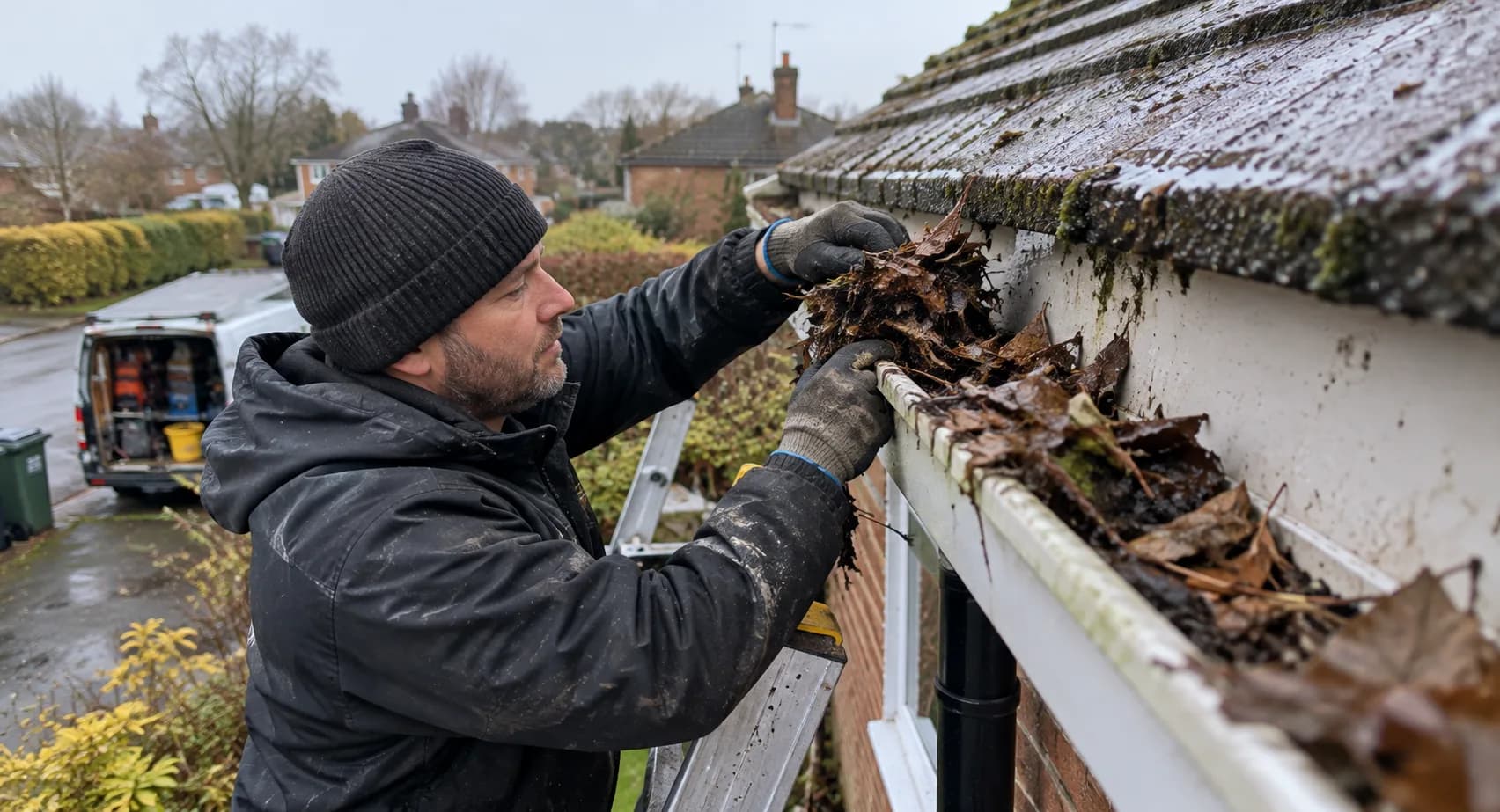
- Blocked outlets. Moss, leaves and silt collect at the outlet and stop water reaching the downpipe. The gutter fills and the water escapes wherever it can: over the front edge, or through any joint that is less than perfect. A joint that looks faulty is often just holding back a full gutter.
- Failed joint seals on PVC-U. Plastic gutters are joined by union brackets with rubber seals. Over the years those seals harden, split or get pushed out of position, and the joint starts to drip.
- Sagging brackets and the wrong fall. Approved Document H (paragraph 1.6) says gutters should be laid with any fall towards the nearest outlet. When a bracket loosens or snaps, the gutter dips, water sits in the low spot instead of running to the outlet, and it spills over or finds the nearest joint.
- Cracked sections. PVC-U gets brittle with age and can crack where a ladder has been leant on it or where ice has formed. Water drips from the middle of a length rather than from a joint.
- Corrosion in cast iron. Cast iron lasts well while it is painted. Once the paint fails it rusts, usually from the inside of the gutter and the back of the downpipe where nobody looks, and eventually a hole opens up or a joint fails.
How do you tell what is causing a leaking gutter?
Watch it in steady rain, or run a hose into the gutter from a safe position. Where the water comes out tells you most of what you need to know.
| What you see | Most likely cause | Usual fix |
|---|---|---|
| Water pouring over the front edge along the whole run | Blocked outlet or downpipe | Clear the gutter and outlet, flush the downpipe |
| Drip from one joint | Perished or displaced seal in the union | Replace the seal or union bracket |
| Water spilling at one low point mid-run | Loose or broken bracket, gutter has lost its fall | Refix or add brackets and reset the fall |
| Drip from the middle of a length, not a joint | Crack or split | Replace the length |
| Water running down the wall behind the gutter | Gutter sits too low under the roof edge, or the fascia has moved | Reposition the gutter, check the roof edge |
| Rust stains, flaking paint, drips from cast iron | Corrosion or a failed bolted joint | Remake the joint or replace the section like for like |
| Gutter overflows in heavy rain even when clean | Gutter or downpipe too small for the roof | Extra downpipe or larger gutter |
| Downpipe shoe or gully overflows at ground level | Blocked gully or drain below | Clear the drain, not the gutter |
That last row matters. If the gutter is clear but water backs up at the bottom of the downpipe, the problem is underground. Our guide to unblocking an outside drain covers that, and if the downpipe runs to a soakaway, see our soakaway guide.
Can you repair a leaking gutter yourself?
Some gutter repairs are simple. The risk is the ladder, not the repair. The Health and Safety Executive says ladders should only be used where a risk assessment shows that equipment offering better fall protection is not justified, and recommends other equipment if a task would keep you on a leaning ladder for more than 30 minutes at a time. It also says a ladder should stand only on firm, level, clean ground, free of moss and leaf litter, and away from doors and passers-by. That guidance is written for workplaces, but the physics is the same at home.
| Job | Reasonable DIY? |
|---|---|
| Clearing a bungalow gutter from a stable ladder or with a pole system | Often, with someone footing the ladder |
| Replacing a seal or union on a single-storey PVC-U gutter | Often, on firm level ground |
| Sealing a small crack from inside as a stopgap | Yes on a bungalow, but plan a proper repair |
| Anything on a two- or three-storey house | No, unless you have proper access equipment |
| Work over a conservatory, glass roof or sloping ground | No |
| Resetting the fall on a long run | Rarely: it needs a line, several brackets and two people |
| Cast iron (heavy, bolted, often old fixings) | No |
Before buying parts, clear the gutter. A surprising number of "leaking joints" stop once the outlet is open. Our guide to how often gutters should be cleaned explains how often most houses need it.
How much does gutter repair cost?
National prices vary with the material, the height and how much of the run is affected. These are figures from MyJobQuote's gutter repair cost guide, last updated 9 September 2026. They are another company's figures, not our prices.
| Repair | Typical cost (MyJobQuote, September 2026) |
|---|---|
| Resealing or repairing a leaking joint | £60–£150 |
| Replacing a bracket or clip | £10–£15 per bracket |
| Re-securing or re-aligning a sagging run | £60–£250 |
| Replacing a short section (1 to 3 metres) | £60–£200 |
| Replacing a downpipe | £80–£250 |
| PVC-U guttering, supplied and fitted | £30–£50 per metre |
| Cast iron guttering, supplied and fitted | £80–£150 per metre |
MyJobQuote puts the average repair at about £215, within a range of £60 to £500. It also notes that many small jobs cost close to a tradesperson's minimum charge, so it is worth getting several faults fixed in one visit.
Our gutter cleaning starts from £120 + VAT. Repairs found during the clean, such as a perished joint or a loose bracket, are priced and agreed with you before we do them, and there is no call-out fee. For what a clean costs by house type, see our gutter cleaning cost guide.
Should you repair or replace guttering?
Repair is the right call when the fault is local. Replacement starts to make sense when you keep paying for the same run.
Repair if:
- one or two joints leak and the rest are sound;
- a bracket has failed and the gutter is otherwise in good condition;
- a single length is cracked.
Replace if:
- several joints are leaking at once, which usually means every seal on that run is the same age;
- PVC-U has gone brittle, faded and cracks when handled;
- cast iron is rusted through in more than one place, or the bolted joints will not hold sealant;
- the gutter overflows in heavy rain even when clean, which points to a gutter or downpipe that is too small for the roof area.
If you replace, make sure the downpipes and the drain or soakaway they feed can cope. Historic England makes the same point for older buildings: upsizing gutters is only useful if the below-ground drains can take the extra flow.
What about cast iron gutters on older or listed homes?
Cast iron is heavy and long-lasting if it is painted and kept clear. Historic England's guidance on rainwater goods says lead and cast iron rainwater goods "can, with appropriate maintenance and redecoration, last far longer than modern replacement materials."
For listed and other designated buildings, it is firmer. Historic England says wholesale replacement in PVC-U "is not generally acceptable on a designated building", that partial replacements should match the original profile and material, and that it is difficult to connect PVC-U or aluminium to cast iron. It also warns that metal rainwater goods can suffer galvanic corrosion, so fixings need choosing with care. Listed building consent may be needed, so speak to your council's conservation officer before changing material.
On an unlisted older house the choice is yours, but the advice still holds. Like-for-like repairs to sound cast iron are often cheaper over time than ripping it out, and a part-plastic, part-iron run tends to leak where the two meet.
Can an overflowing gutter cause damp?
Yes. Historic England notes that leaking gutters or drainpipes are often the cause of damp walls. Water spilling down the same patch of brickwork every time it rains can soak into solid walls, stain render, rot fascias and soffits, and saturate the ground at the foot of the wall.
Historic England's inspection guidance adds that when below-ground drains break or their joints fail, water may saturate the surrounding soil and affect the building's fabric and foundations. So a leak at roof level and a problem at ground level are often part of the same story. If you have a damp patch under a gutter, fix the gutter before spending money on the wall. Our guide to getting drains ready for winter and heavy rain covers the ground-level side.
When to call a professional
Call someone in if the gutter is above single-storey height, the leak comes back after clearing, a run is visibly sagging, the gutter is cast iron, or there is damp on an inside wall. It is also worth a professional look if water is backing up out of the gully at the foot of the downpipe, because that is a drain problem rather than a gutter one.
Our engineers clear the gutters, flush every downpipe, and then reseal leaking joints, refix brackets or replace damaged sections. Gutter cleaning starts from £120 + VAT, the price is agreed before any work starts, and our repairs carry a 12-month workmanship guarantee. We are open 7 days a week, 6am to 8pm, across Nottinghamshire, Derbyshire, Leicestershire and Lincolnshire, including Newark, Mansfield and Lincoln. Call 07300 600 950 or book online.
Sources
- Approved Document H: Drainage and waste disposal (gov.uk)
- Health and Safety Executive: How and when to use a ladder at work
- Health and Safety Executive: Where ladders should be used
- Historic England: Upgrades or alterations to rainwater goods (2024)
- Historic England: Inspection, maintenance and repair of rainwater systems (2024)
- MyJobQuote: Gutter repair cost guide (9 September 2026)
Frequently Asked Questions
Cite this guide: “Leaking Gutters: Causes, Gutter Repair Options and When to Replace”, Urgent Drainage Solutions, 6 October 2026. https://urgentdrainagesolutions.co.uk/blog/leaking-gutters-gutter-repair

Need A Drainage Engineer?Book Online Today