
How to Clean Gutters: A Step-by-Step Guide for UK Homes
Written by the Urgent Drainage Solutions teamPublished 9 min read
Checked by Eren Birinci (Gino), Founder & Lead Drainage Engineer on
Quick answer
To clean gutters, set a ladder on firm, level ground at a 1-in-4 angle, resting on the wall or a stand-off and never on the gutter. Scoop debris into a bucket, starting at the downpipe outlet. Flush the run with a hose, check the water reaches the drain, then look for leaking joints and sagging sections.
- Only clean gutters from a ladder on a single-storey run with firm, level ground; HSE says ladders suit low-risk, short-duration tasks.
- Never rest the ladder on a plastic gutter: HSE guidance calls for a strong upper resting point.
- Start at the downpipe outlet, scoop into a bucket and move the ladder often; do not wash debris down the downpipe.
- Flush with a hose from the far end and watch the water: it should run to the outlet without pooling and come out at the bottom of the downpipe.
- Standing water, dripping joints and loose brackets found during a clean are repairs, and cleaning will not fix them.
To clean gutters, set a ladder safely on firm, level ground, scoop the leaves, moss and silt into a bucket by hand, starting at the downpipe outlet, then flush the run with a hose and watch where the water goes. Finish by checking the fall, the joints and the downpipes. That is a reasonable job on a bungalow or a single-storey extension. On a two- or three-storey house it is not a ladder job, and our gutter cleaning service starts from £120 + VAT with every downpipe flushed.
This is the full method for a typical UK house. If you would rather stay on the ground, see our guide to cleaning gutters without a ladder.
Should you clean your own gutters?
Only if you can reach them safely, and height decides that. The Health and Safety Executive says ladders can suit low-risk, short-duration tasks but should not automatically be the first choice. Its guidance is written for workplaces, but a fall is the same at home.
| Your situation | Clean it yourself? |
|---|---|
| Bungalow or single-storey extension, firm level ground below | Yes, with a helper |
| Two-storey house, gutter reachable with poles from the ground | Yes, from the ground only |
| Two-storey house, ladder needed | No |
| Three-storey house or town house | No |
| Gutter above a conservatory, glass roof or flat-roof extension | No |
| Sloping, soft or mossy ground under the gutter | No |
| Overhead power line near the roof | No |
| You are on your own, or not confident at height | No |
What do you need to clean gutters?
A short list, most of which you may already own:
- a leaning ladder long enough to stand at least 1 metre above the gutter, in good condition;
- a ladder stand-off or stability device;
- rope or straps to tie the ladder, or a second person to foot it;
- thick waterproof gloves and safety glasses;
- a gutter scoop or small trowel, preferably plastic so it does not scratch the gutter;
- a bucket with a hook to hang from the ladder;
- a garden hose that reaches the far end of each run;
- a tarpaulin or rubble sacks for the waste.
MyJobQuote's gutter cleaning guide, updated 6 October 2026, says buying this kind of kit from scratch can cost £100 to £300.
How do you set up a ladder safely for gutter cleaning?
Put it on firm, level, clean ground at the right angle, rest it on something strong and secure it. HSE's ladder guidance gives the detail:
- Check the ladder first. Look at the stiles, feet, rungs and locking mechanisms. If anything is bent, worn, loose or missing, do not use it.
- Choose the ground. HSE says to use a ladder only on firm, level ground and on clean, solid surfaces with "no oil, moss or leaf litter". Do not pack the feet with bricks or timber.
- Set the angle. Use the 1-in-4 rule: one unit out for every four units up, which gives a 75° angle.
- Rest it on the wall. HSE says the ladder needs a strong upper resting point and should not rest against "weak upper surfaces such as glazing or plastic gutters". A stand-off holds the top of the ladder against the wall and keeps it clear of the gutter.
- Secure it. HSE's order of preference is to tie the ladder, then use a stability device, then wedge it. Having someone foot the ladder is the last resort.
- Keep it away from doors and windows that could open onto it, and keep children and pets clear.
Once you are up there, HSE's rules are simple:
- keep your belt buckle within the stiles, which means no leaning sideways to reach the next bit;
- keep three points of contact when climbing and, wherever possible, while working;
- do not work off the top three rungs;
- do not try to move or extend the ladder while you are standing on it;
- do not work within 6 metres horizontally of an overhead power line.
HSE also suggests using other equipment for any task that would keep you up a leaning ladder for more than 30 minutes at a time. A full house of gutters takes longer than that, so work in short spells with breaks on the ground, or use ground-based tools.
How do you clean gutters step by step?
Pick a dry day. Dry leaves and moss are lighter, and the ground and the rungs are less slippery.
- Walk round first. Look for overhead cables, loose roof tiles, wasp nests and birds' nests. Note where each downpipe is.
- Protect the ground. Lay a tarpaulin under the section you are working on and move cars and garden furniture.
- Cover the outlet. Put a rag or an upturned plant pot over the downpipe outlet so nothing falls into the pipe while you work.
- Start at the outlet end. Set the ladder beside the downpipe and clear that area first.
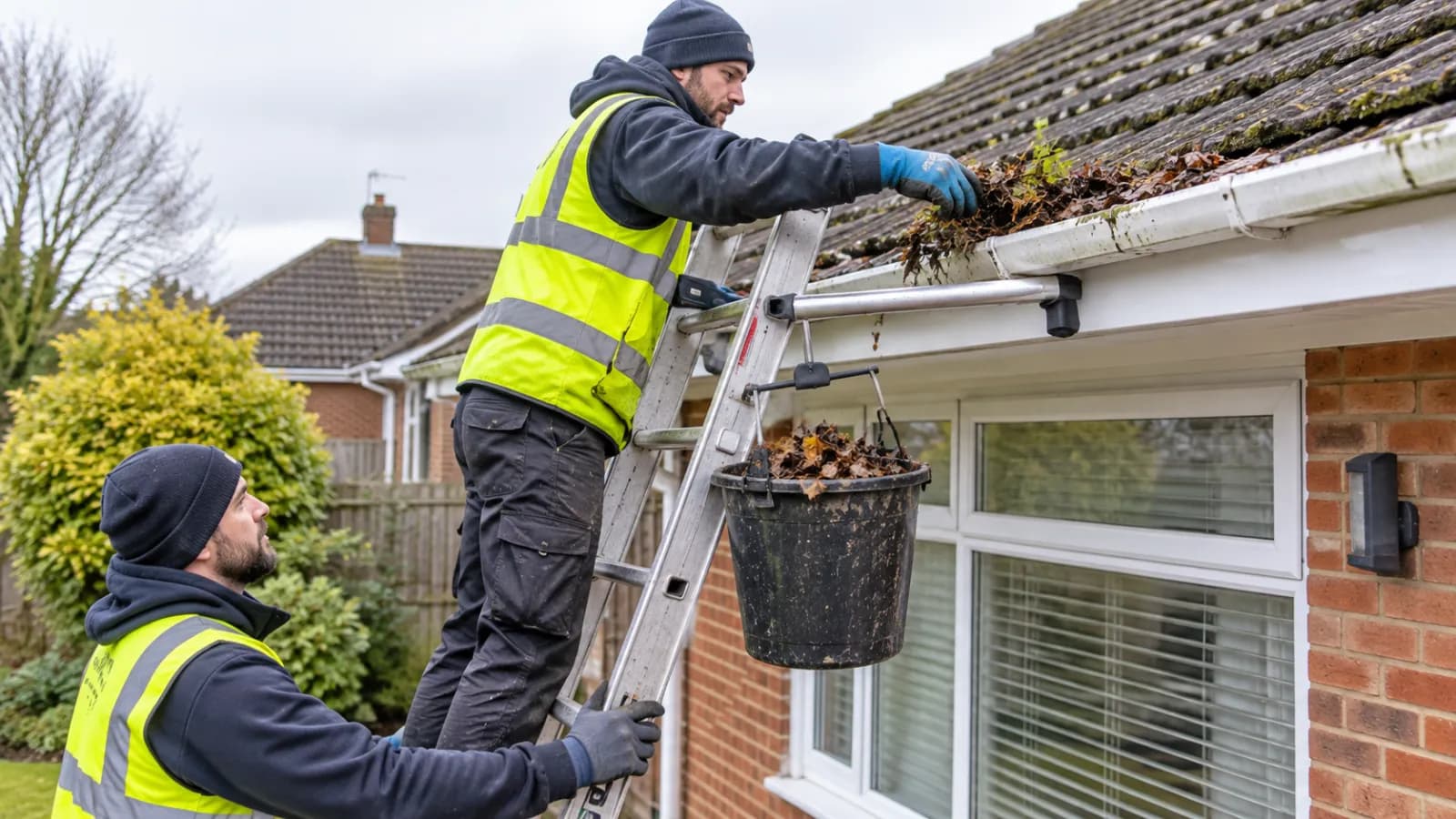
- Scoop, do not push. Lift the debris out with the scoop or a gloved hand and drop it in the bucket. Do not push it along the gutter or flick it over the edge onto the wall.
- Move the ladder often. Clear only what you can reach with your belt buckle inside the stiles. Climb down, move the ladder along and climb back up.
- Clear the silt. Under the leaves there is usually a layer of fine grit from the roof tiles. Scrape it out, because it holds water and feeds moss.
- Check hoppers and stop ends. Debris collects in corners, behind stop ends and in open hopper heads.
- Uncover the outlet and lift out anything sitting in it by hand.
Go easy with pressure washers. MyJobQuote warns that a pressure washer set too high can crack plastic guttering, and a jet also drives debris into the downpipe.
How do you flush and test gutters after cleaning?
Run a hose into the gutter at the end furthest from the downpipe and watch the water all the way to the drain. This tells you more than looking at an empty gutter.
- In the gutter: the water should run steadily to the outlet and leave the gutter almost empty when you turn the hose off.
- At the outlet: it should drop into the downpipe without backing up.
- At the bottom: it should come out of the shoe, or run into the gully, almost straight away and drain away.
If water backs up at the outlet, the downpipe is blocked. Do not keep running the hose, because a full downpipe is heavy and can pull its joints apart. Our guide to unblocking a blocked downpipe covers where blockages sit and how to clear them from the bottom. If the pipe runs freely but the gully at the bottom overflows, the blockage is in the drain, which is a different job.
How do you check the fall, joints and downpipes?
Use the water from the flush test. Every fault below shows up while the hose is running.
The fall. A gutter should slope gently towards its outlet. Manufacturer Brett Martin says guttering should be installed with a fall of 1mm for every 600mm towards the outlet, so the slope is too slight to see by eye. What you can see is the result: water that sits in a pool after the hose is off means that stretch has dropped or was never set right.
The brackets. Brett Martin says gutter supports should be no more than 900mm apart. Look for brackets that are missing, snapped or pulling out of the fascia, and for a gutter that has come unclipped from the back of its brackets.
The joints. Watch each union, corner and stop end while the water runs. A drip from a clean joint means the rubber seal has perished or slipped. Check that the gutter ends sit on the seals inside the fitting and have not pulled out.
The downpipes. Check that each clip is fixed to the wall, each joint is pushed home and the shoe at the bottom points onto the gully and not onto the path.
The Society for the Protection of Ancient Buildings says rainwater fittings are best checked for leaks in heavy rain, so look again from the ground the next time it pours.
What do you find in gutters that means a repair?
Cleaning removes blockages. It does not fix anything that is broken, loose or out of level. Use this table to sort what you found.
| What you find | What it means | What to do |
|---|---|---|
| Water pooling in one stretch after flushing | The run has lost its fall | Brackets need resetting or adding |
| Drip from a union, corner or stop end | Perished or displaced seal | Replace the seal or the fitting |
| Drip from the middle of a length | Crack or split | Replace that length |
| Gutter loose in its brackets or pulling off the fascia | Failed brackets or rotten fascia | Refix; check the timber behind |
| Water running behind the gutter down the fascia | Gutter set too low or roof felt has rotted back | Needs a closer look at the roof edge |
| Rust, flaking paint or holes in cast iron | Corrosion | Repair or replace like for like |
| Clean gutter still overflows in heavy rain | Gutter or downpipe too small, or too few outlets | Ask for advice on an extra downpipe |
| Downpipe clear but gully backs up | Blocked drain or failed soakaway | Drain unblocking, not gutter work |
Our guide to leaking gutters and gutter repair explains each of these faults and which repairs are reasonable to do yourself. We carry out gutter repairs from £230 + VAT.
What do you do with the debris from gutters?
Bag it and compost it, or put it in your council garden waste bin. Gutter debris is mostly leaves, moss, twigs and roof grit. The RHS says fallen leaves can be bagged or heaped to make leafmould, a free soil conditioner, and that most leaves take about two years to break down.
Three things to avoid:
- Do not wash it down the downpipe. It settles in the bends, the gully trap or the soakaway and causes the next blockage.
- Do not leave it on the path or in the gully. The next rain carries it into the drain.
- Leave active nests alone. GOV.UK's guidance on wild birds says you must not intentionally take, damage or destroy a wild bird's nest while it is being used or built. If birds are nesting in or above the gutter, leave that section until they have gone.
How often do gutters need cleaning?
Twice a year suits most UK homes, in late autumn and again in spring, with extra cleans for houses under trees. Our guide on how often gutters should be cleaned has a frequency table by house type and the best months to do it.
When to call a professional
Call a professional if the gutters are above single-storey height, sit over a conservatory or sloping ground, or have power lines nearby. Call one too if the flush test showed pooling, dripping joints or a downpipe that will not clear, because those need repairs or drain work, and if you are simply not comfortable on a ladder.
Our gutter cleaning starts from £120 + VAT. We clear every gutter, hopper and outlet, flush and test each downpipe, take the waste away, and photograph and quote for any leaking joints or loose brackets we find. The price is fixed before we start and there is no call-out fee. Our gutter cleaning cost guide shows how that compares with national prices. We cover Nottinghamshire, Derbyshire, Leicestershire and Lincolnshire, including Nottingham and Derby, 7 days a week from 6am to 8pm. Call 07300 600 950 or book online.
Sources
- Health and Safety Executive: Safe use of ladders and stepladders
- Health and Safety Executive: How and when to use a ladder at work
- Health and Safety Executive: Types of ladder and using them safely
- Health and Safety Executive: Where ladders should be used
- Health and Safety Executive: How to check your ladder is safe before you use it
- Health and Safety Executive: Securing ladders and ladders used for access
- Brett Martin: How to install a rainwater guttering system
- SPAB: Rainwater fittings
- RHS: Leafmould
- GOV.UK: Wild birds, protection and licences
- MyJobQuote: Gutter cleaning cost guide (updated 6 October 2026)
Frequently Asked Questions
Cite this guide: “How to Clean Gutters: A Step-by-Step Guide for UK Homes”, Urgent Drainage Solutions, 13 November 2026. https://urgentdrainagesolutions.co.uk/blog/how-to-clean-gutters