
How to Clean Gutters Without a Ladder
Written by the Urgent Drainage Solutions teamPublished 8 min read
Quick answer
You can clean gutters without a ladder using a telescopic gutter pole with a scoop or claw, a wet-and-dry vacuum with gutter poles, or a leaf blower or pressure washer gutter kit. Poles and blower kits suit single-storey homes; vacuum kits with a camera reach higher. Check for overhead power lines before raising any pole.
- Telescopic poles, gutter vacuum kits, leaf blower attachments and pressure washer gutter kits all work from the ground or close to it.
- Reach is the limit: Toro recommends its blower gutter kit for single-storey homes, and Wolf Garten's pole set extends to 4 metres.
- A camera on a pole is the only way to see inside a gutter from the ground and check the job is done.
- Never raise a long pole near overhead lines: the Ladder Association guidance, written with HSE, says keep 6 metres away horizontally.
- Leaking joints, loose brackets and sagging runs cannot be fixed from the ground.
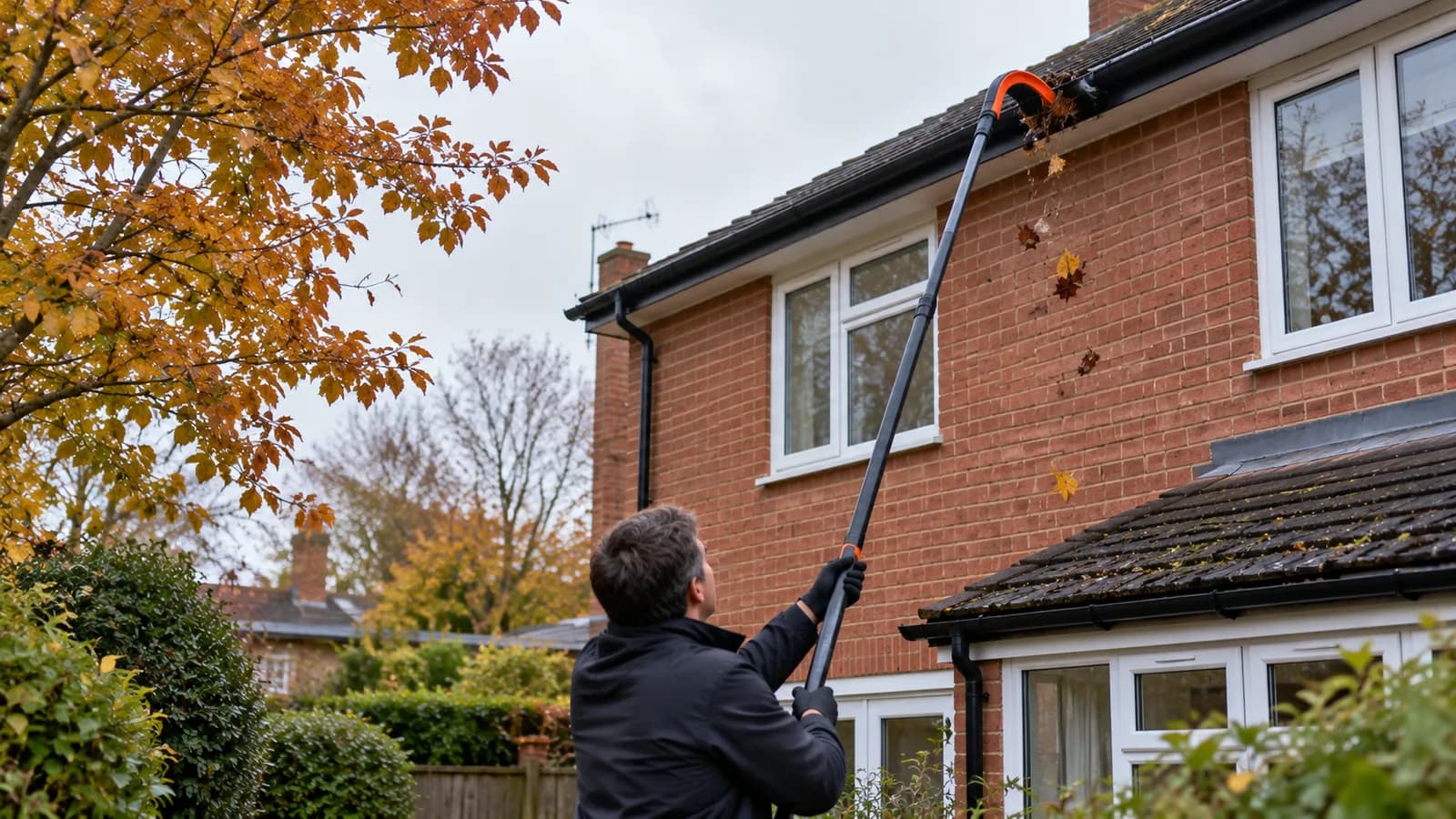
You can clean gutters without a ladder by working from the ground with a telescopic gutter pole and scoop, a wet-and-dry vacuum with gutter poles, or a leaf blower or pressure washer gutter kit. Each has a reach limit, and none of them lets you see into the gutter unless you add a camera, so the job is easiest on bungalows and single-storey extensions. On a two- or three-storey house, or where power lines run near the roof, our gutter cleaning service starts from £120 + VAT and includes flushing the downpipes.
Below is a comparison of the main tools, a step-by-step method from the ground, how to check the downpipes, the safety rules that matter and what you cannot do without getting up to the gutter.
Why clean gutters without a ladder?
Because ladders are where most of the risk in gutter cleaning lies. The Ladder Association's guide to the safe use of ladders, produced in co-operation with the Health and Safety Executive (HSE), says ladders can be a sensible option for low-risk, short-duration tasks but "should not automatically be your first choice". Its foreword from HSE notes that falls from height remain the most common kind of fatal workplace accident, with many involving a fall off a ladder.
Cleaning a gutter by hand also means moving the ladder every metre or so. The same guide says you should not overreach, keeping your belt buckle within the stiles. Ground-based tools avoid all of that, at the cost of less control and visibility.
What tools can you use to clean gutters from the ground?
There are five main options, and most people end up combining two of them: one to get the debris out and a camera or hose to check the result.
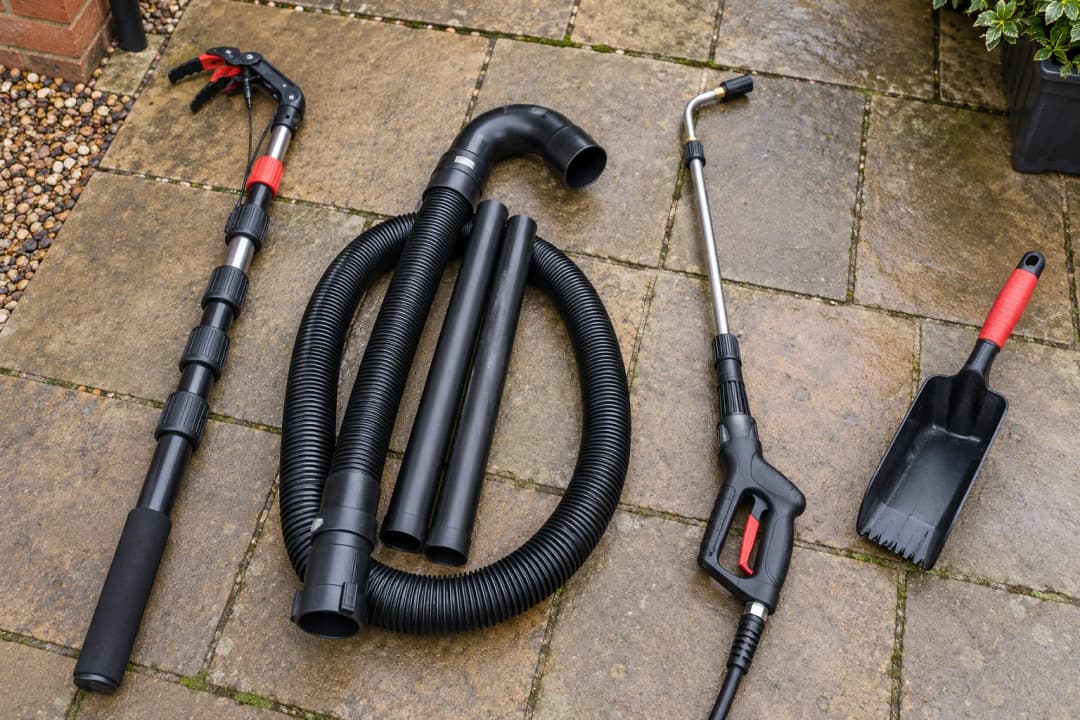
- Telescopic gutter pole with a scoop, claw or brush. A pole that extends to gutter height with a curved scoop or pincer head on the end. Wolf Garten's multi-change set, for example, has a telescopic handle that extends from 220 to 400 cm, with a plastic scoop and a bristle brush head.
- Wet-and-dry vacuum with gutter poles. A powerful wet-and-dry vacuum connected to sectional poles with a curved nozzle that hooks over the gutter edge and sucks out leaves, moss and silt. This is what most professional gutter cleaners use.
- Leaf blower gutter attachment. Extension tubes and a curved end that fit a handheld blower and blow debris out of the gutter. Toro's universal kit has four extension tubes for an 11 ft (about 3.4 m) maximum reach and is recommended for one-storey homes.
- Pressure washer gutter kit. A long hose with a nozzle that runs along the gutter on a sled. Kärcher's gutter and pipe cleaning kit has a 20 m hose for its K2 to K7 pressure washers, and the same kit includes a nozzle for clearing pipes.
- Inspection camera on a pole. Not a cleaning tool, but the only way to see inside a gutter from the ground. Some gutter vacuum kits include one; a separate pole camera or even a phone on a pole works on low gutters.
Which gutter cleaning tool is best for your house?
The right tool depends on gutter height, how much is in the gutter and whether you have power and water to hand. This table compares them using the makers' own figures where they publish them.
| Tool | Reach | Best for | Downsides |
|---|---|---|---|
| Telescopic pole with scoop or claw | Wolf Garten set: 2.2 m to 4 m | Bungalows, porches and extensions with dry leaves | Heavy at full length; you cannot see what you are scooping; wet moss falls back in |
| Wet-and-dry vacuum with gutter poles | Depends on the number of pole sections; check the length against your gutter height | Two-storey houses; wet silt, moss and leaves | Bulky and heavy to handle; needs mains power; poles conduct electricity |
| Leaf blower gutter attachment | Toro universal kit: 11 ft (about 3.4 m); maker recommends one-storey homes | Dry leaves in single-storey gutters | Blows debris over you, the walls and windows; poor on wet or compacted moss |
| Pressure washer gutter kit | Kärcher kit: 20 m hose along the gutter | Flushing silt and grit along a run; clearing downpipes | Sled has to be placed in the gutter; sprays dirty water; can force debris into the downpipe |
| Pole-mounted inspection camera | Depends on the pole | Checking the gutter before and after cleaning | Does not clean anything on its own |
Wolf Garten's set was listed at £89.99 by Gates Garden Centre when we checked on 16 October 2026. Prices for vacuum and camera kits vary widely between retailers, so compare the pole length and nozzle design, not just the vacuum size.
How do you clean gutters from the ground, step by step?
Work in dry weather, when leaves and moss are lighter and come away more easily. Then:
- Look up and around before you extend anything. Check for overhead power lines, telephone cables, satellite dishes and roof lights, and plan where you will stand for each section.
- Lay a tarpaulin along the wall to catch debris, and move cars, bins and garden furniture out of the way.
- Wear safety glasses, gloves and a hat. Whatever is in the gutter will come down towards you.
- Start at the downpipe outlet and work away from it, so you clear the outlet first and do not push debris into it.
- Remove the bulk of the debris with the scoop, vacuum nozzle or blower, a section at a time. Keep the pole as close to vertical as you can; a pole held at a shallow angle is much harder to control.
- Check the run with a camera, or a phone on a pole for a low gutter. Look for leftover silt at joints and corners, and any plants growing in the gutter.
- Flush the gutter with water from the far end, using a hose on a pole or the pressure washer kit, and watch it run to the downpipe.
- Bag the debris. Leaves and moss can go in the compost or garden waste bin.
How do you check the downpipes from the ground?
Watch the water you flushed into the gutter: it should disappear into the downpipe outlet and come out at the bottom quickly. If water backs up at the outlet or spills over the gutter near the downpipe, the downpipe is probably blocked.
From the ground, you can usually remove the shoe or access cap at the bottom of the downpipe and pull out what has collected there, and run a hose up the pipe from below to loosen a blockage. A pressure washer kit with a pipe nozzle can work up the pipe too. Our guide to unblocking a blocked downpipe explains where blockages usually sit and when the real problem is the gully or drain at the bottom.
What safety rules apply when cleaning gutters from the ground?
The biggest danger is overhead power lines. Long aluminium and carbon poles conduct electricity, and electricity can jump a gap without the pole touching the line. The Ladder Association's guide, produced with HSE, says not to work within 6 m horizontally of any overhead power line unless it has been made dead or is protected with insulation. HSE's guidance note GS6 covers avoiding danger from overhead power lines in more detail. If a line crosses near your roof, don't raise a pole at all.
Other risks to plan for:
- Uneven or sloping ground. A long pole at full stretch is hard to control on a slope, a step or a soft lawn. Stand on firm, level ground and shorten the pole if you start to wobble.
- Electricity and water together. A wet-and-dry vacuum or pressure washer outside should be plugged into an RCD-protected socket, with the cable kept out of puddles.
- Falling debris. Wet moss and silt are heavy. Keep children and pets away from the area below.
- Damage to the roof and gutter. Do not lever against gutter brackets or lift roof tiles with the nozzle, and keep pressure washer jets out of the roof covering.
- Fragile roofs. Never lean anything on a conservatory or plastic roof to reach the gutter above it.
If you do decide a ladder is needed, the same guide says to set it at 75°, using the 1-in-4 rule (one unit out for every four up), on firm, level ground free of moss and leaf litter, keeping three points of contact.
What can't you do from the ground?
You can clear and flush a gutter from the ground, but you cannot repair it. Leaking joints, perished seals, cracked sections, loose or missing brackets, sagging runs that hold water, and downpipes that have come away from the wall all need someone at gutter height with the right access equipment. You also cannot easily clear valley gutters, box gutters or gutters behind a parapet.
If the camera shows any of these, a clean will not stop the overflow. Our guide to leaking gutters and gutter repair helps match the drip to the cause. We carry out gutter repairs from £230 + VAT, and minor fixes can often be done on the same visit as a clean.
How often should you clean your gutters?
Twice a year suits most UK homes: once in late autumn after the leaves have fallen and again in spring. Homes under trees or with mossy roofs may need three or four cleans. Our guide to how often gutters should be cleaned has a frequency table by house type, and our gutter cleaning cost guide shows what a professional clean typically costs.
When to call a professional
Call a professional if your gutters are on the second storey or higher and you do not have a vacuum kit long enough to reach them, if overhead power lines run near the roof, if the gutter is above a conservatory, or if water still overflows after a clean. Persistent overflowing usually means a blocked downpipe, a sagging run or a leaking joint rather than leaves.
Our gutter cleaning starts from £120 + VAT and covers clearing every gutter, hopper and outlet, flushing the downpipes and taking the waste away, with a fixed price agreed before we start. We note any leaking joints or loose brackets and can repair them from £230 + VAT. We cover Nottinghamshire, Derbyshire, Leicestershire and Lincolnshire, 7 days a week from 6am to 8pm. Call 07300 600 950 or book online.
Sources
- Ladder Association, in co-operation with HSE: Safe Use of Ladders and Stepladders, a brief guide (LA455)
- Health and Safety Executive: Safe use of ladders and stepladders
- Health and Safety Executive: Avoiding danger from overhead power lines (GS6)
- Kärcher: Roof gutter and pipe cleaning set
- Toro: Universal Gutter Cleaning Kit for Blower/Vacs (model 51668)
- Gates Garden Centre: Wolf Garten multi-change Gutter Cleaner with Metal Telescopic Handle Set
Frequently Asked Questions
Cite this guide: “How to Clean Gutters Without a Ladder”, Urgent Drainage Solutions, 16 October 2026. https://urgentdrainagesolutions.co.uk/blog/clean-gutters-without-ladder

Need A Drainage Engineer?Book Online Today