
Soakaway Crates: Sizes, Cost and How They Are Installed
Written by the Urgent Drainage Solutions teamPublished 8 min read
Quick answer
Soakaway crates are plastic boxes, usually 1 m × 0.5 m × 0.4 m, that are about 95% empty space, so each holds roughly 190 litres of rainwater. They are wrapped in geotextile, buried at least 5 m from buildings and sized from a BRE 365 soakage test. Supply-only crates cost from about £38 + VAT each at Drainfast.
- A standard 1 m × 0.5 m × 0.4 m crate with a 95% void ratio stores about 190 litres; a rubble pit stores about 30% of its volume.
- The number of crates comes from the area drained, the design storm and your ground's infiltration rate, measured with a BRE 365 trial pit.
- A crate soakaway must also half-empty within 24 hours, which a long, narrow layout helps on slower ground.
- Cover depth and crate strength depend on load: Drainfast gives 150 mm for gardens and 350 mm for light traffic as minimums.
- Approved Document H says infiltration devices should not be built within 5 m of a building or road.
Soakaway crates are plastic boxes, most commonly 1 m × 0.5 m × 0.4 m, that are about 95% empty space. Each one stores roughly 190 litres of rainwater while it soaks into the ground, around three times what the same hole filled with rubble would hold. They must be wrapped in geotextile, sized from a soakage test and kept at least 5 m from buildings and roads. If you need one designed and built, our soakaway installation service starts every job with a percolation test.
This guide goes deeper than our general guide to what a soakaway is. It covers crate sizes, a worked sizing example, load ratings, prices, installation and upkeep.
What sizes do soakaway crates come in?
Most domestic crates are 1 m long, 0.5 m wide and 0.4 m high, a gross volume of 0.2 m³. Larger units of 1.2 m × 0.6 m are common on bigger systems. Crates clip together side by side and can be stacked in layers, so the soakaway can be shaped to fit the site.
| Crate (manufacturer data) | Size | Storage per unit | Void ratio | Strength |
|---|---|---|---|---|
| Polypipe Polystorm-R (PSM1A) | 1.0 m × 0.5 m × 0.4 m | 190 litres | 95% | Light/medium duty |
| Wavin AquaCell NG, standard | 1.2 m × 0.6 m × 0.4 m (425 mm with base plate) | 0.306 m³, then 0.288 m³ per extra layer | 94.6% minimum | 438 kN/m² vertical, short term |
| Wavin AquaCell NG, high strength | 1.2 m × 0.6 m (460 mm high) | 0.331 m³ | 92.5% | 621 kN/m² vertical, short term |
| Drainfast Storm Water Crate (SWC20) | 1 m × 0.5 m × 0.4 m | Not stated | Not stated | 20 tonne loading |
Figures come from JDP's Polystorm-R listing, Wavin's AquaCell NG technical data sheet and Drainfast's product page. Always use the data sheet for the exact crate you buy, because void ratio and strength vary between products.
How do crates compare with a rubble-filled soakaway?
Crates hold far more water for the same size of hole. A crate with a 95% void ratio stores 0.95 m³ in every cubic metre, while CNC Building Control's guidance assumes clean rubble leaves only about 30% voids. To store the same water, a rubble pit has to be roughly three times larger.
That matters in a small garden where the 5 m rule already limits where a soakaway can go. Rubble also has a second weakness: silt settles in the gaps between stones and cannot be cleaned out, which is why old rubble pits often end up rebuilt rather than repaired. Our guide to a blocked soakaway covers that in detail.
How many soakaway crates do I need?
The number comes from three things: the area draining to the soakaway, the design storm, and how fast your ground absorbs water. Approved Document H (para 3.29) says the storage should hold the difference between what flows in during the storm and what soaks out over the same time. BRE Digest 365 sets out how to measure the infiltration rate with a trial pit and how to design from it.
A worked example (illustrative only)
The numbers below are assumptions chosen to show the method. They are not a design for your property, which needs a site test and local rainfall data.
| Step | Assumption or calculation | Result |
|---|---|---|
| Area drained | Roof of 60 m² | 60 m² |
| Design storm | Assume 15 mm of rain in 15 minutes | 0.015 m |
| Inflow | 60 m² × 0.015 m | 0.90 m³ |
| Layout | 6 crates, 1 m × 0.5 m × 0.4 m, in one layer, 3 m × 1 m | 1.14 m³ storage |
| Side area at half depth | Perimeter 8 m × 0.2 m (base ignored, as a cautious assumption) | 1.6 m² |
| Infiltration rate | Assume 1 × 10⁻⁵ m/s from a trial pit | 0.00001 m/s |
| Outflow during storm | 1.6 m² × 0.00001 m/s × 900 seconds | 0.01 m³ |
| Storage needed | 0.90 − 0.01 m³ | 0.89 m³, about 5 crates |
| Half-emptying time | Half of 1.14 m³ ÷ (1.6 m² × 0.00001 m/s) | About 9.9 hours |
Five crates would just hold the storm, so six gives a margin. The second check matters as much as the first: BRE 365 expects a soakaway to fall from full to half-full within 24 hours, ready for the next storm. If the ground drained ten times more slowly, the same six crates would take about 99 hours to half-empty and fail that test. The usual answer is a longer, narrower layout with more side area, or accepting that a soakaway will not work there.
A real design repeats the calculation for storms of different lengths, because Approved Document H (para 3.27) says the duration that gives the largest storage volume should be used, with a return period of once in ten years. For areas of 25 m² or less, it allows a simple design rainfall of 10 mm in 5 minutes.
What load rating and cover depth do crates need?
It depends on what will be above them. A crate under a lawn only carries soil and people, while one under a drive carries vehicles, so stronger crates and deeper cover are needed.
| Location | Minimum cover (Drainfast guide) | What to check |
|---|---|---|
| Garden or lawn | 150 mm | Light-duty crate is usually enough |
| Light traffic | 350 mm | Crate rated for vehicles, deeper cover |
| Vehicles up to 9 tonnes gross | 1,000 mm | Heavy-duty crate and a structural check |
These figures come from Drainfast's installation guide; other makers set their own, so follow the instructions for your crate. JDP's listing for the Polystorm-R says installation depths vary with application and ground, and recommends a structural design check in line with CIRIA C680 before installation. A deeper soakaway also adds load from the soil above, which is another reason to check the maximum depth on the data sheet.
How is a crate soakaway installed?
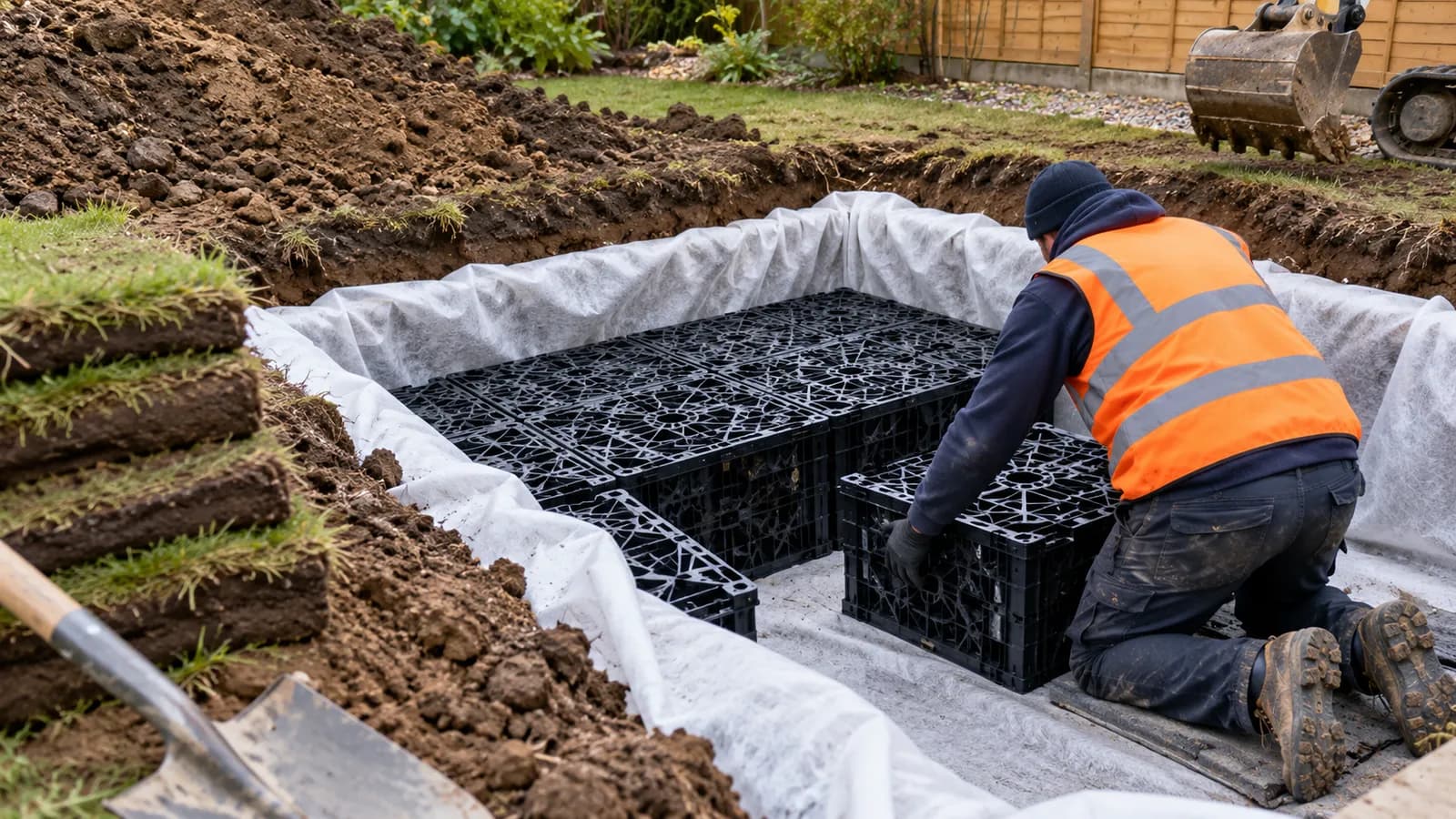
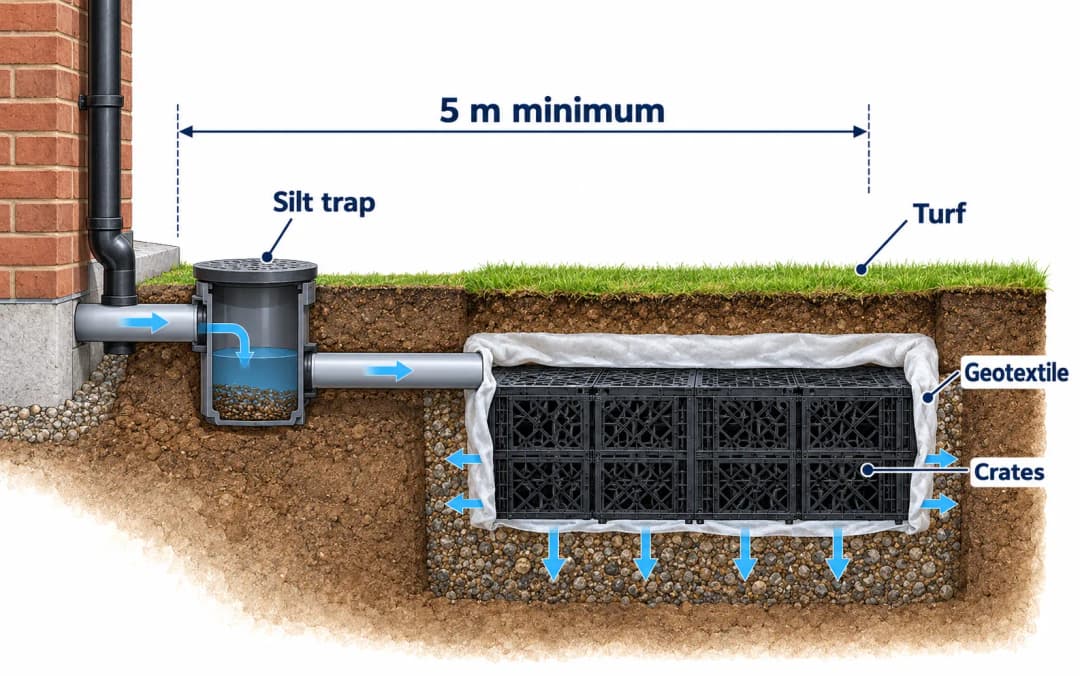
A crate soakaway is installed in a lined pit below the incoming pipe, with the crates fully wrapped before backfilling. The sequence below follows Approved Document H, BRE 365 and Drainfast's installation guide:
- Test the ground with a BRE 365 trial pit at the planned depth, and check the winter water table.
- Set out the position at least 5 m from any building or road, as Approved Document H (para 3.25) requires, and clear of buried services. Drainfast advises a greater distance if the ground slopes towards the building.
- Excavate 150 mm larger than the crates on every side, supporting the trench sides where needed.
- Lay the base with 150 mm of 20 mm pea shingle or sharp sand, levelled and compacted.
- Line the pit with non-woven geotextile, place and clip the crates, then fold the membrane over the top with no gaps.
- Connect the inlet through a silt trap so leaves and grit are caught before they reach the crates.
- Backfill the sides with 150 mm of sharp sand or pea shingle, compacted in layers.
- Cover to at least the depth the crate maker specifies for the load above, then reinstate the surface.
New drainage work usually needs building control approval, so check with your council or an approved inspector before starting.
How much do soakaway crates cost?
Supply-only crates cost tens of pounds each, but the crates are only a small part of the job. On 16 October 2026, Drainfast listed these prices:
| Item (Drainfast) | Price ex VAT | Price inc VAT |
|---|---|---|
| Storm Water Crate, 20 tonne, 1 m × 0.5 m × 0.4 m | £38.16 | £45.79 |
| Hydrocell Storm Water Crate, heavy duty, 1.0 m × 0.5 m × 0.4 m | £50.63 | £60.76 |
| Kit of 4 × 20 tonne crates with geotextile and tape | £250.38 | £300.46 |
| Kit of 6 × 20 tonne crates with geotextile and tape | £318.84 | £382.61 |
| Kit of 8 × 60 tonne crates with geotextile and tape | £499.18 | £599.02 |
For a fitted soakaway, MyJobQuote's guide, last updated 6 October 2026, gives £660 for a 190-litre crate system and £1,200 for 950 litres, with a typical domestic soakaway around £850. It lists a percolation test at £150 to £300 and a building control application at £200 to £400. These are national figures from other companies, not our prices. We do not publish a price for soakaway installation, because the size depends on the soakage test, so we quote after a site visit and test.
How do you maintain and inspect a crate soakaway?
Most maintenance happens upstream of the crates. Drainfast's guide says the silt trap's mesh bucket needs periodic emptying, and keeping gutters and gully grates clear stops leaves reaching it. Our guide on how often gutters should be cleaned covers the roof side.
Check whether the crate you choose can be inspected. Wavin's data sheet lists open channels for inspection and maintenance on AquaCell NG; with other crates, the silt trap or an inspection chamber may be the only access point. Watch for water backing up at gullies in heavy rain or a damp patch over the soakaway, both early signs of a problem.
How do crates compare with other options?
Crates suit most domestic soakaways, but they are not the only choice, and on poor ground none of the infiltration options will work.
| Option | Best for | Main limitation |
|---|---|---|
| Crate soakaway | Most homes with free-draining ground | Needs correct wrap, cover and load rating |
| Rubble-filled pit | Small areas where space is not tight | About 30% void, cannot be cleaned once silted |
| Perforated ring or chamber | Sites where access for cleaning matters | Heavier and slower to install |
| Sealed attenuation tank | Ground that will not drain | Needs an approved outlet with controlled discharge |
| French drain or trench | Spreading water along a garden | Stores less water than a crate soakaway |
For wet lawns rather than roof water, see our guide to French drains.
When to call a professional
Call a drainage contractor if you are adding an extension, garage or drive with nowhere for the rain to go, if your trial pit barely drains, or if the soakaway has to sit under a driveway. Those are the cases where sizing, load rating and position matter most. Through our soakaway installation service we run a BRE 365 percolation test, size the crates from the result, and excavate, install and reinstate the ground. If the test shows a soakaway will not work, we will tell you and set out the alternatives.
We cover Nottinghamshire, Derbyshire, Leicestershire and Lincolnshire, with no call-out fee. Get a quote or call 07300 600 950.
Sources
- Approved Document H: Drainage and waste disposal (gov.uk)
- BRE Digest 365: Soakaway design (2016)
- Wavin: AquaCell NG technical data sheet
- JDP: Polypipe Polystorm-R storage crate
- Drainfast: Soakaway crates (prices checked 16 October 2026)
- Drainfast: Soakaway systems installation guide (updated 28 October 2025)
- CNC Building Control: How to calculate the size of a soakaway
- MyJobQuote: Soakaway installation cost guide (6 October 2026)
Frequently Asked Questions
Cite this guide: “Soakaway Crates: Sizes, Cost and How They Are Installed”, Urgent Drainage Solutions, 16 October 2026. https://urgentdrainagesolutions.co.uk/blog/soakaway-crates

Need A Drainage Engineer?Book Online Today