
ACO Drains and Channel Drains: A Guide for UK Homes
Written by the Urgent Drainage Solutions teamPublished 10 min read
Quick answer
An ACO drain is a brand of channel drain: a narrow channel with a grating, set flush with paving to catch surface water. Use load class A15 for paths and patios and at least B125 where cars cross. It must run to a soakaway, watercourse or surface water sewer, bedded and haunched in concrete.
- ACO is a brand name; the generic term is a channel drain, also called a linear or trench drain.
- The load class number is the EN 1433 test load in kilonewtons: A15 is 15 kN, B125 is 125 kN, C250 is 250 kN and D400 is 400 kN.
- ACO recommends at least B125 for a driveway, and C250 if heavier vehicles will use it.
- Rainwater from paved areas should go to a soakaway first, then a watercourse, then a sewer, and never into a foul-only drain.
- In England, a new impermeable front driveway over 5 m² needs planning permission unless the water drains to a permeable area within the property.
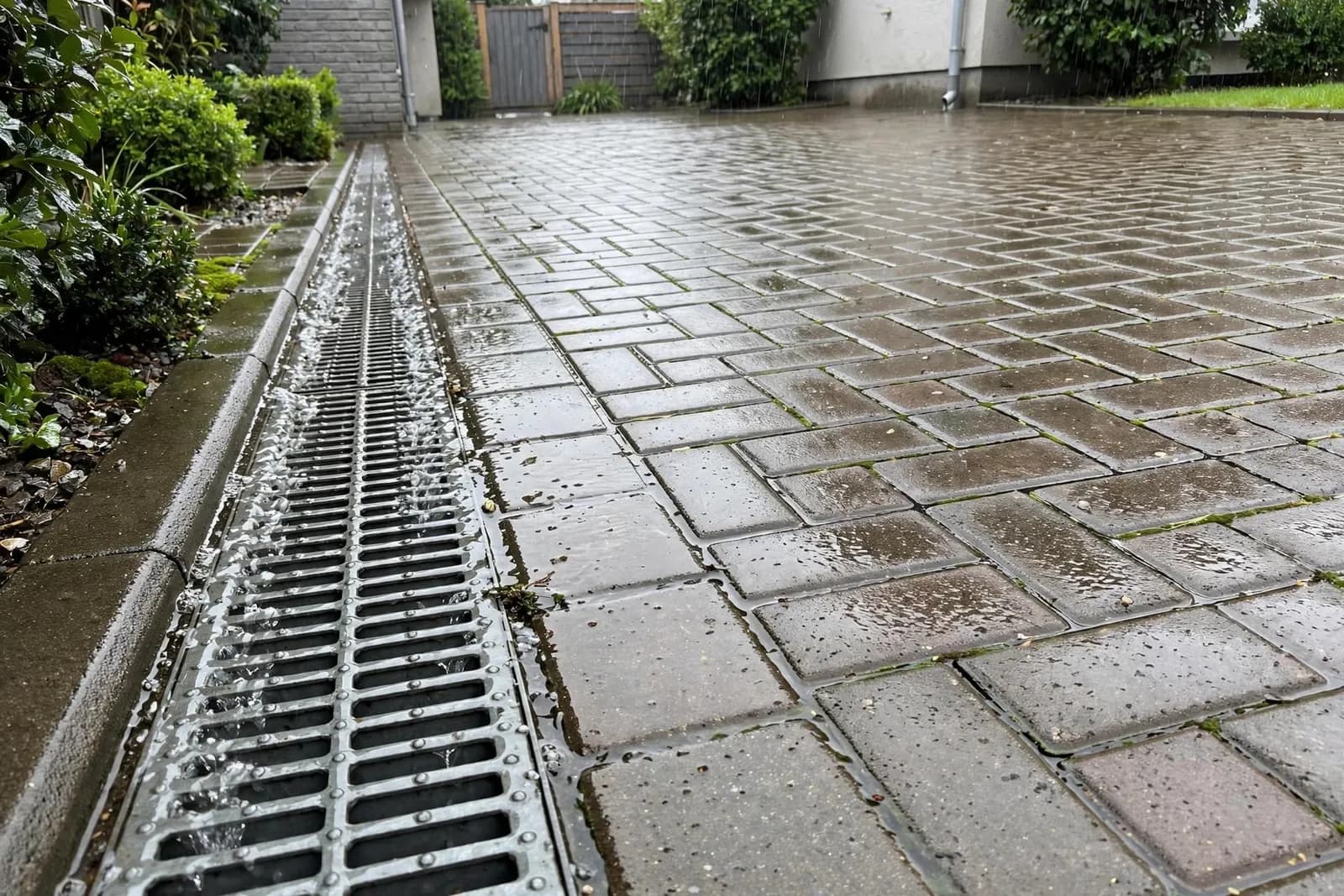
An ACO drain is a channel drain made by ACO, the best-known brand in the UK: a narrow channel with a grating on top, laid flush with paving so that rain running across a drive, patio or doorway drops in and flows to an outlet. Channel drains are also called linear drains or trench drains. The key choices are the load class, where the water goes and how the channel is bedded. If you would rather have one designed and fitted, our groundworks and drainage installation team lays channel drains as part of driveway and surface water work.
ACO is a trade mark. This is an independent guide written by a drainage company. It is not endorsed by, or affiliated with, ACO Technologies plc or the ACO Group. We use "ACO" for the brand and "channel drain" for the product in general, because several manufacturers make equivalent systems.
What is an ACO channel drain?
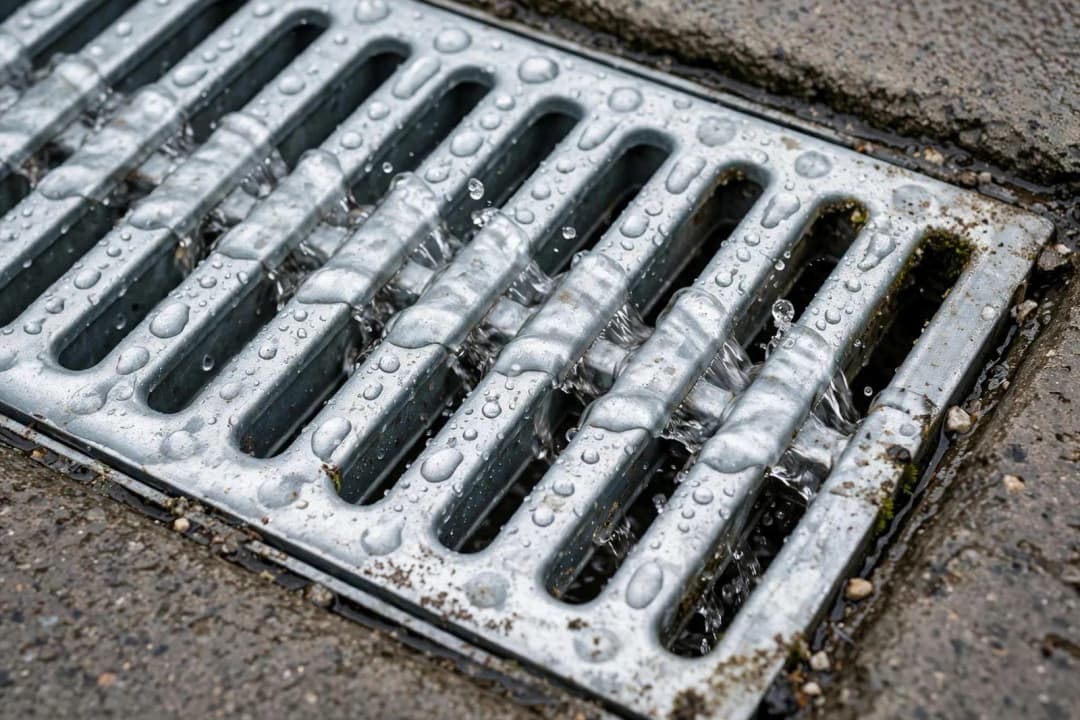
An ACO channel drain is a factory-made section of open channel, usually 1 m long, with a removable grating clipped on top. Lengths interlock to form a run, and the run ends at an outlet that connects to underground pipework.
Domestic channels are usually made from plastic or polymer concrete. ACO's RainDrain range, for example, uses Vienite, ACO's recycled polymer concrete, and its 1 m channel measures 118 mm wide and 97 mm deep according to the manufacturer's product sheet. Gratings come in galvanised steel, stainless steel, cast iron or plastic. The grating affects both the look and the strength, and metal or cast-iron gratings are the usual choice where vehicles cross.
What load class does a channel drain need?
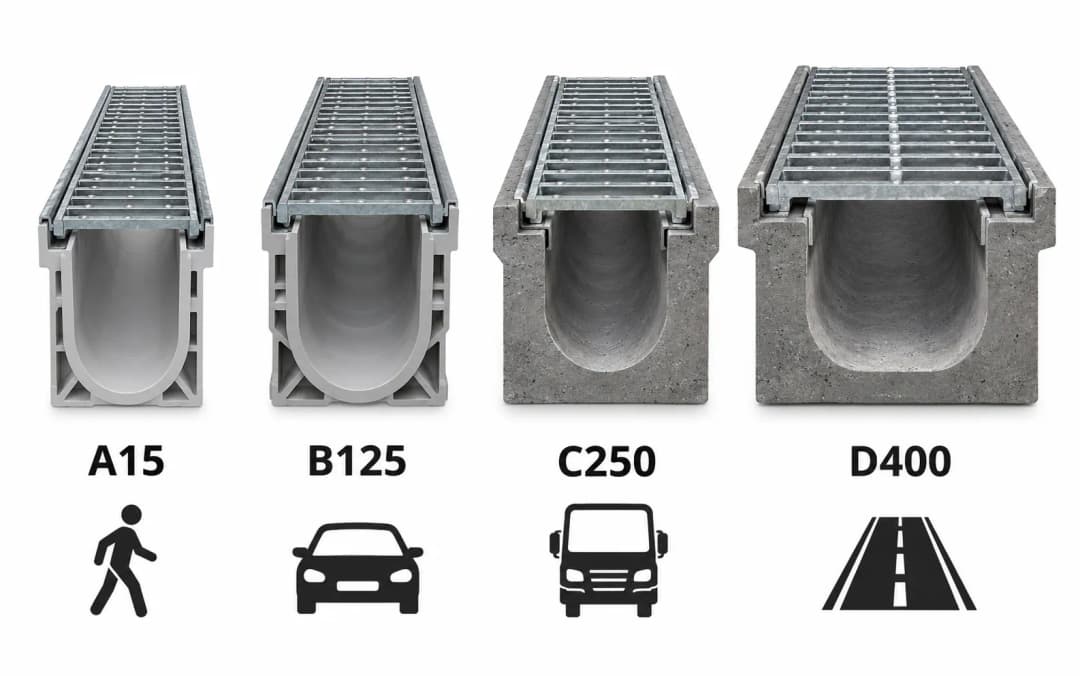
The load class tells you what the installed channel is designed to carry, and it is set by the European standard BS EN 1433. The number in each class is the test load in kilonewtons (kN) used when the channel and grating are tested, not the weight of vehicle allowed over it. Tonnes are shown only as a rough equivalent.
| Class | Test load | Rough equivalent | Typical use |
|---|---|---|---|
| A15 | 15 kN | About 1.5 tonnes | Paths, patios and other pedestrian areas |
| B125 | 125 kN | About 12.5 tonnes | Domestic driveways and residential parking |
| C250 | 250 kN | About 25 tonnes | Kerbside channels, small car parks, forecourts |
| D400 | 400 kN | About 40 tonnes | Roads and carriageways |
Classes continue to E600 and F900 for industrial yards and airfields. ACO's load class guidance says most domestic projects only need the first three classes and that A15 is the most popular. It recommends at least B125 for a driveway, and C250 if heavier vehicles may use it. ACO also warns that load classes are often chosen inappropriately, so check the class printed on the product, not just the word "driveway" in the listing.
Where are channel drains used at home?
Channel drains go wherever water runs across a hard surface and needs catching before it reaches a building, a neighbour or the road. Common positions are:
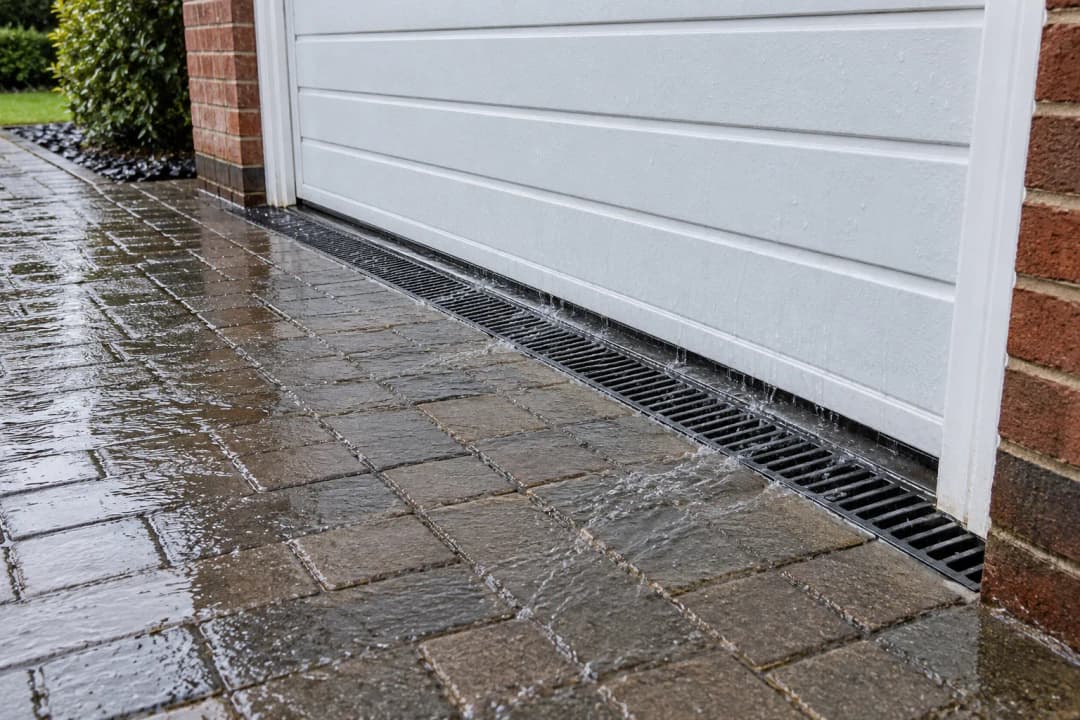
- Across a driveway entrance, to stop water running onto the footway or road water running in.
- In front of a garage door, where the garage sits lower than the drive.
- Along a patio edge, where paving meets a lawn or border.
- At level-access door thresholds, where there is no step to keep water out.
- Beside extensions and outbuildings, where new roofs and paving add runoff the old drains never took.
The government's guidance on permeable front gardens also suggests a drainage channel where a driveway slopes towards the house, connected to the drains that take the roof water.
Do you need planning permission for a driveway channel drain?
Not usually, as long as the water ends up somewhere permeable. In England, a new or replacement front driveway of any size can be laid without planning permission if the surface is permeable or the rainwater is directed to a lawn or border to drain naturally. An impermeable surface over 5 square metres that drains elsewhere needs permission.
That is set out in the gov.uk permeable surfacing guidance. A channel across the bottom of the drive that feeds a soakaway or rain garden within the property is one way to meet it. The guidance also notes that soakaways need sandy or gravelly ground rather than clay, and that rights are more restricted in conservation areas, National Parks and for listed buildings. Rules differ in Wales, Scotland and Northern Ireland, so check with your council if you are unsure.
Where can the water from a channel drain go?
Rainwater from paved areas should go to a soakaway or other infiltration system first, then a watercourse, and only then a sewer. That order of priority is requirement H3 of the Building Regulations 2010, explained in Approved Document H, and you only move down the list where the option above is not reasonably practicable.
A channel drain must never be connected to a foul-only drain. Doing so is a misconnection that overloads the sewer in heavy rain; our guide to foul water and surface water drainage explains how to tell the two apart. Connecting a new pipe to a public sewer also needs the water company's consent under section 106 of the Water Industry Act 1991. If a soakaway is the outlet, it needs sizing from a percolation test; our guide to what a soakaway is covers the basics and our soakaway crates guide covers sizing.
How do you install a channel drain?
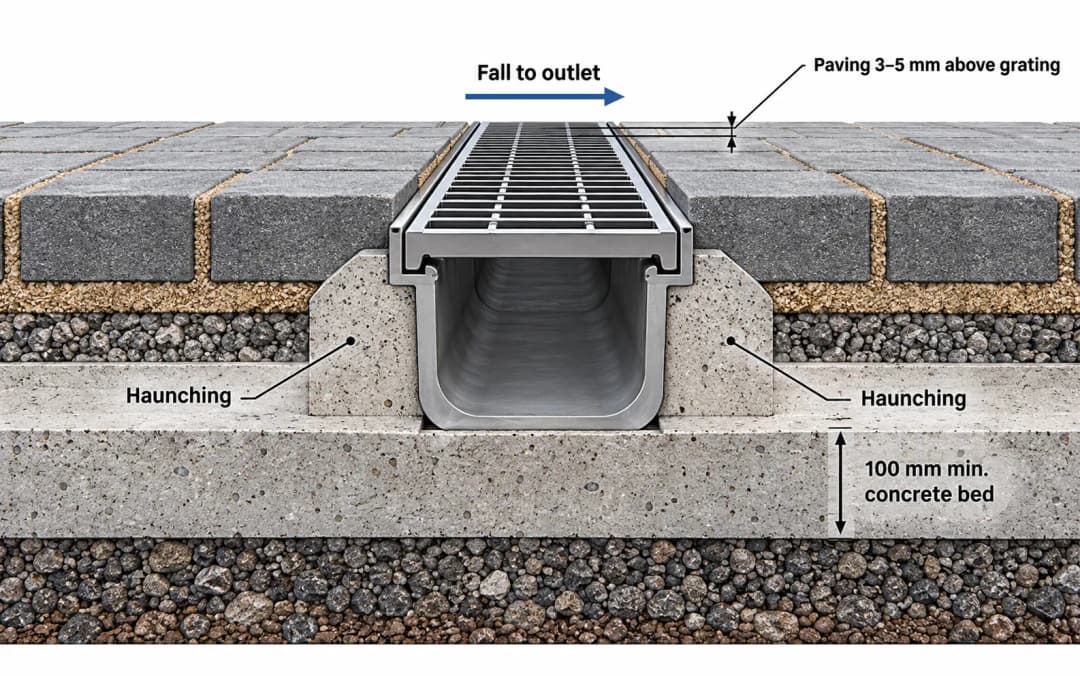
A channel drain is installed on a concrete bed, laid from the outlet upwards, then haunched in concrete with the gratings in place so the channels keep their shape. The steps below follow ACO's installation instructions for its RainDrain B125 channel; other products have their own figures, so always use the sheet for the channel you buy.
- Plan the run and the outlet. Mark the line, decide where the outlet or sump unit sits and confirm where it will discharge.
- Dig the trench. ACO's RainDrain B125 sheet gives 318 mm wide (218 mm against a structure) and 200 mm deep, or 400 mm deep at the sump.
- Set a line for the finished level 3 mm below the final surface.
- Lay a concrete bed of at least 100 mm.
- Fit the outlet. Knock out the preformed outlet or fit a sump or outlet end cap, set it on the bed and connect it to the drainage pipework.
- Lay the channels from the outlet or sump end, lowering each unit horizontally so the joints connect, and fit an end cap to the last channel. ACO suggests a suitable sealant for fully watertight joints.
- Haunch both sides in concrete with the gratings fitted.
- Finish the paving so the final surface sits 3 mm above the grating, with bricks or paviours next to the channel laid in mortar for lateral stability.
The run also needs a steady fall towards the outlet, with no backfalls on corners or short lengths. Pavingexpert's ACO channel case study treats a fall of 1 in 100 as adequate for smooth channels; check what the maker of your channel specifies.
Across the trade, the usual cause of a rocking, cracked or sunken channel is skipped bedding: units laid on sand or soil with no concrete surround. The concrete bed and haunching are what let the channel reach its rated load class.
How much does an ACO drain cost?
The channel itself is the cheaper part of the job; most of the cost of installation is excavation, concrete, the outlet connection and making good the paving. These are retailer prices we checked on 16 October 2026:
| Product (1 m length) | Retailer | Price inc VAT |
|---|---|---|
| ACO RainDrain A15, galvanised steel grating (47000) | Protiler Tools | £19.80 (£16.50 ex VAT) |
| Unbranded A15 channel, steel grating | Toolstation | £25.99 (£21.66 ex VAT) |
| Clark-Drain A15 channel, galvanised grating | Wickes | £30, or 6 for £120 |
| ACO RainDrain B125, cast-iron grating (47001) | Beesley & Fildes | £55.92 (£46.60 ex VAT) |
Sump units, outlet end caps, corner units and adaptors are extra. For fitted prices, Trade2Base's channel drainage cost guide, published on 14 June 2026 for groundworkers pricing jobs, gives £60 to £120 per linear metre installed, including excavation, concrete and connection, and £400 to £1,000 for a typical 4 to 8 m garage or driveway run. It puts heavy-duty, vehicle-rated runs at £120 to £200 or more per metre and treats a new soakaway as a separate cost.
Those are national figures from another company, not our prices. Our groundworks jobs start from £500 + VAT, and we quote channel drains after a site visit, because length, depth, ground conditions and the outlet change the price more than the channel does.
How do you maintain a channel drain?
A channel drain needs little upkeep, but it is not maintenance-free: silt, grit and leaves wash in with every storm, and a channel full of debris cannot carry water.
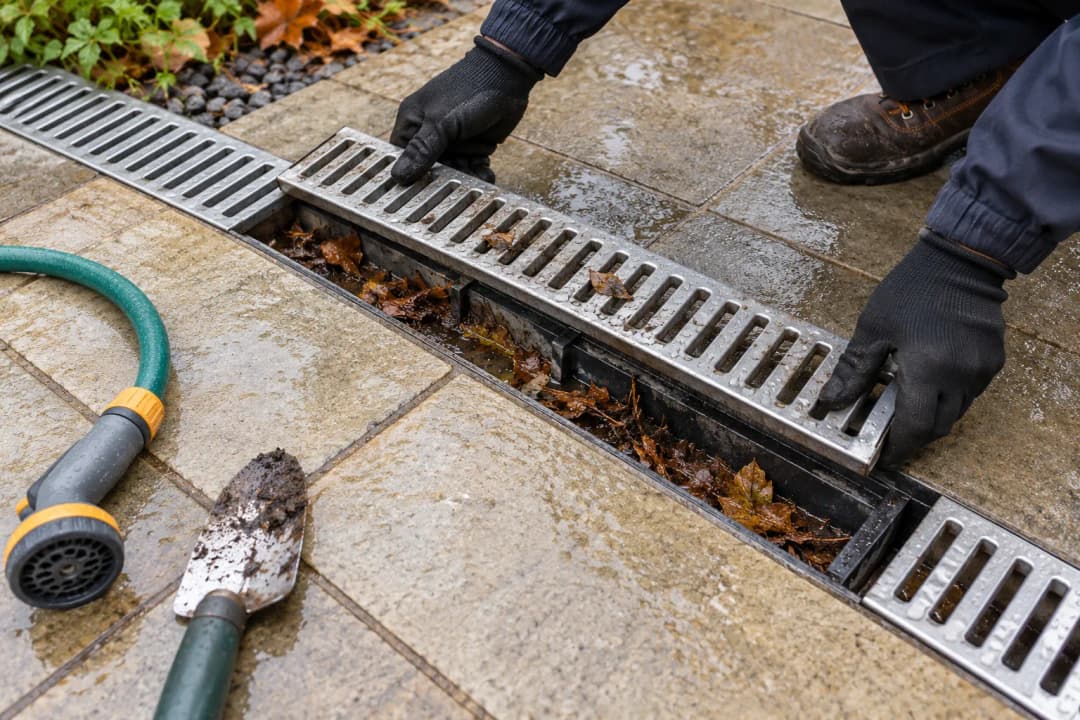
- Keep the gratings clear of leaves and litter so water can get in.
- Lift the gratings and clean the channel at least once a year, scooping out silt and flushing it through towards the outlet.
- Empty the silt bucket in any sump unit, which is there to catch grit before it reaches the pipes.
- Clean after leaf fall in late autumn, when channels block most easily.
If water still backs up after cleaning, the blockage is usually in the outlet or the pipe beyond it; our guide on how to unblock an outside drain covers the safe first checks. Overflowing gutters dump water and debris onto drives, so gutter cleaning is often part of the fix.
Channel drain or French drain: which do you need?
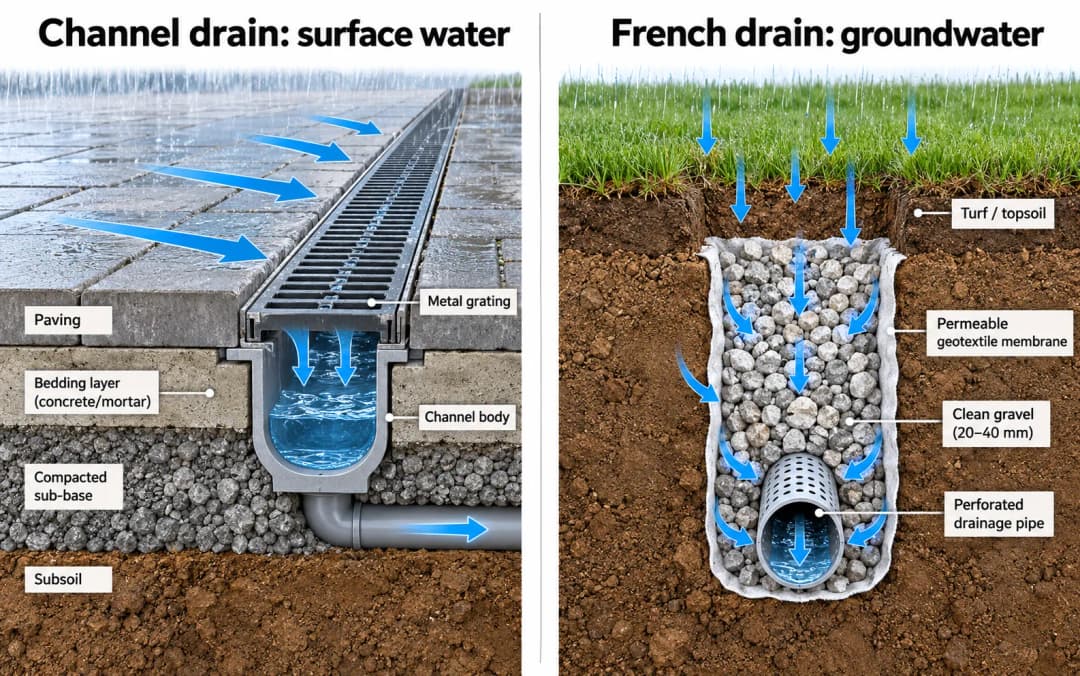
A channel drain catches surface water running across hard paving, while a French drain is a gravel-filled trench with a perforated pipe that collects water from saturated ground. They solve different problems, and some gardens need both.
| Feature | Channel drain | French drain |
|---|---|---|
| Water handled | Surface water on paving | Water in the soil |
| Visible? | Yes, the grating sits flush with the paving | No, once turfed or gravelled |
| Load rated | Yes, from A15 to F900 under BS EN 1433 | No |
| Best for | Driveways, thresholds, patios | Waterlogged lawns and borders |
| Maintenance | Lift gratings and clear silt | Silt can build up; harder to clean |
Our guide to French drains for waterlogged gardens explains how they are built.
What are the alternatives to a channel drain?
There are three main alternatives: slot drains, point gullies and permeable paving. The right one depends on the size of the area and how it falls.
- Slot drains are a slim form of channel with a narrow slot instead of a wide grating, chosen where appearance matters.
- Point drains or yard gullies collect water at a single low spot, which suits a small area laid to fall to one point but not a long edge.
- Permeable paving lets rain soak through the surface itself, which can remove the need for a channel on free-draining ground and keeps a front driveway within the planning rules above.
When to call a professional
Call a drainage contractor if the channel has to connect to underground drains, cross the boundary onto a public footway, discharge to a new soakaway or carry vehicles heavier than cars. Also get help if an existing channel rocks, cracks or sinks, if water still pools or reaches the garage or door after cleaning, or if you cannot tell whether it runs to a surface water or foul drain. Those signs usually point to failed bedding, a blocked outlet, the wrong load class or a misconnection.
Through our groundworks service we survey the site, check where the water can legally go, choose the load class and lay the channel on a full concrete bed with the outlet connected. If an existing channel is broken, our drain repairs team can advise whether to repair or replace it. We cover Nottinghamshire, Derbyshire, Leicestershire and Lincolnshire. Get a quote or call 07300 600 950.
Sources
- The Building Regulations 2010, Schedule 1, requirement H3 (legislation.gov.uk)
- Approved Document H: Drainage and waste disposal (gov.uk)
- Guidance on the permeable surfacing of front gardens (gov.uk)
- Water Industry Act 1991, section 106 (legislation.gov.uk)
- BS EN 1433:2002 Drainage channels for vehicular and pedestrian areas (BSI)
- ACO: Drainage load class
- ACO RainDrain B 125 product and installation sheet (Barbour Product Search)
- Trade2Base: Channel drainage (ACO drain) costs UK, 14 June 2026
Frequently Asked Questions
Cite this guide: “ACO Drains and Channel Drains: A Guide for UK Homes”, Urgent Drainage Solutions, 16 October 2026. https://urgentdrainagesolutions.co.uk/blog/aco-channel-drains

Need A Drainage Engineer?Book Online Today