
Condensate Soakaway: What It Is and Why Your Boiler Needs One
Written by the Urgent Drainage Solutions teamPublished 8 min read
Quick answer
A condensate soakaway is a small pit beside the house, filled with limestone chippings, that takes the slightly acidic water from a condensing boiler and lets it soak into the ground. Manufacturers treat it as a last resort: an internal soil stack or waste pipe comes first. It must be at least 500 mm from the building.
- Condensing boilers produce slightly acidic condensate; Vaillant's ecoTEC plus manual gives a pH of 3.5 to 4.0.
- Boiler makers and HHIC guidance prefer an internal soil stack or waste pipe; a soakaway is for when no other route works.
- Worcester Bosch specifies a hole at least 400 mm deep and 300 mm across, filled with limestone chippings, 500 mm from the footings.
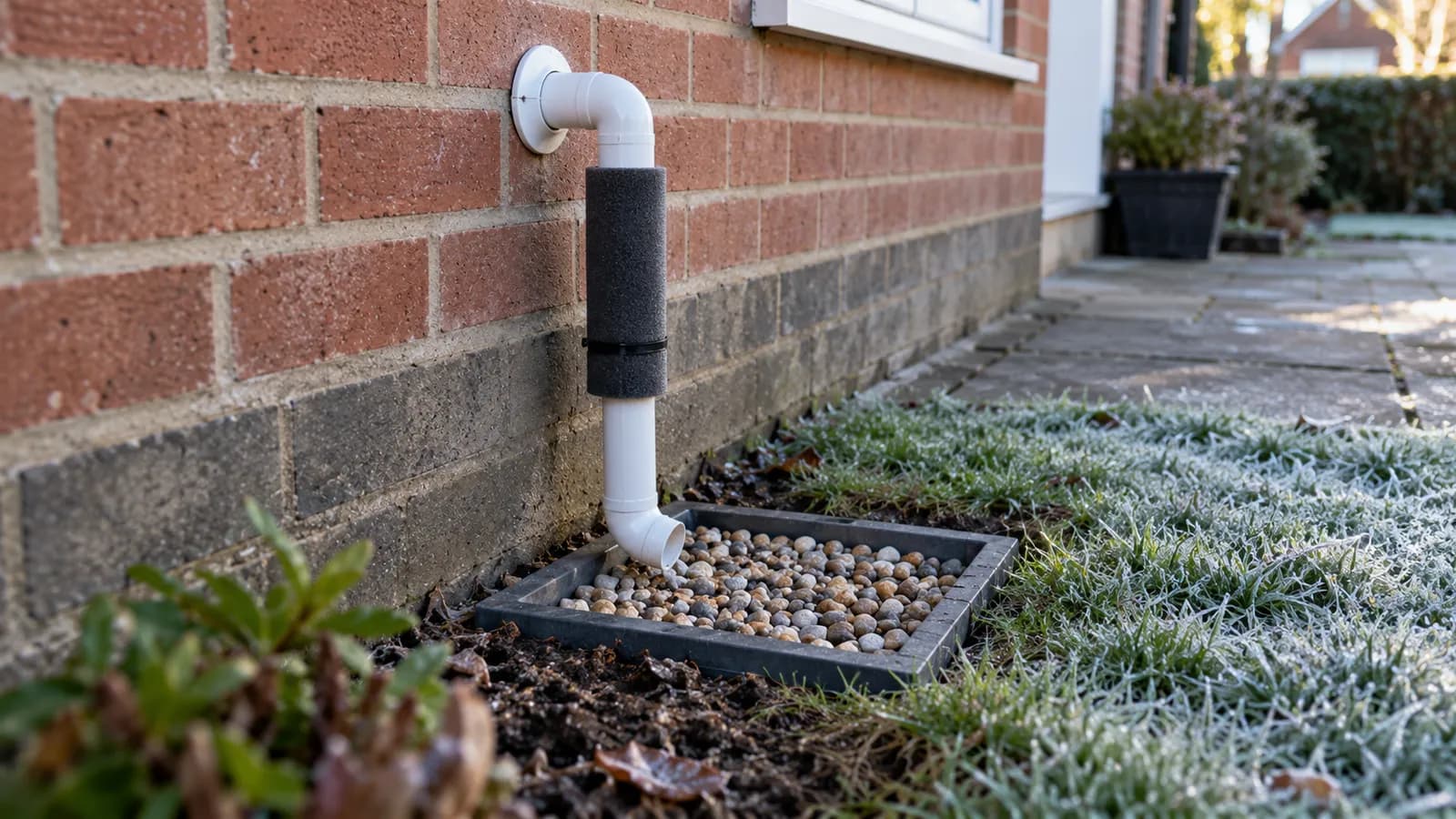
- External condensate pipes freeze, so HHIC guidance keeps them under 3 m, at least 30 mm bore and insulated.
- Work on the boiler itself must be done by a Gas Safe registered engineer.
A condensate soakaway is a small pit next to the house, filled with limestone chippings, that takes the mildly acidic water a condensing boiler produces and lets it soak into the ground. Despite the name of this guide, most boilers should not need one: manufacturers prefer the condensate to run to an internal soil stack or waste pipe, and treat a soakaway as the fallback. It is a different thing from a rainwater soakaway, which our soakaway installation service designs and builds for roofs and paving.
This guide explains what condensate is, where it should go, how a condensate soakaway is built and how to stop the pipe freezing. For rainwater soakaways, see our guide to what a soakaway is.
What is boiler condensate and why is it acidic?
Condensate is water that condenses out of the boiler's flue gases as it recovers their heat, which is what makes a condensing boiler efficient. It is slightly acidic: Vaillant's ecoTEC plus installation manual gives a pH of 3.5 to 4.0. Worcester Bosch describes it as harmless to people but slightly acidic, and advises against letting it drain into garden soil.
The volume is small but steady. The same Vaillant manual gives approximate condensate rates of 1.2 to 3.1 litres an hour, depending on model, in 50/30 °C heating mode. Because of the acidity, Approved Document H (para 1.14) says pipework receiving condensate should be made from materials resistant to a pH of 6.5 and lower, installed in accordance with BS 6798.
Where should boiler condensate go first?
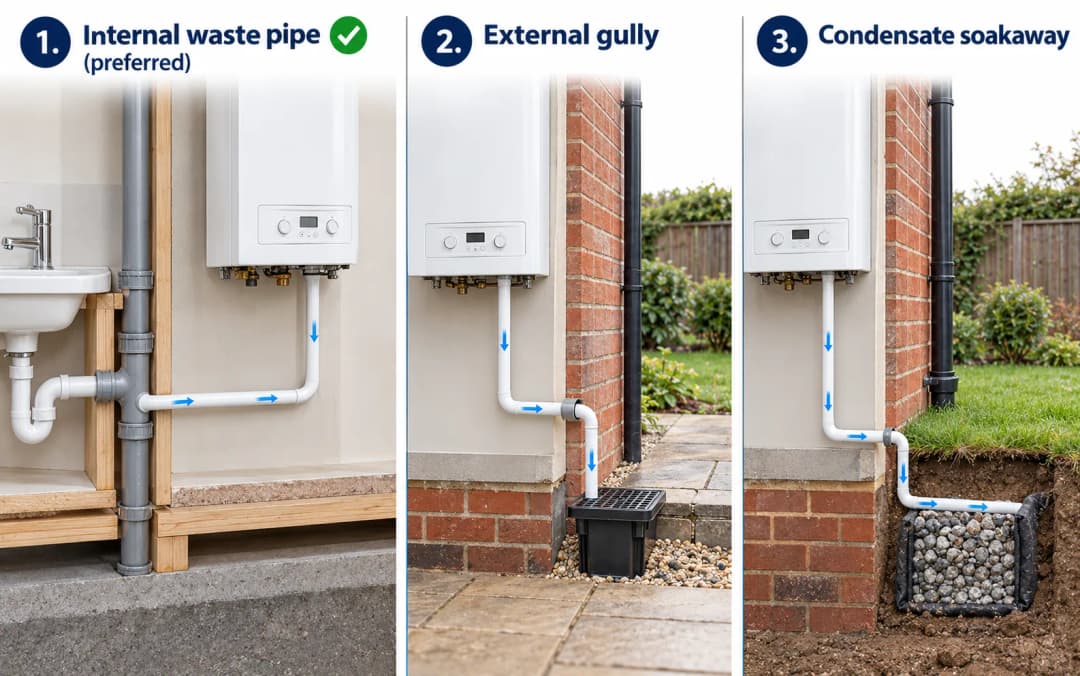
Inside the building, by gravity, wherever possible. Boiler manufacturers and the Heating and Hotwater Industry Council's installer guide put the options in a clear order:
| Order | Discharge route | Notes from manufacturer and HHIC guidance |
|---|---|---|
| 1 | Internal soil and vent stack | The preferred method; Approved Document H also prefers an internal stack |
| 2 | Internal kitchen, bathroom or washing machine waste | Connect downstream of the waste trap |
| 3 | Condensate pump to an internal waste | Where gravity discharge is not physically possible |
| 4 | External gully, drain or hopper | Short insulated run; a downpipe only if it serves a combined foul and rainwater system |
| 5 | Purpose-made condensate soakaway | When nothing above is practical, and only in ground that drains |
The reason for this order is freezing. HHIC notes that the prolonged cold spells of 2010 and 2018 led to a sharp rise in calls about boilers that had shut down because an external condensate pipe had frozen. A pipe that stays inside the heated building cannot freeze.
When is a condensate soakaway the right choice?
A condensate soakaway is used when the boiler cannot reach an internal drain or a suitable external drain, for example in an outbuilding or a property with no drain on that side. The McAlpine instructions for its SOAK1GR condensate soakaway say it should only be used if connecting to the soil pipe or mains drainage is not practical or convenient.
The ground must drain. Worcester Bosch warns that areas prone to flooding and ground with a high clay content can drain poorly, leaving the pipe blocked by water or ice and the boiler shut down. It allows a larger soakaway and more limestone in clay areas, but says a soakaway may not be suitable at all where clay prevents the condensate dispersing.
How is a condensate soakaway built?
It is a small, simple pit, quite unlike a rainwater soakaway. The two published designs below come from the Worcester Bosch Greenstar 8000 Life installation manual and McAlpine's SOAK1GR instructions:
| Detail | Worcester Bosch example | McAlpine SOAK1GR |
|---|---|---|
| Hole size | At least 400 mm deep by 300 mm across | About 200 mm wide by 400 mm deep |
| Distance from house | At least 500 mm from building footings | At least 500 mm from the wall to the centre of the hole |
| Unit | Plastic tube of at least 100 mm, sealed at the bottom | Purpose-made plastic soakaway unit |
| Outlet holes | Two rows of three 12 mm holes at 25 mm centres, 50 mm from the bottom | Holes facing away from the wall |
| Fill | At least 100 mm of limestone chippings around the tube, to 400 mm deep | 10 mm limestone chippings: 50 mm bed, inside the unit and around it |
| Other | Holes face away from the house; air break in the external pipe | Porous soil only; clear of gas, electricity and water services |
The external pipe should take the shortest, least exposed route with as steep a fall as possible and no horizontal sections where condensate could sit. Always follow the instructions for the specific boiler, because air break and trap requirements vary between models.
Why are limestone chippings used?
Limestone is calcium carbonate, which reacts with acid and neutralises it. As acidic condensate trickles through the chippings, it is neutralised before it reaches the surrounding soil. The chippings slowly dissolve in the process, so it makes sense to check the level when the boiler is serviced and top them up if they have sunk. Gravel that is not limestone, such as flint or granite, does not neutralise acid in the same way.
How far from the house should a condensate soakaway be?
At least 500 mm from the building, according to both Worcester Bosch and McAlpine, and clear of other buried services. Worcester Bosch also asks installers to take care to avoid damaging existing services and building footings.
That is far closer than a rainwater soakaway. Approved Document H (para 3.25) says infiltration devices for rainwater should not be within 5 m of a building or road, because they take the run-off from whole roofs. A condensate soakaway takes a few litres an hour, which is why manufacturers give their own, much smaller distance. Do not combine the two by running condensate into a rainwater soakaway.
Can condensate go into a rainwater downpipe or soakaway?
Usually not. Worcester Bosch says a rainwater downpipe or external drain should only be used for condensate if it is connected to a combined foul and rainwater system, and that untreated condensate must not be allowed to flow into streams or rivers. Where a downpipe runs to a rainwater soakaway or a surface water sewer, that rules it out.
Where a downpipe connection is allowed, Worcester Bosch requires an air break or rainwater hopper between the boiler and the downpipe, so the boiler cannot flood if the downpipe blocks. Our guide to foul water and surface water drainage explains how to tell which system a downpipe joins.
Why do condensate pipes freeze and how do you stop it?
External condensate pipes freeze because the flow is slow and the pipe is small, so the water cools and turns to ice at the open end, a bend or a dip. A frozen pipe stops the boiler. HHIC's installer guide sets out how to reduce the risk:
- run the pipe inside the heated building for as far as possible;
- keep the external run short, with a maximum of 3 m in HHIC's diagrams;
- increase the pipe to at least 30 mm internal diameter before it goes through the wall;
- insulate external pipe with at least 13 mm of waterproof, UV-resistant insulation;
- cut the open end at 45° and terminate it into a gully below the grid but above the water line;
- treat pipes in unheated lofts, garages and basements as external pipes.
If the pipe does freeze, HHIC's householder advice is to thaw it with a hot water bottle, a microwaveable heat pack or warm water, never boiling water, and then reset the boiler. Do not put yourself at risk reaching a pipe at height. Our guide to preparing drains for winter covers other cold-weather checks.
Who should install a condensate soakaway?
The boiler's heating engineer, as part of the boiler installation. Any work on a gas boiler must be done by a Gas Safe registered engineer, as the Health and Safety Executive explains, and HHIC notes that the Benchmark commissioning checklist asks the engineer to confirm the condensate drain has been fitted correctly.
We are drainage engineers, not gas engineers, so we do not work on boilers. Where a condensate problem is really a drain problem, such as a blocked gully the pipe runs into or a waste pipe or soil stack that will not drain, that is work we can do.
Condensate soakaway checklist
Use this to check an existing condensate soakaway, or to discuss a new one with your heating engineer:
- Is there really no internal soil stack, waste pipe or pump route available?
- Is the soakaway at least 500 mm from the building footings and clear of services?
- Is the ground free-draining, rather than heavy clay or prone to flooding?
- Is the pit filled with limestone chippings, not ordinary gravel or rubble?
- Is the external pipe run as short as possible, ideally under 3 m?
- Is the external pipe at least 30 mm bore, insulated and falling steeply with no flat sections?
- Does the pipe end cut at 45°, with any air break the manufacturer requires?
- Is the condensate kept out of rainwater soakaways, surface water drains and watercourses?
- Are the chippings checked at each annual boiler service?
When to call a professional
Call a Gas Safe registered heating engineer if the boiler keeps locking out in cold weather, the condensate pipe freezes repeatedly, or you want the condensate rerouted to an internal drain. If the problem is in the drainage the pipe runs into, such as a blocked gully, a waste pipe that backs up or ground that stays waterlogged next to the house, call a drainage contractor. For waste pipes and soil stacks, see our drainage plumbing service. For rainwater soakaways for roofs and paving, our soakaway installation service sizes every one from a percolation test.
We cover Nottinghamshire, Derbyshire, Leicestershire and Lincolnshire, with no call-out fee. Get a quote or call 07300 600 950.
Sources
- Approved Document H: Drainage and waste disposal (gov.uk)
- Vaillant: ecoTEC plus installation and maintenance instructions
- Worcester Bosch: Greenstar 8000 Life installation and maintenance instructions
- Worcester Bosch: Your quick guide to condensate
- HHIC: Installer guide, condensate discharge pipe installation (January 2021)
- McAlpine: SOAK1GR condensate soakaway installation instructions
- Health and Safety Executive: Domestic gas frequently asked questions
Frequently Asked Questions
Cite this guide: “Condensate Soakaway: What It Is and Why Your Boiler Needs One”, Urgent Drainage Solutions, 16 October 2026. https://urgentdrainagesolutions.co.uk/blog/condensate-soakaway

Need A Drainage Engineer?Book Online Today