
Blocked Downpipe? How to Unblock a Downpipe Safely
Written by the Urgent Drainage Solutions teamPublished 7 min read
Quick answer
A blocked downpipe usually shows as a gutter overflowing at one end or water spurting from a joint. Most blockages sit at the gutter outlet, the swan neck bends or the shoe at the bottom. Clear the top, then flush from the ground. If water backs up at the gully, the blockage is in the drain below.
- A gutter that overflows at the outlet end while the rest of the run is fine usually means the downpipe or its outlet is blocked.
- Most downpipe blockages form at the gutter outlet, the swan neck bends under the eaves or the shoe and gully at ground level.
- If the downpipe is clear but water backs up at the bottom, the blockage is in the underground drain or a failed soakaway.
- HSE guidance says leaning ladders suit short, low-risk tasks; anything above single-storey height is a job for proper access equipment.
- Under Section 106 of the Water Industry Act 1991, rainwater should not go into a separate foul sewer without the water company's approval.
A blocked downpipe is nearly always stuck at one of three points: the outlet where the gutter drains into the pipe, the swan neck bends that take the pipe round the eaves, or the shoe and gully at ground level. Clear the top first, flush the pipe and watch where the water goes. If the pipe runs clear but water backs up at the bottom, the blockage is in the drain below. Our gutter cleaning and repair service clears and flushes every downpipe as standard.
What are the signs of a blocked downpipe?
The giveaway is a gutter that overflows at the outlet end while the rest of the run copes. A downpipe drains a set length of gutter, so when it stops taking water, the gutter fills from that end first.
Other signs we look for:
- water spurting or weeping from the joints or brackets partway down the pipe, because it is backing up under pressure;
- gurgling or slow glugging from the pipe in rain;
- standing water in the gutter a day after rain, with silt and seedlings growing in it;
- the shoe at the bottom dribbling when it should be gushing;
- a damp stripe, green staining or flaking paint on the wall beside the pipe.
If water is spilling along the whole length of the gutter, or from one joint well away from the outlet, the gutter itself may be the problem. Our guide to leaking gutters and gutter repair covers those faults.
Where does a downpipe usually block?
Blockages form where the water changes direction or slows down.
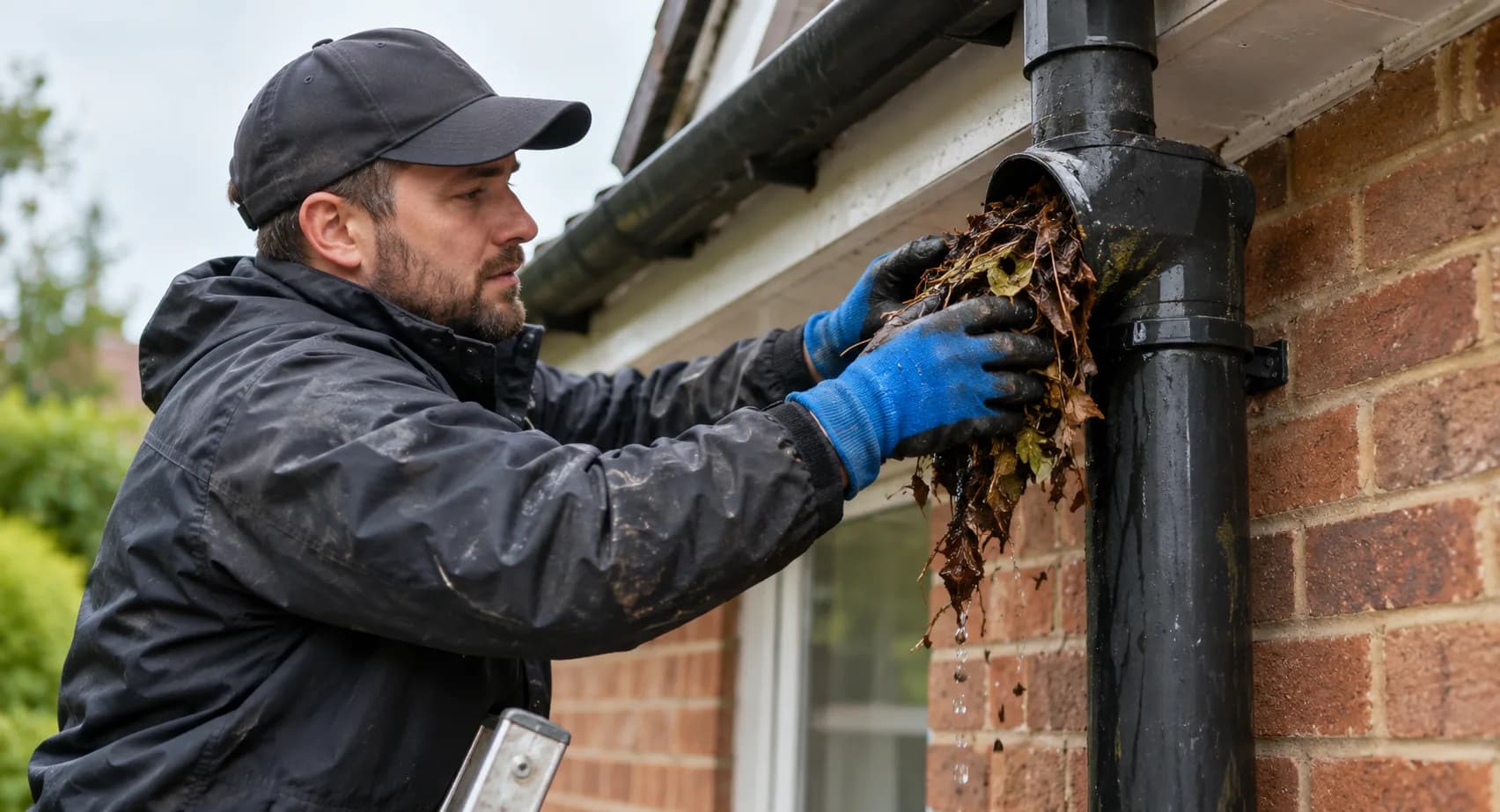
- The gutter outlet. The most common spot. Moss and leaves wash along the gutter and mat over the outlet.
- Swan neck or offset bends. Where the pipe bends back under the eaves, debris catches in the tight turns.
- Hoppers. Open hopper heads on older houses fill with leaves and overflow.
- The shoe and gully. At ground level the pipe either turns out through a shoe onto a gully grate, or runs straight into the ground. Leaves pile up on the grate and silt builds up in the gully trap.
- The underground connection. Below ground the rainwater pipe joins a surface water drain, a combined drain or a soakaway. Roots, silt and broken joints all cause trouble here.
How do you find where a downpipe is blocked?
Run water in at the top, or wait for steady rain, and watch what happens at each point. This table is the quickest way to narrow it down.
| What you see | Where the blockage probably is | Who usually fixes it |
|---|---|---|
| Gutter full at the outlet, little or nothing coming out of the shoe | Gutter outlet or top bends | Gutter cleaning |
| Water spurting from a joint partway down | Below that joint, in the pipe | Gutter cleaning |
| Pipe takes water slowly, gurgles, then backs up | Bend or offset partway down | Gutter cleaning |
| Shoe runs freely but the gully overflows | Gully trap or drain below | Drain unblocking |
| Pipe runs straight into the ground and backs up to the bottom joint | Underground connection or drain | Drain unblocking or CCTV survey |
| Several downpipes and gullies back up at once | Shared drain further down | Drain unblocking |
| Backs up only in heavy rain, ground near the pipe stays soggy | Silted or failed soakaway | Soakaway investigation |
How do you unblock a downpipe safely?
Start at ground level. A lot can be done without leaving it.
- Clear leaves and silt off the gully grate and scoop out the gully with a gloved hand or trowel. Sometimes that is the whole problem.
- If the pipe has a shoe, remove it and check it is not packed with debris.
- Look for an access cap or rodding point near the bottom of the pipe. Open it, then push flexible drain rods upwards in short pushes. Do not force them hard through a bend, as plastic joints pull apart.
- Flush with a garden hose from the bottom, or from the top if you can reach it safely, and watch where the water reappears.
- Check the gutter outlet from an upstairs window or with a pole system. Lifting a mat of moss off the outlet often frees everything below it.
Skip chemical drain cleaners. They do little against leaves and moss, and they end up in the ground or a watercourse.
The ladder is where people get hurt. The Health and Safety Executive says leaning ladders and stepladders are for low-risk, short-duration work, and recommends other equipment if a task would keep you up there for more than 30 minutes at a time. It also says the feet need firm, level and clean ground, with no moss or leaf litter, which rules out a lot of the ground under a downpipe. On a bungalow with someone footing the ladder, clearing the outlet is reasonable. On a two-storey house, leave it to someone with the right access.
What if the blockage is underground?
If the downpipe runs clear but water backs up at the gully or the bottom joint, you have a blocked drain rather than a blocked downpipe. That is a different job: lift the nearest inspection chamber cover and see whether it is full. A full chamber means the blockage is further downstream.
Our guide on how to unblock an outside drain walks through rodding a gully and finding the blocked section. If rods do not clear it, or it keeps coming back, it needs jetting and possibly a camera. Our blocked drain service starts from £120 + VAT, and a CCTV survey from £149 + VAT if we need to see why it keeps blocking.
Approved Document H says rainwater pipes should discharge into a drain or gully (paragraph 1.8), and its guidance on Requirement H3 says a rainwater drainage system should minimise the risk of blockage and be accessible for clearing blockages. Plenty of older homes fall short of that, with no rodding point or a pipe buried straight into the ground, which makes underground blockages harder to reach.
What if the downpipe goes to a soakaway?
Many homes send roof water to a soakaway rather than a drain. Approved Document H puts a soakaway first in the order of preference for rainwater, ahead of a watercourse and then a sewer. When a soakaway silts up or the ground around it stops draining, the downpipe backs up in heavy rain even though the pipe itself is clear.
Signs include backing up only in prolonged rain and a soggy patch of lawn over the soakaway. Rodding the downpipe will not fix that. Our guide to soakaways explains why they fail and what the repair options are.
Is your downpipe connected to the right drain?
It should be. Where an area has separate public sewers, Section 106 of the Water Industry Act 1991 says nobody is entitled to discharge surface water into a sewer provided for foul water "except with the approval of the undertaker". Rainwater going into the foul sewer adds to the load in heavy rain, and Approved Document H says any rainwater pipe discharging into a combined system should do so through a trap.
Misconnections are common. The Environment Agency estimates that 1 in 5 homes have misconnected drains. Its focus is waste water wrongly going into surface water drains, but a downpipe plumbed into the foul sewer is a misconnection too. If you are unsure where your downpipes go, a dye test or CCTV survey will show it. Our guide to foul water and surface water drainage explains the difference.
How do you stop a downpipe blocking again?
Keep the gutters clean, because almost everything that blocks a downpipe comes off the roof. Most homes need cleaning once or twice a year, more under trees. Our guide on how often gutters should be cleaned sets out a sensible schedule.
A few other things help:
- fit a wire balloon or leaf guard in each gutter outlet, and check it after leaf fall, because a guard full of leaves blocks the outlet just as well;
- keep gully grates clear, especially in autumn;
- cut back overhanging branches where you can;
- if one downpipe blocks every year, ask whether it is undersized for the roof area or has too many bends.
When to call a professional
Call someone in if the blockage is above single-storey height, the pipe or gully keeps blocking, water is coming into the house, or the downpipe goes into the ground and you cannot reach the blockage. A wall that stays damp beside the pipe is also worth a look.
Our engineers clear the gutters, then clear and flush each downpipe and repair leaking joints. Gutter cleaning starts from £120 + VAT, with no call-out fee and the price agreed before work starts. Repairs carry a 12-month guarantee. If the problem turns out to be underground, we also unblock, jet and survey drains. We are open 7 days a week, 6am to 8pm, with emergency call-outs 365 days a year, covering Nottingham, Worksop and the rest of the East Midlands. We are WJA and NADC members and hold CHAS and CSCS. Call 07300 600 950 or book online.
Sources
- Approved Document H: Drainage and waste disposal (gov.uk)
- Health and Safety Executive: How and when to use a ladder at work
- Health and Safety Executive: Where ladders should be used
- Water Industry Act 1991, section 106 (legislation.gov.uk)
- Environment Agency: One small action in your home could help clean up beaches (2015)
Frequently Asked Questions
Cite this guide: “Blocked Downpipe? How to Unblock a Downpipe Safely”, Urgent Drainage Solutions, 6 October 2026. https://urgentdrainagesolutions.co.uk/blog/blocked-downpipe

Need A Drainage Engineer?Book Online Today