
Blocked Gully Drain: How to Clear a Rainwater Gully
Written by the Urgent Drainage Solutions teamPublished 9 min read
Checked by Eren Birinci (Gino), Founder & Lead Drainage Engineer on
Quick answer
A gully is the small grated pot at ground level that takes water from a downpipe, sink waste or yard into the drain. It holds water in a trap to stop smells. Most blocked gullies are full of leaves, silt or fat and can be scooped out by hand with gloves. If it refills, the drain beyond is blocked.
- A gully is a trapped pot at ground level that takes rainwater or waste water into the underground drain.
- Water sitting in the bottom of a gully is normal: it is the trap seal that keeps drain smells and gases in.
- Most gully blockages are leaves, silt, fat or lint in the pot and can be scooped out by hand with gloves.
- A gully on your land that serves only your home is yours to clear; road gullies belong to the highway authority.
- A sunken, cracked or tilted gully is a drain repair; ours start from £250 + VAT, and unblocking from £120 + VAT.
A gully is the small grated opening at ground level, usually at the foot of a downpipe or under a kitchen waste pipe, that takes water into the underground drain. Below the grate is a pot with a trap that holds water to keep drain smells in. When a gully blocks, it is nearly always because the pot has filled with leaves, silt or fat, and most can be cleared by hand without special tools. If the water comes straight back, the drain beyond the trap is blocked, and our blocked drain service clears it from £120 + VAT.
Our guide on how to unblock an outside drain covers rodding and inspection chambers. This one is about the gully itself: the types, how the trap works, how to empty one and what it means when a gully has sunk or cracked.
What is a gully?
A gully is a fitting that connects surface pipes to the underground drain. It has a grate or grid on top, a pot beneath that catches debris, a trap that holds water, and an outlet to the drain. The drainage supplier JDP says domestic gullies are usually found under a downspout or an outside waste water discharge point.
Building Regulations guidance expects them. Approved Document H says rainwater pipes "should discharge into a drain or gully", and that a ground-floor waste pipe carrying only waste water may discharge to a gully. Such a pipe should end below the grating but above the water in the trap. That is why waste pipes poke through a slot in the grid, and it is covered in our guide to what a downpipe is and where it drains.
How does a gully trap work?
The trap is a bend or chamber that always stays full of water. Water flows in from the top, pushes through the bend and leaves by the outlet, but air from the drain cannot get back past the water. JDP says the trapped water "serves to prevent any smells and gases from escaping back out of the drain".
Three things follow from that:
- Standing water in the bottom of a gully is normal. A gully with clear water sitting well below the grate is working. A gully full to the grate is not.
- The trap is also a silt catcher. Anything heavier than water settles in the pot. The supplier Drainfast says such particles tend to accumulate as silt in a trapped gully, and recommends regular checks where silt is a known problem.
- A dry trap smells. Drainfast notes that a gully that is rarely used can lose its seal through evaporation. Pouring in a bucket of water restores it.
Approved Document H adds that a rainwater pipe discharging into a combined system should do so through a trap, so a downpipe gully on an older street is doing an important job.
What types of gully are there?
Most homes have one of the first four. The names describe the shape of the trap or where the pipes enter.
| Type | What it looks like | Where you find it | Can you rod through it? |
|---|---|---|---|
| P-trap gully | A pot with a P-shaped bend, usually with a square hopper and grid on top | Under downpipes on houses of every age, in clay or plastic | No. JDP says the tight bend cannot be cleared with a drain rod unless it has a rodding eye |
| Bottle gully | A round pot with a removable inner sleeve or baffle | Newer homes and replacement gullies | Yes. Lifting out the sleeve gives a rod direct access to the outlet |
| Back inlet gully | A gully with a pipe socket in the side or back below the grid | Where a waste pipe or downpipe connects below ground level | Depends on the trap; bottle types can be rodded |
| Yard gully | A larger trapped pot under a heavier grating | Drives, yards and car parks | Depends on the design |
| Road gully | A larger, heavier-duty pot under a grating in the kerb or channel | Public roads | Not yours to clear; report it |
Sources: JDP, Drainfast and the Designing Buildings construction wiki, which notes that gullies draining large areas are frequently called yard gullies or road gullies. JDP describes road gullies as much more robust than domestic ones and mostly made from concrete or HDPE.
Why do gullies block?
A gully blocks when the pot fills faster than anyone empties it. What is in it tells you where it came from.
- Leaves and moss. Washed down the downpipe from the gutter, or blown onto the grate. A mat of leaves over the grid will flood a patio even when the pot below is empty.
- Silt and grit. Soil from borders, sand from block paving and grit off the roof settle in the trap until the outlet is buried.
- Fat and food. A kitchen sink that empties over an outside gully leaves a grey, greasy crust on the grid and a plug of fat in the trap.
- Washing-machine lint. A utility room waste discharging to a gully leaves a felt-like layer of fibres that binds with fat and soap.
- Things that should not be there. Stones, moss from pressure washing, cement or grout washings, plant labels and children's toys.
Approved Document H recognises the silt problem. It says provision should be made to stop silt and grit entering the drainage system, "either by provision of gully pots of suitable size or by catchpits". The pot is meant to fill. It is also meant to be emptied.
How do you clear a blocked gully by hand?
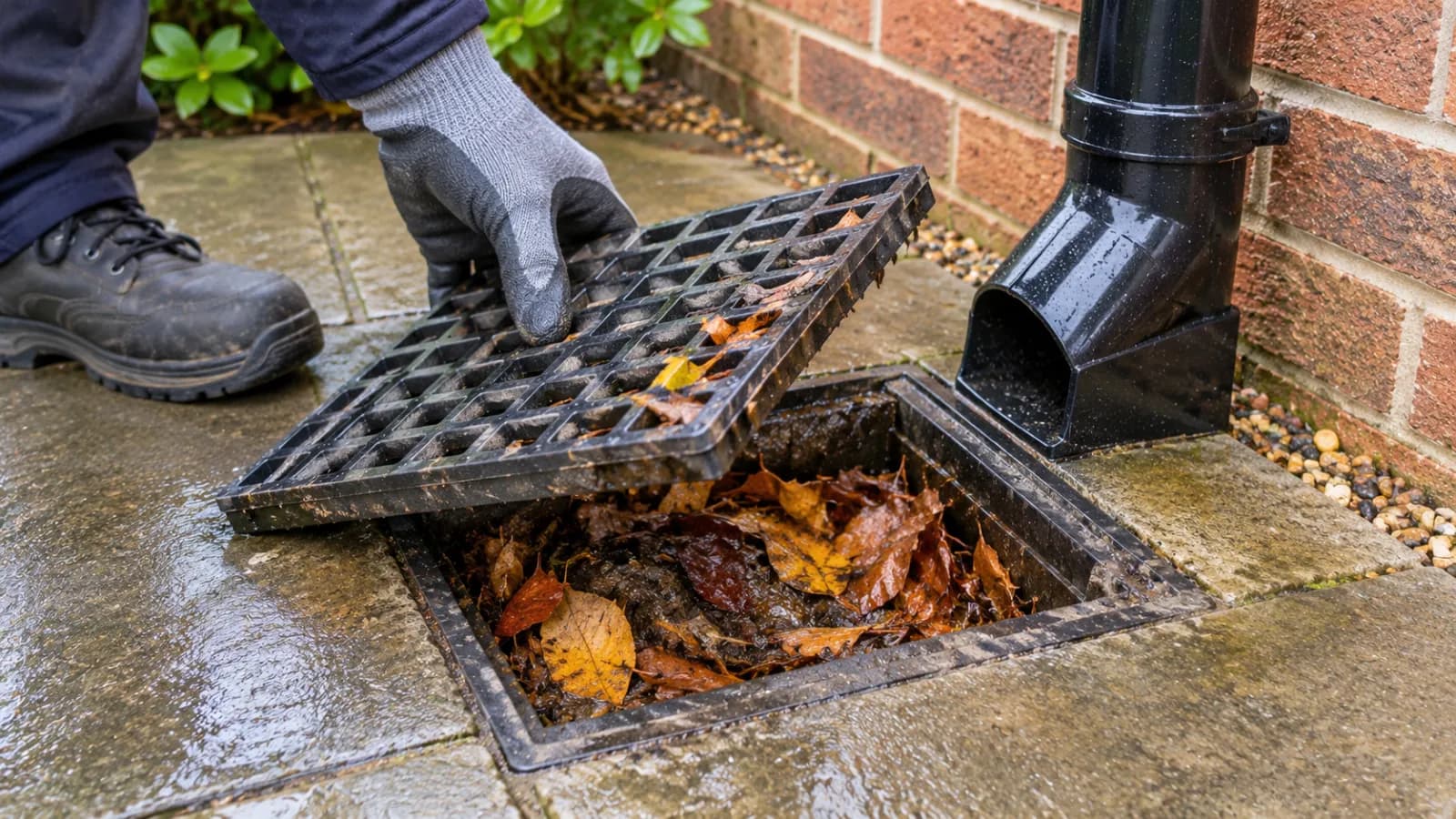
Start with the pot, because that is where most blockages are. You need waterproof gloves, a trowel or old ladle, a bucket and a hose.
- Put gloves on and cover any cuts. A gully can carry waste water, and rats use drains. The Health and Safety Executive lists gastroenteritis, hepatitis and Weil's disease, which is passed on in rat urine, among the illnesses linked to contact with sewage, and says hand-to-mouth contact is the most common way in.
- Clear the top of the grate, then lift it out. Some are hinged, some lift straight up and some are held by a screw.
- Bale out the water with the ladle so you can see what you are doing.
- Scoop out the pot down to the bottom. Bag the sludge and put it in the household waste. Do not wash it back down.
- Find the outlet. On a bottle gully, lift out the inner sleeve or rodding plug. On a P-trap, feel round the bend with your gloved fingers and pull out what you can reach.
- Flush with a hose or a bucket of water. The level should drop to the trap and stay there. A slow swirl back down is a good sign; no movement is not.
- Refit the grate and wash your hands and tools thoroughly.
Do not force drain rods round a P-trap. The bend is tight, and on an old clay gully you can crack the pot. If rods will not pass easily, the pipe is better cleared from the next inspection chamber or by jetting.
How do you know if the blockage is beyond the trap?
If the pot is clean and the water still will not go, the drain beyond it is blocked. This table narrows it down.
| What you see | Likely cause | What to do |
|---|---|---|
| Water pooling on the grate, pot underneath not full | Leaves matted on the grid | Clear the grate |
| Pot full of sludge, water drains once emptied | Silted trap | Scoop out; check again after the next heavy rain |
| Clean pot, water sits at the grate and does not move | Blockage in the pipe beyond the trap | Rod or jet from the next chamber |
| Clean pot, drains slowly, backs up only in heavy rain | Partly blocked pipe, or a silted soakaway | Jetting, or a soakaway check |
| Several gullies back up together | Shared drain further down | Check the inspection chambers; may be the water company's |
| Grey water or sewage rising in the gully when a bath or toilet is emptied | Foul drain blocked downstream | Stop using water and call for help |
| Gully smells but is not blocked | Dry trap, or decaying sludge in the pot | Top up with water; clean the pot |
A downpipe gully with no inspection chamber anywhere near it may run to a soakaway. If it backs up only in prolonged rain, read our guide to a blocked soakaway.
Who is responsible for a blocked gully?
It depends on where the gully is. Citizens Advice says "You are responsible for maintaining or repairing any drains inside the boundaries of your property", and that covers the gullies on them. In a rented home the landlord normally arranges repairs.
Road gullies are different. They drain the highway, and under section 41 of the Highways Act 1980 the highway authority has a duty to maintain a highway that is maintainable at public expense. You can report a blocked public drain on gov.uk, which sends you to your council by postcode. Nottinghamshire County Council takes reports of blocked gullies online and says it will send an inspector within five working days. Never lift a grating in the road yourself.
For shared pipes, boundaries and the water company's part, see our guide to who is responsible for blocked drains.
What does a sunken or broken gully mean?
A gully that has dropped, tilted or cracked usually means water has been escaping into the ground around it. A grid sitting slightly low is normal. Approved Document H says gully gratings should be set about 5mm below the surrounding paving to allow for settlement. A gully that sits well below the paving, with slabs dipping towards it or a gap opening round the rim, is another matter.
Common signs of a failed gully:
- paving or tarmac sinking around the grate;
- a pot that never holds water, which means the trap is cracked and the seal has gone;
- a hopper that has come away from the pot beneath, so water runs down the outside;
- a broken or missing grid. Approved Document H notes that rats can displace gully covers and gratings, and recommends ones that can be fixed in place.
Once the pot or the first joint leaks, water washes out the soil that supports it, and the gully sinks further each winter. Clearing it will not help. Replacing a gully means digging it out, bedding a new one and reconnecting the drain, and that is a drain repair. Our guide to the signs of a blocked or collapsed drain explains how to tell the two apart.
When to call a professional
Call a drainage engineer if the pot is clean but the water will not drain, if the gully blocks again within weeks, if sewage is coming up through it, or if the gully has sunk, cracked or lost its seal. You should also call if you cannot lift the grate or the pot is too deep to reach safely.
Our blocked drain service covers outside gullies and starts from £120 + VAT, with no call-out fee and a fixed price before we start. Silt and fat that rods will not move are cleared by drain jetting. If a gully needs replacing, our drain repairs start from £250 + VAT, and a CCTV drain survey from £149 + VAT shows whether the pipe beyond it is damaged too. For yards and car parks with several gullies that need emptying on a schedule, ask us for a quote.
We cover Nottingham, Mansfield, Derby and the rest of Nottinghamshire, Derbyshire, Leicestershire and Lincolnshire, 7 days a week from 6am to 8pm, with emergency call-outs 365 days a year. Call 07300 600 950 or book online.
Sources
- Approved Document H: Drainage and waste disposal, 2015 edition (gov.uk)
- HSE: Working with sewage, the health hazards (INDG198)
- Highways Act 1980, section 41 (legislation.gov.uk)
- Report a blocked drain (gov.uk)
- Nottinghamshire County Council: Report a flooding or drainage problem
- Citizens Advice: who is responsible for repairing drains and sewers
- JDP: What are gullies and where do you need them?
- Drainfast: What is a trapped gully? (updated 21 July 2026)
Frequently Asked Questions
Cite this guide: “Blocked Gully Drain: How to Clear a Rainwater Gully”, Urgent Drainage Solutions, 13 November 2026. https://urgentdrainagesolutions.co.uk/blog/blocked-gully-drain