
Why Does My Shower Drain Smell? Causes and Fixes
Written by the Urgent Drainage Solutions teamPublished 10 min read
Checked by Eren Birinci (Gino), Founder & Lead Drainage Engineer on
Quick answer
A shower drain usually smells because slime made of soap, hair and bacteria is coating the trap, or because the trap has lost its water seal and is letting drain air into the room. Clean the trap, then run the shower to refill it. If the smell returns within hours, suspect siphoning, a faulty valve or a leak.
- A musty or sour smell usually means slime in the trap; a sewage smell usually means the trap's water seal has gone.
- A shower can smell without being blocked, because biofilm and a lost seal do not slow the water down.
- Approved Document H gives a shower trap a 50mm water seal and says traps should keep at least 25mm in use.
- Never mix bleach with limescale remover, vinegar or other cleaners: UKHSA says bleach mixed with acidic products produces chlorine gas.
- Gurgling, smells in more than one room or a smell that returns within hours point to the pipework or drain, not the shower.
A shower drain usually smells for one of two reasons: slime made of soap, hair and bacteria is coating the trap and waste pipe, or the trap has lost its water seal and is letting air from the drain into the room. Both can happen in a shower that drains perfectly well. Clean the trap, run the shower to refill it and see whether the smell comes back. If it returns within hours, or you hear gurgling, the cause is further along the pipework, and our blocked drain engineers can trace it.
This guide is for diagnosing a smell from one shower or one bathroom. If the whole house smells, start with why do my drains smell. If the shower is holding water, see how to unblock a shower drain.
What causes a smelly shower drain?
Match the smell and when you notice it to the likely cause. This table covers the faults that account for most smelly showers, from the simplest to the least common.
| What you notice | Likely cause | Fix |
|---|---|---|
| Musty, sour or "wet dog" smell at the waste; shower drains normally | Slime (biofilm) on the trap and waste pipe | Lift out and scrub the trap insert; wipe the waste body |
| Sewage smell in a shower that has not been used for a while | Trap has dried out | Run the shower for a minute to refill it |
| Sewage smell after the bath, basin or toilet has been used, often with a gurgle | Trap siphoned by another fitting | Refill the trap; have the venting or a partial blockage checked |
| Smell started straight after the drain was cleaned | Trap insert or seal refitted wrongly, or left out | Refit the insert and rubber seal; replace missing parts |
| Smell and slow draining together | Hair and soap mat rotting in the trap | Pull the hair out and clean the trap |
| Constant sewage smell from new or altered pipework | No trap fitted, or a failed waterless valve | Have a trap fitted or the valve replaced |
| Smell strongest near a boxed-in pipe, cupboard or loft | Air admittance valve stuck open | Replace the valve |
| Musty, damp smell around the tray; stained ceiling below; loose or blackened sealant | Leak under the tray | Find and fix the leak; dry the floor out |
| Smell in several rooms, gurgling toilets, slow fittings | Blocked or badly vented stack or drain | Drain clearance and a check of the stack |
Why does my shower drain smell when it is not clogged?
Because the two commonest causes have nothing to do with how fast the water drains. Slime on the walls of the trap smells without narrowing the pipe much, and a trap with no water in it lets drain air through while the water still runs away freely. A blockage is only one of several reasons a shower smells.
Slime in the trap
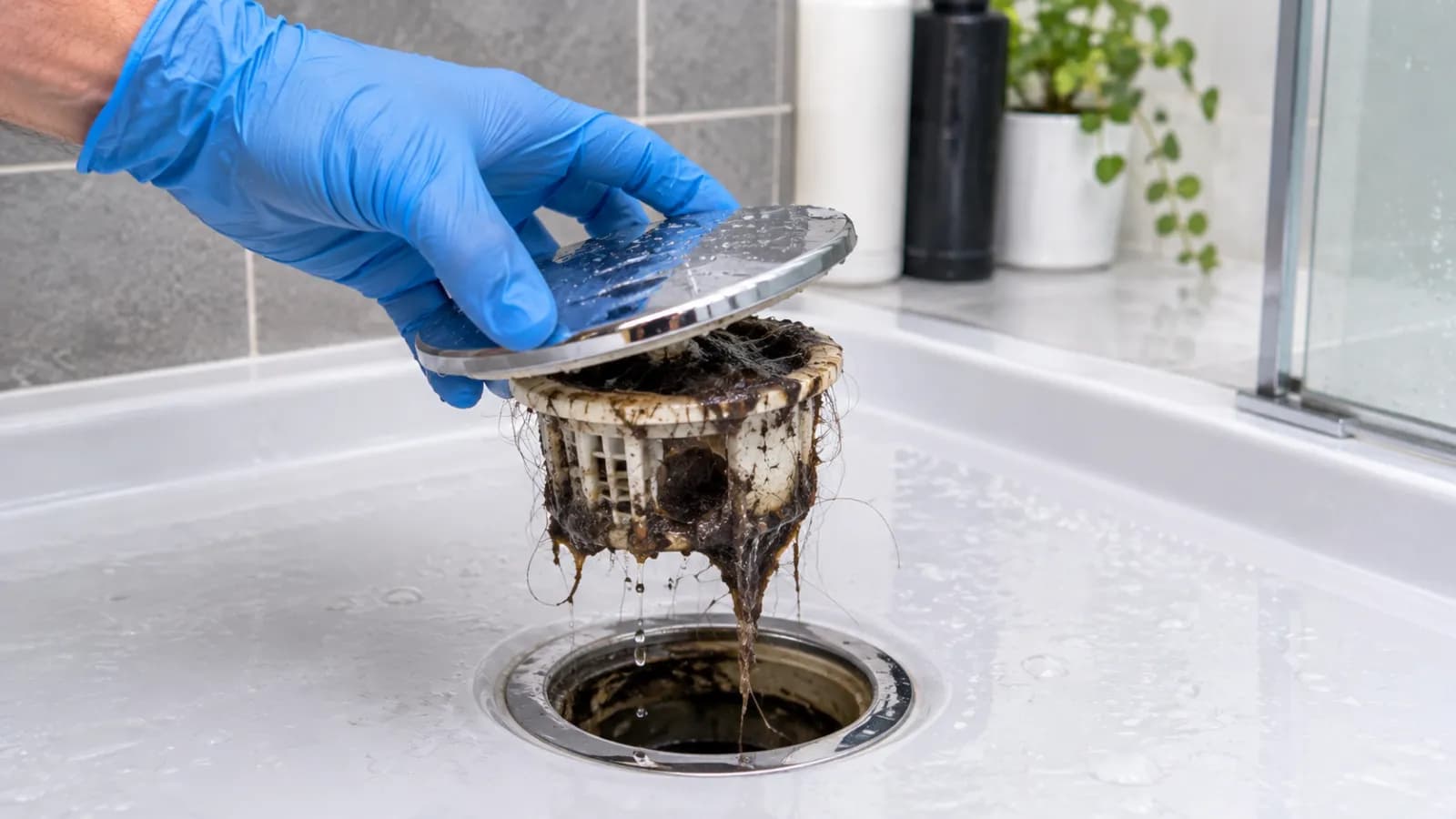
The dark, slippery coating inside a shower waste is a biofilm. The Drinking Water Inspectorate explains that "Biofilms contain a mixture of microscopic organisms" growing on a surface, that people typically notice pink, orange or black staining in showers, drains and plugholes, and that "Soaps, aerosols or other sprays can provide an additional food source". A shower trap is warm, wet and fed with soap every day, so it suits them well.
The Inspectorate says these growths generally do not indicate a risk to health. They do smell, though, particularly when hair is caught in them. Which? quotes a drainage expert who says smells occur because "trapped debris begins to decompose or stagnant water allows bacteria to grow".
A dry trap
Every shower has a trap that holds a plug of water between the room and the drain. Approved Document H says all points of discharge should be fitted with a trap "to prevent foul air from the system entering the building", gives a shower a 40mm trap with a 50mm water seal, and says traps should retain at least 25mm of seal in use.
That is not much water, and shower traps are shallow so they fit under the tray. Wavin, which makes traps, says the seal "can be broken or lost because of siphonage, evaporation, movement, leaking or low usage". In a guest bathroom or en suite that goes unused, the water evaporates and the smell arrives. Run the shower for a minute and it should go.
A siphoned trap
If the smell follows a gurgle, the trap is being emptied by suction. When a bath, basin or toilet on the same pipework discharges, the moving water can pull air through the nearest trap and take some of its seal with it. Approved Document H says branch pipes have to be designed "to prevent the water seal from being broken by the pressures which can develop in the system", and that stacks should be ventilated for the same reason.
Siphoning that has only recently started usually means a partial blockage further down, or a vent that has stopped working. Refilling the trap brings relief for a few hours, but the smell will return until the cause is fixed.
Could the trap be missing or fitted wrongly?
Yes, and it is worth checking if the smell began after the drain was cleaned or the bathroom was refitted. Most modern shower wastes form their seal with a removable cup or dip tube. If that insert is left out, put back upside down or seated without its rubber seal, there is no water barrier at all, even though the shower drains perfectly.
Lift the cover and look. You should see water standing in the waste a little below the grate. If you can see straight down a dry pipe, the insert is missing or broken.
Some showers have no water trap by design. Wavin describes its waterless valve as using "a self-sealing membrane which performs the same function as a water trap". These valves cannot dry out, but the membrane can be held open by hair or grit, and a valve that no longer closes needs cleaning or replacing. Occasionally a shower added in a conversion has no trap of any kind, which gives a constant smell from the first day.
Could it be an air admittance valve?
It could, if the smell is strongest near a boxed-in pipe, in a cupboard or in the loft, not at the shower waste itself. An air admittance valve sits on top of a soil pipe that ends inside the house. JDP describes them as "one-way air valves" with a diaphragm that stays closed under normal pressure and opens when water flowing down the pipe creates suction. They let air in so traps are not siphoned, and should let nothing out.
When the diaphragm sticks open, drain air escapes into the boxing and drifts into the bathroom. When it sticks shut, the pipework cannot draw air, and traps get siphoned instead. Approved Document H says these valves "should be accessible for maintenance" and should be removable, so replacing one is normally a short job once it has been found.
Is there a leak under the shower tray?
Suspect a leak if the smell is musty and damp, not drain-like, and seems to come from around the tray, not out of the waste. Water getting past failed sealant, cracked grout or a loose waste fitting soaks the floor under the tray, and wet timber and plasterboard smell long before any damage shows.
Other signs are a brown stain on the ceiling below, sealant that has gone black or come away, a tray that moves when you step on it, and a smell that is worse after showers and fades when the room has been dry for a few days. Cleaning the drain will not help. The leak has to be found and stopped, and the floor allowed to dry out.
When is it the stack or the drain?
When the shower is not the only thing affected. Showers, baths and basins discharge into a shared branch pipe or the soil stack, and a partial blockage there affects every fitting upstream. Signs include:
- the smell is present in more than one room;
- the toilet gurgles when the shower or bath empties;
- water rises in the shower tray when the toilet is flushed;
- several fittings have become slow together;
- an outside gully or inspection chamber is full.
A ground-floor shower is often the lowest fitting in the house, so it is the first place a backing-up drain shows itself. If dirty water appears in the tray, stop using water and check outside. Our guide to the signs of a blocked or collapsed drain explains what to look for.
How do you clean a smelly shower drain safely?
Lift the trap out and clean it by hand. That removes the slime, which pouring products down the waste does not.
- Open the window or turn on the extractor fan, and put on rubber gloves.
- Lift off the waste cover. If it is held by a screw, cover the plughole with a cloth first so the screw cannot drop in.
- Pull out the hair catcher and the trap insert. Note which way up they sit, or take a photo.
- Pull off the hair and bin it.
- Scrub the insert, the cover and the inside of the waste body with an old toothbrush and warm soapy water. The slime wipes off easily.
- Pour a jug of hot tap water down the waste to rinse the pipe beyond the trap.
- Refit the insert and its seal, then the cover.
- Run the shower for a minute to refill the trap.
If you want to use a product afterwards, use one, follow the label and rinse it away thoroughly before using anything else. The warning that matters most in a shower is about mixing. The UK Health Security Agency says: "If sodium hypochlorite is mixed with acidic products, chlorine gas is produced", and that mixing it with ammonia-containing cleaners may produce chloramines, which also irritate the airways. Sodium hypochlorite is the active ingredient in household bleach. Limescale removers, which people use on shower screens and heads, are acidic, and so is vinegar. Which? gives the same warning about bleach reacting with limescale removers and vinegar. Our guide on whether bleach unblocks drains has more.
Bicarbonate of soda and vinegar are a popular alternative. A drainage expert quoted by Which? says home remedies "may tackle some of the smell of a blocked drain", so they do no harm as a freshener, as long as they are never combined with bleach. They are no substitute for scrubbing the trap.
Is a smell from a shower drain harmful?
In most homes it is unpleasant, not dangerous. The rotten egg smell people associate with drains is the characteristic odour of hydrogen sulphide, and the UK Health Security Agency says it is very unlikely that the general population will be exposed to a level high enough to cause adverse health effects. Treat a persistent smell as a sign that something needs fixing. A trap that keeps losing its seal or a floor that stays wet will not improve by being left.
How do you stop a shower drain smelling again?
- Pull the hair off the catcher every week or two.
- Take the trap insert out and scrub it every couple of months.
- Rinse the tray with clean water after each shower so soapy water does not sit in the trap.
- Run a little-used shower for a minute every week or two to keep the seal topped up.
- Use the extractor fan or open a window. The Drinking Water Inspectorate advises keeping damp areas as dry as possible and well ventilated.
- Renew cracked or blackened sealant round the tray before water gets under it.
When to call a professional
Get help if the smell is back within hours of cleaning and refilling the trap, if the shower or toilet gurgles, if more than one fitting is slow or smelly, if dirty water comes up in the tray, or if you suspect a leak under it. Those point to the pipework or the drain, and they tend to get worse.
If the cause is a blockage in the drain, our blocked drain service starts from £120 + VAT, with no call-out fee and a fixed price agreed before we start. Traps, shower wastes, leaking waste pipes and soil stacks inside the house come under our drainage plumbing service, which we quote individually. We cover Nottingham and the East Midlands, 7 days a week from 6am to 8pm, with emergency call-outs 365 days a year. Call 07300 600 950 or book online.
Sources
- Approved Document H: Drainage and waste disposal (gov.uk)
- Drinking Water Inspectorate: Biofilms, mould, slimes and staining
- UK Health Security Agency: Sodium hypochlorite, general information (updated 24 April 2025)
- UK Health Security Agency: Hydrogen sulphide, general information (updated 15 September 2025)
- Which?: how to unblock a sink and bathroom drains
- Wavin: Waste traps explained
- JDP: Soil vent pipes vs air admittance valves
Frequently Asked Questions
Cite this guide: “Why Does My Shower Drain Smell? Causes and Fixes”, Urgent Drainage Solutions, 13 November 2026. https://urgentdrainagesolutions.co.uk/blog/shower-drain-smells