
Does Bleach Unblock Drains?
Written by the Urgent Drainage Solutions teamPublished 6 min read
Quick answer
No. Bleach disinfects and takes away smells, but it does not dissolve fat, hair, wipes or the other things that block drains. Caustic soda can break down fresh grease, but it is corrosive and gets hot in water. A plunger, cleaning the trap or mechanical rodding clears more blockages, more safely, than any chemical.
- Bleach kills germs and masks smells; it won't break down fat, hair, wipes or sanitary items.
- Bleach mixed with acid cleaners such as vinegar or limescale remover gives off chlorine gas; mixed with ammonia it gives off chloramines.
- Caustic soda can clear fresh grease but can burn skin and eyes and generates heat when mixed with water.
- A plunger, cleaning the U-bend or a drain snake will clear most household blockages without chemicals.
No, bleach doesn't unblock drains. It kills germs and takes away smells, but it does not dissolve the fat, hair, wipes and paper that cause most blockages. Caustic soda is a different product: it can break down fresh grease in a kitchen waste, but it's corrosive, gets hot in water and won't touch wipes or a damaged pipe. For most blockages a plunger, cleaning the trap or a drain snake does the job better, and if that fails our blocked drain engineers clear it mechanically, without chemicals.
Here's what each product actually does, why we'd rather you didn't pour chemicals into an old drain, and what to try instead.
Does bleach unblock drains?
No. Household bleach is sodium hypochlorite in water. The UK Health Security Agency's sodium hypochlorite guidance says household bleach usually contains about 5% sodium hypochlorite, and that it's used for bleaching, disinfecting and removing stains. Which? says it's effective at killing germs and can help eliminate odours.
That's why a smelly drain seems better after a cup of bleach. The smell goes, but the grease, hair or wipes are still there. The water runs as slowly as before, and the smell comes back once the bleach has washed through.
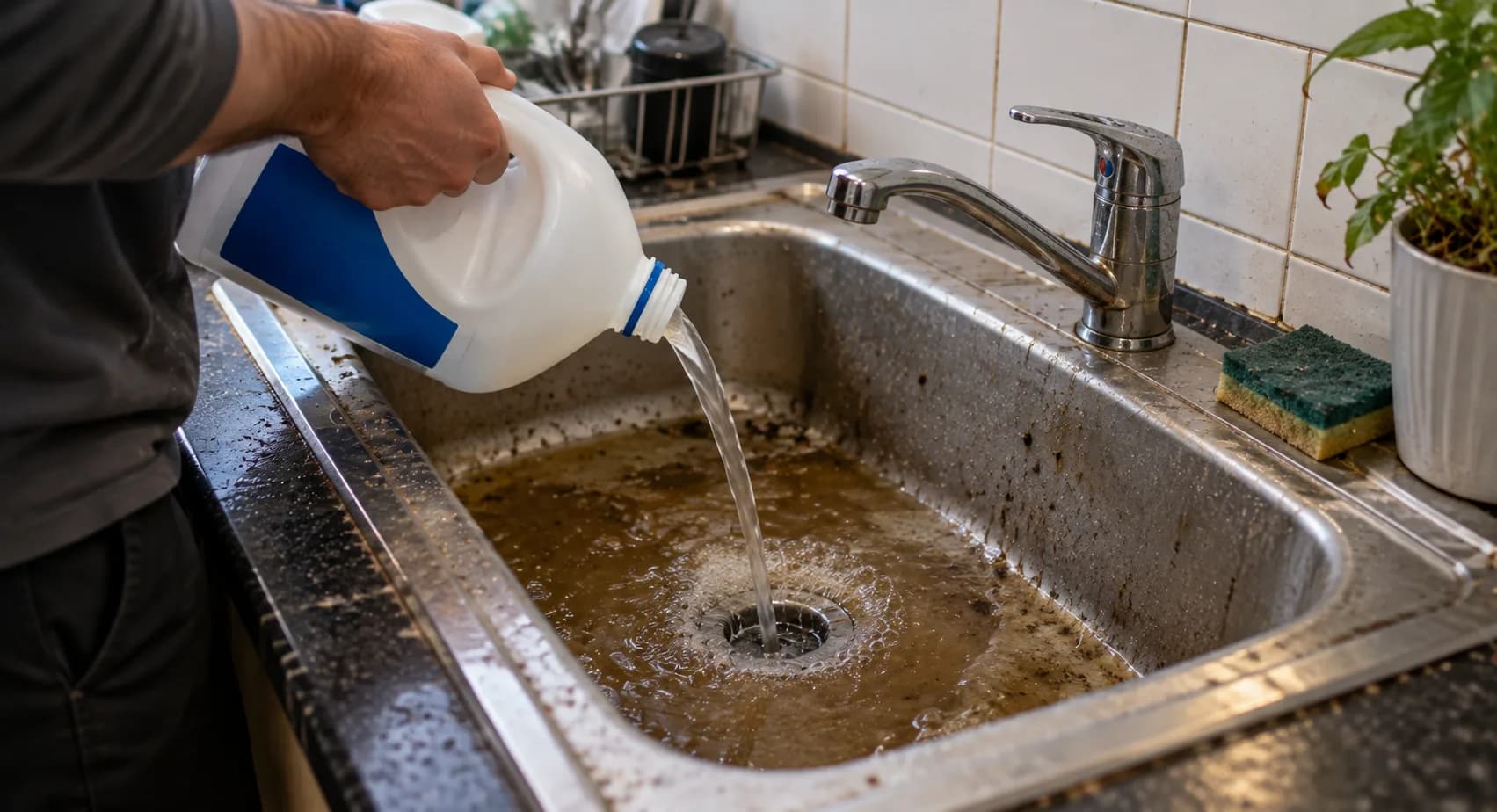
There's nothing in bleach that breaks down fat or fibres. On a full blockage it simply sits on top of the standing water, which makes the job more unpleasant for whoever has to clear it.
Why is mixing bleach with other products dangerous?
Because it gives off toxic gas. UKHSA says that if sodium hypochlorite is mixed with acidic products, chlorine gas is produced, and minor exposures can cause burning eyes and throat, coughing and a sore throat, while larger exposures can cause breathing difficulties. Mixed with an ammonia-based cleaner, it can produce chloramines, which are also highly irritating to the airways.
Which? warns specifically about acid-based limescale removers and vinegar, and notes that bleach can react with the ammonia in urine, so you should flush the toilet before and after cleaning with it.
The practical rule: one product at a time, never one poured on top of another, and never a product into a blocked fitting that already has something else in it.
What does caustic soda do in a drain?
Caustic soda is sodium hydroxide, a strong alkali. UKHSA's sodium hydroxide guidance lists drain cleaners among the household products that contain it. It reacts with fats and oils and turns them into a soapy residue that can be washed through, which is why it can help a kitchen sink slowed by fresh grease.
It has real limits and real risks:
- It only works on certain blockages. It does nothing useful to wipes, sanitary items, cotton buds, roots, silt or a broken pipe.
- It burns. UKHSA says skin contact with stronger solutions can cause pain, burns and ulcers, and eye contact can cause burns.
- It gets hot. Rustins' product data sheet for its caustic soda crystals warns that heat is generated when they are dissolved in water.
- It can splash back. In a blocked sink or toilet, the product sits in standing water. Plunge it and you can get it in your face.
If it gets on your skin or in your eyes, the NHS lists drain cleaners and bleach among the causes of chemical burns and says to call 999, remove contaminated clothing and put the area under cool or lukewarm running water for about an hour.
Can drain chemicals damage old pipes?
They can make a weak pipe worse, and they can't fix one. Older houses often have clay drains with worn joints, and some built from the 1950s to the 1970s have pitch fibre, which softens with heat. Our guide to pitch fibre pipes explains why hot water and grease make it blister. A caustic product that heats up as it dissolves is not something we'd pour into a drain like that.
The bigger problem is that a chemical can't fix the reason the drain is blocking. If a joint has dropped or roots are growing in, the chemical might open a channel for a while and the blockage returns. Meanwhile you've lost time, and the drain may now be full of corrosive water.
Which method works on which blockage?
Here's how bleach and caustic soda compare with the alternatives we'd suggest first.
| Method | Works on | Doesn't work on | Main risk | Our view |
|---|---|---|---|---|
| Bleach | Smells and germs | Fat, hair, wipes, paper, objects | Toxic gas if mixed with acids or ammonia | Cleaning only, not unblocking |
| Caustic soda | Fresh grease in a kitchen waste | Wipes, sanitary items, roots, broken pipes | Burns, heat, splash-back | Last resort on a slow sink, never in standing water |
| Hot (not boiling) water and washing-up liquid | Fresh grease, soap, paper | Hair clumps, wipes, objects | Boiling water can soften plastic pipes and crack a toilet pan | Good first try |
| Bicarbonate of soda and vinegar | Mild smells | Real blockages | Low, but never follow with bleach | Not an unblocker |
| Enzyme sticks or treatments | Keeping fat and soap build-up down | An existing blockage | Low | Useful for prevention |
| Plunger | Sinks, basins, toilets | Blockages beyond the trap | Low | Best first tool |
| Cleaning the U-bend | Kitchen and basin blockages | The drain outside | Low, keep a bucket under it | Fixes most sinks |
| Drain snake or toilet auger | Hair, wipes near the fitting | Underground drains | Scratching a toilet pan with bare wire | Cheap and effective |
| Rodding or jetting | Blockages in the drain | Structural faults | Needs the right kit | What we use |
An expert quoted by Which? says home remedies like bicarbonate of soda and vinegar may tackle the smell of a blocked drain but are "not strong enough to help with a drain that is really clogged". Which? also says enzyme sticks, dropped into the plughole once a month, are designed to digest fat, grease and soapy residue, which makes them a maintenance product rather than a cure.
What should you do instead of using chemicals?
Work up from the simplest fix:
- Stop pouring. Don't add more water or product to a fitting that isn't draining.
- Plunge it. Cover the overflow on a sink or basin, and use a flange plunger on a toilet. See how to unblock a sink and how to unblock a toilet.
- Clean the trap. Most kitchen and basin blockages are in the U-bend.
- Pull out hair. A plastic drain snake clears showers and baths in minutes.
- Check outside. If several fittings are slow, the blockage is in the drain and no product poured down a sink will reach it.
To stop grease coming back, scrape pans into the bin and wipe them before washing. Our guide to fat, oil and grease in kitchen sinks has the full routine.
When to call a professional
Call a drainage engineer if the plunger and trap haven't worked, if more than one fitting is slow, if the same drain keeps blocking, or if an outside chamber is full. Tell us if you've already used a chemical, what it was and when, so we can take care with standing water. If the drain keeps blocking after it has been cleared, a CCTV drain survey from £149 + VAT shows why.
Our blocked drain service starts from £120 + VAT, with no call-out fee and a price agreed before we start. We cover Nottingham, Derby, Nottinghamshire, Leicestershire and Lincolnshire, 7 days a week from 6am to 8pm, with emergency call-outs 365 days a year. Call 07300 600 950 or book online.
Sources
Frequently Asked Questions
Cite this guide: “Does Bleach Unblock Drains?”, Urgent Drainage Solutions, 6 October 2026. https://urgentdrainagesolutions.co.uk/blog/does-bleach-unblock-drains

Need A Drainage Engineer?Book Online Today