
Pitch Fibre Pipes: What They Are, Why They Fail and How to Fix Them
Written by the Urgent Drainage Solutions teamPublished Updated 6 min read
Quick answer
Pitch fibre pipes are drain pipes made of wood fibre impregnated with coal tar pitch, laid widely in UK homes from the 1950s to the 1970s. Many now blister, delaminate and deform into an oval, causing blockages and eventually collapse. A CCTV survey confirms them; deformed runs are usually re-rounded and relined, collapsed sections replaced.
- Pitch fibre is wood cellulose impregnated with coal tar, used for drains mainly from the 1950s to the 1970s.
- Metrorod says pitch fibre drains were designed to last about 40 to 50 years, so most are at or past the end of that life.
- Typical failures are blistering, delamination and deformation into an oval, visible on a CCTV survey.
- Deformed pipes can often be re-rounded and relined; collapsed or very weak sections need excavation.
- Many insurance policies don't cover pitch fibre, and Anglian Water's standard build-over criteria exclude it.
Pitch fibre pipes are drain pipes made from wood fibre impregnated with coal tar pitch, laid widely in UK homes from the 1950s to the 1970s. Many are now failing: the walls blister, delaminate and flatten into an oval under ground pressure, causing repeat blockages and eventually collapse. A CCTV survey confirms the material and condition, and damaged runs are usually re-rounded and relined through our drain relining service, or dug out and replaced where they have collapsed.
This guide explains what pitch fibre is, why it fails, how to spot it, the repair options, and what it means if you are buying a house built in that period.
What are pitch fibre pipes?
Pitch fibre was a cheap, lightweight alternative to clay for underground drains. Trade magazine PFM describes it as "wood cellulose impregnated with inert coal tar" and says that "from the 1950s to 1970s, a lot of drainage pipes were made from a product called pitch fibre". The British Standards Institution's specification BS 2760:1956, for pitch-impregnated fibre drain and sewer pipes, was published on 29 June 1956 and has since been withdrawn.
The pipes were typically used for the private drains around a house and the connection to the sewer, and they are common on estates built in the post-war decades.
How long do pitch fibre pipes last?
Drainage firm Metrorod says pitch fibre drains "were originally designed with a lifespan of approximately 40 to 50 years" and that "many systems have now exceeded their expected service life". A pipe laid in 1970 reached 50 years in 2020, so most surviving pitch fibre is at or past the end of its design life. PFM adds that pitch fibre pipes "can rot and disintegrate much more quickly than clay, cast iron or plastic pipes".
Why do pitch fibre pipes fail?
They fail in ways that clay and plastic pipes don't:
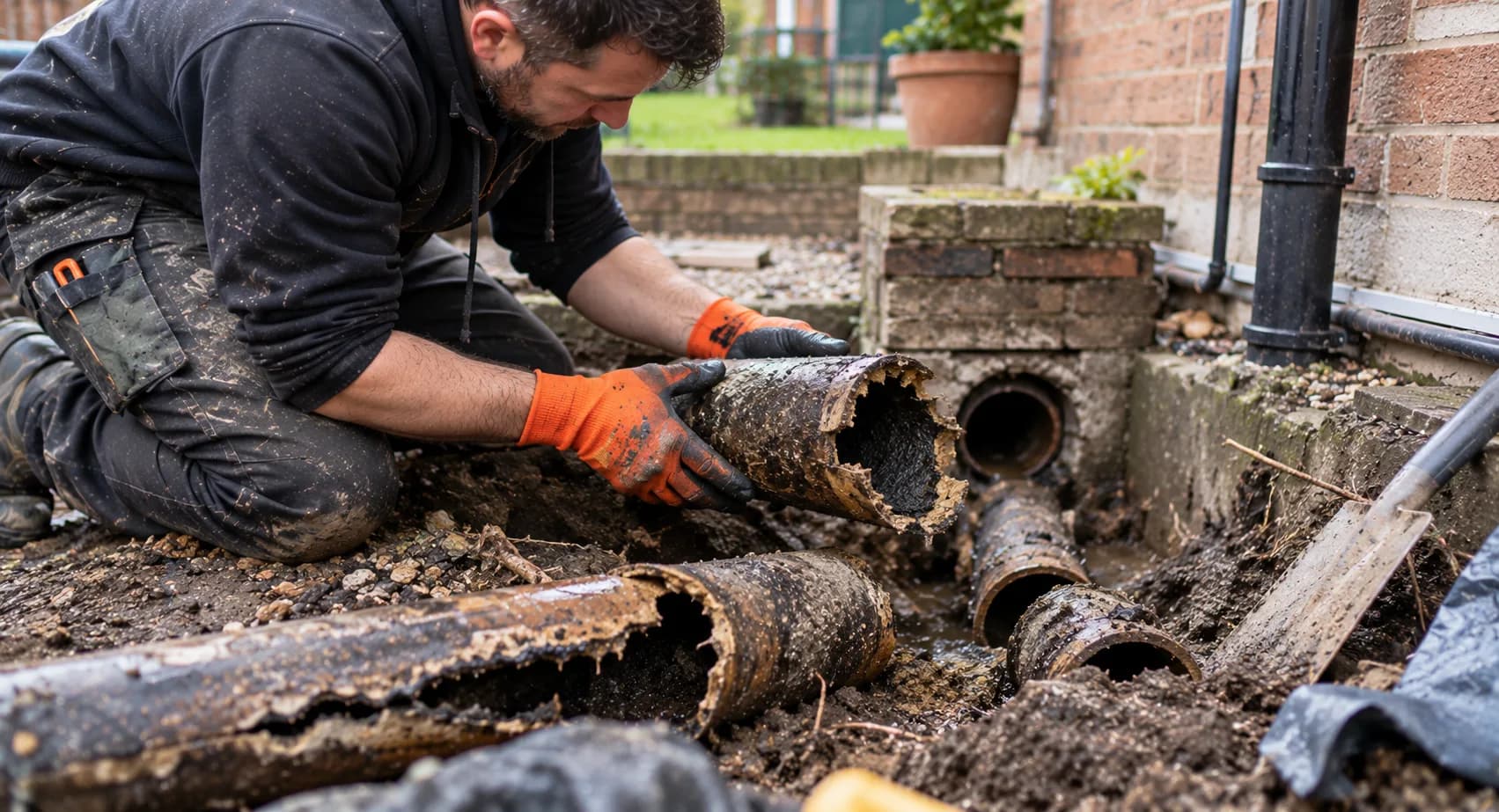
- Blistering and delamination. Metrorod says "hot water, fats, oils and grease can soften the bitumen within the pipe walls". The inner layer separates and lifts into bubbles that catch paper and debris.
- Deformation. The pipe is relatively soft, and Metrorod notes that "ground pressure can cause the pipe to deform", flattening it into an oval or making it bow.
- Collapse. Once a section has deformed far enough, it can split or collapse completely.
- Root intrusion. Weakened walls and joints let roots in. See tree roots in drains.
Kitchen and bathroom runs, which carry the most hot water and grease, are often the first to show damage.
What are the signs of failing pitch fibre drains?
The signs are the same as for any damaged drain, in a house of the right age:
- a drain that blocks again and again, especially from the kitchen or bathroom;
- slow drainage and gurgling from several fittings at once;
- a smell outside that doesn't go away (see why do my drains smell);
- damp or sinking ground over the line of the drain;
- a house built between the 1950s and 1970s that still has its original drains.
None of these proves the pipe is pitch fibre. Our guide to the signs of a collapsed drain explains how to tell damage from a simple blockage.
How is pitch fibre confirmed?
With a CCTV drain survey. Metrorod says engineers can identify "coal-black pipe interiors", "bubble formations caused by delamination", "deformed or flattened pipe sections", "bowing and distortion" and "evidence of historical repairs". A report coded to WRc's MSCC5 standard records the material, each defect's distance along the pipe and how much the pipe has deformed. That measurement decides whether it can be re-rounded. Our guide to reading a CCTV drain survey report explains the D (deformed) code and grades.
How are pitch fibre pipes repaired?
The repair depends on how far the pipe has deformed. This table sets out the usual options by condition:
| Condition on the survey | Usual repair | Notes |
|---|---|---|
| Blistered but still round | Clean, then reline | Blisters are removed so the liner sits against the wall |
| Deformed (oval) but intact | Re-round, then reline | The pipe is pushed back into shape before lining |
| Short damaged section in a sound run | Patch repair | Suits one localised defect |
| Collapsed, split or too weak to re-round | Excavate and replace | The failed length is dug out and replaced in plastic |
| Mixed: one collapse in a deformed run | Excavate the collapse, reline the rest | Keeps digging to a minimum |
Metrorod says deformed pitch fibre drains "can also be re-rounded before lining takes place, helping restore flow capacity". Trenchless Technology reports a case where a pitch fibre pipe collapsed when re-rounding was attempted. That is why the survey must come first and why the engineer needs to know it is pitch fibre before rodding or jetting. Our guide to drain relining vs excavation compares the methods and their costs.
Is there asbestos in pitch fibre pipes?
Possibly, in some. Metrorod says "some versions also contained glass fibre reinforcement and, in certain cases, asbestos to improve strength". If a section is going to be dug out and removed, that needs considering before work starts. Relining leaves the old pipe in place.
Does insurance cover pitch fibre pipes?
Often not. The Financial Ombudsman Service says "many policies don't cover damage to pitch fibre pipes" and lists gradual damage and wear and tear among the usual reasons claims are declined. Pitch fibre deterioration is typically gradual. Check your policy and speak to your insurer before any work starts, and read does home insurance cover drain damage.
What does pitch fibre mean if you're buying a house?
It means you should find out the condition of the drains before you exchange contracts. A standard RICS survey only looks into the inspection chambers, so a homebuyer drain survey is the way to see what the pipes are made of and whether they are deforming. Use this checklist on any home built between the 1950s and 1970s:
| Question | Why it matters |
|---|---|
| Are the drains original, and has anyone relined them? | A relined run is far less of a concern than original pipe |
| Has the drain blocked or been jetted repeatedly? | Repeat blockages are the classic early sign |
| Is there an extension over or near a drain? | Anglian Water's standard build-over criteria exclude pipes made of pitch fibre or asbestos cement, so building over one needs the water company's assessment |
| Which runs are shared with neighbours? | Shared pipes are usually the water company's responsibility, not yours |
| Will my insurer cover the drains? | Many policies exclude pitch fibre |
If the survey finds deformed pitch fibre, your solicitor can use the report and a repair quote to ask for a price reduction, a repair before completion or a retention. See our guide to drain surveys when buying a house.
Can you slow down pitch fibre damage?
You can't reverse it, but you can avoid speeding it up while you plan a repair:
- let cooking fat cool and set, then bin it rather than pouring it away;
- avoid pouring boiling water or hot fat down sinks that drain into the old pipe;
- tell any engineer the pipe is pitch fibre before they rod or jet it;
- get a drain that has started blocking regularly surveyed while relining is still possible.
Our guide to fat, oil and grease in the kitchen sink has more on keeping grease out of the drain.
When to call a professional
Call us if a drain in a 1950s to 1970s house keeps blocking, if a survey has flagged pitch fibre, or if you've been quoted to dig up a drive without seeing the footage. Our drain relining service repairs blistered and deformed pitch fibre from the inside wherever the pipe can be re-rounded; where it can't, our drain repairs team replaces the damaged section. CCTV surveys start from £149 + VAT and drain repairs from £250 + VAT, with a 12-month workmanship guarantee. We give you a fixed price before any work starts.
We cover Nottinghamshire, Derbyshire, Leicestershire and Lincolnshire. Call 07300 600 950 or ask for a quote.
Sources
- BSI: BS 2760:1956 pitch-impregnated fibre drain and sewer pipes
- PFM: drain repair highlights pitch fibre problems (20 January 2015)
- Metrorod: pitch fibre drain pipes
- Financial Ombudsman Service: home insurance and damage to underground pipes
- Anglian Water: standard criteria for building over or near a sewer
- Trenchless Technology: relining pitch fibre sewers
Frequently Asked Questions
Cite this guide: “Pitch Fibre Pipes: What They Are, Why They Fail and How to Fix Them”, Urgent Drainage Solutions, 6 October 2026. https://urgentdrainagesolutions.co.uk/blog/pitch-fibre-pipes

Need A Drainage Engineer?Book Online Today