
Soil Pipe Repair and Replacement: Faults, Options and Costs
Written by the Urgent Drainage Solutions teamPublished 10 min read
Checked by Eren Birinci (Gino), Founder & Lead Drainage Engineer on
Quick answer
A soil pipe can usually be repaired when the fault is one leaking joint, one cracked length or a blockage, and the rest of the stack is sound. Replace it when cast iron has corroded through, cracks keep appearing or the layout is being changed. If the pipe could be asbestos cement, do not cut or break it.
- A soil pipe carries waste from toilets and other fittings down to the underground drain; the vertical pipe is the soil stack and its open top is the vent.
- One leaking joint or one cracked length is normally a repair; widespread corrosion or repeated cracking points to replacement.
- Approved Document H says an open vent should finish at least 900 mm above any opening into the building within 3 m.
- Grey fibre-cement pipes on older houses may be asbestos cement, which HSE says releases fibres when disturbed or damaged.
- In flats, a stack serving several homes is usually the freeholder's to repair, but the lease decides.
A soil pipe can usually be repaired if the fault is a single leaking joint, one cracked length or a blockage. It needs replacing when cast iron has rusted through, when cracks keep appearing, or when bathrooms are being moved. The first job is to find out what the pipe is made of and where it is leaking. Our drainage plumbing service repairs soil and vent stacks, leaking soil pipe joints and toilet connections, with the price agreed before work starts.
This guide explains what the pipe does, the faults to look for, how to choose between repair and replacement, the venting rules and who pays in a block of flats.
What is a soil pipe, soil stack or soil vent pipe?
A soil pipe carries waste from toilets down to the underground drain. The names overlap:
- Soil pipe. Any pipe carrying toilet waste, including the short branch from the pan.
- Soil stack. The vertical pipe, usually about 100 mm across, that the branches join. Basins, baths and sinks usually discharge into it too. Approved Document H, the Building Regulations guidance for drainage in England, calls it a discharge stack.
- Soil vent pipe, or SVP. A stack whose top is open to the air above the roof line, so the system can breathe.
Approved Document H says all stacks should discharge to a drain, through a bend at the foot with as large a radius as possible and at least 200 mm at the centre line (paragraph 1.26). A stack serving a normal toilet, with an outlet over 80 mm, should be at least 100 mm in diameter (paragraph 1.28). The first inspection chamber on the drain is usually close to the foot of the stack. Our guide to inspection chambers and manholes explains how to find it.
What is your soil pipe made of?
Older houses usually have cast iron, some have asbestos cement, and newer houses and replacements have plastic. The material decides how the pipe can be repaired.
| Material | How to recognise it | What goes wrong | Repair notes |
|---|---|---|---|
| Cast iron | Black or painted, heavy, thick collars at each joint; a magnet sticks to it | Rust, often at the base; cracked collars; failed joints | Sections can be replaced in plastic with adaptor couplings |
| Asbestos cement | Dull grey, matt and cement-like; a magnet does not stick | Brittle with age; cracks if knocked | Do not cut, drill or break it. Have it identified first |
| Plastic (uPVC) | Grey, black, brown or white, light, with ring-seal or solvent-welded joints | Joints pulled apart, perished seals, sun-brittled or impact-cracked lengths | Easiest to repair section by section |
Approved Document H lists both cast iron and PVC-U among the accepted materials for sanitary pipework (Table 4). Pricing guide Trade2Base notes that old cast iron stacks can corrode through, often at the base.
What if the pipe might be asbestos cement?
Leave it alone until it has been identified. The Health and Safety Executive says asbestos "can be present today in any building built or refurbished before the year 2000", and that fibres are released "when materials that contain asbestos are disturbed or damaged". Its list of asbestos cement products includes downpipes and gutters, flues, and water and sewage pipes.
HSE treats most work on asbestos cement as lower-risk, non-licensed work, to be done by people "trained to recognise and work safely with asbestos". Its task sheet for removing asbestos cement gutters and drain pipes relies on the material staying intact: items are unbolted and lowered, not broken up. So a sound asbestos cement stack is best left in place and undisturbed. One that is cracked or leaking should be assessed by someone trained for the work, not sawn through with a grinder.
What are the signs of a soil pipe problem?
Most faults show up as staining, smell or slow fittings before they show up as a flood.
| What you notice | Likely cause | What to do |
|---|---|---|
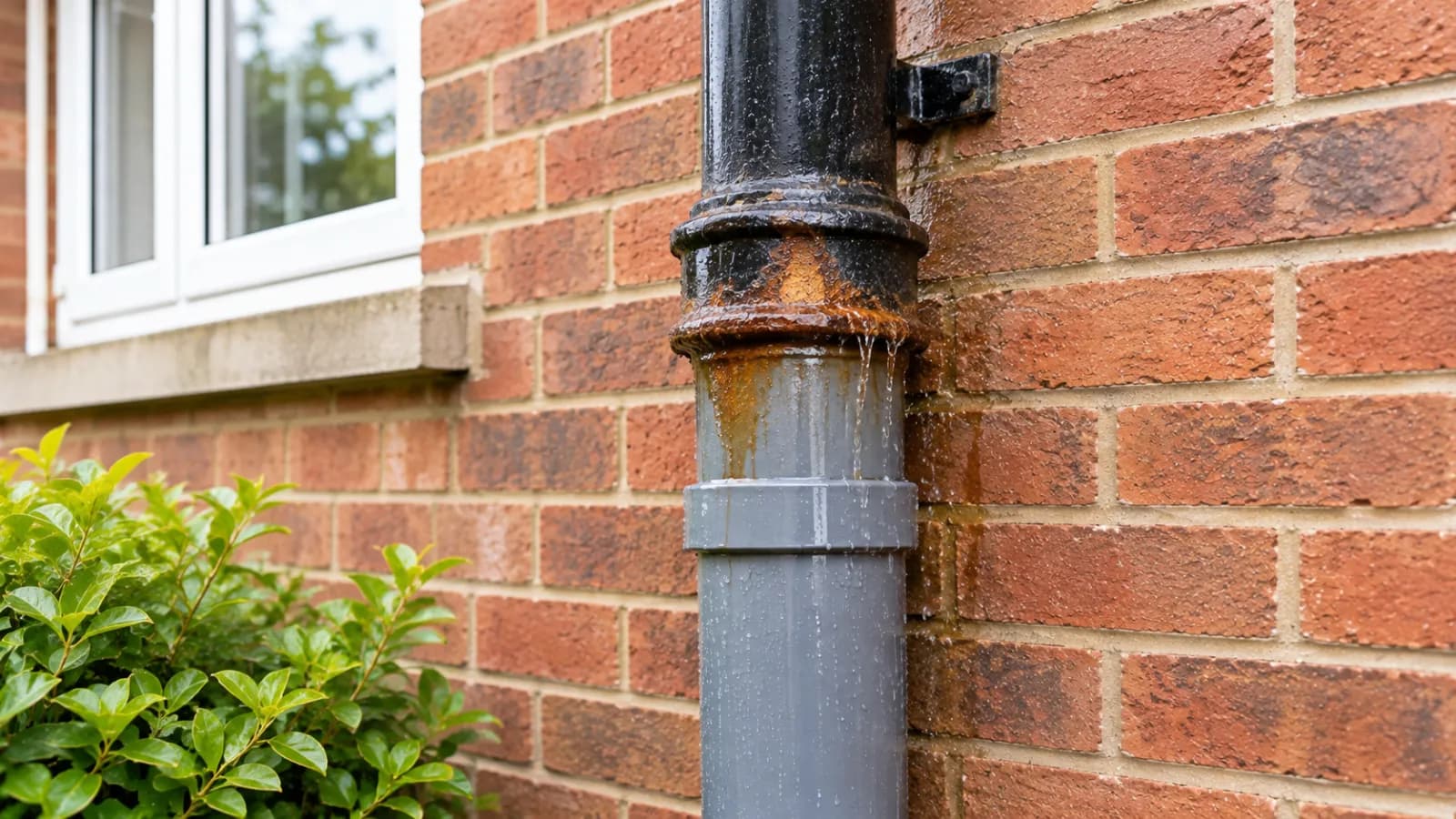
| Brown streaks or drips below a joint outside | Failed joint seal, or a cracked collar on cast iron | Repair or remake the joint |
| Rust blisters or weeping near the base of a cast iron stack | Corrosion through the pipe wall | Replace the affected section; check the rest |
| Damp, mould or stains on the boxing round a pipe indoors | Leak from a hidden joint or branch connection | Open the boxing and trace it |
| Sewage smell in a bathroom, loft or cupboard | Failed air admittance valve, dried-out trap or open joint | Check traps and valve; see our smells guide |
| Toilets gurgle, or basin and bath traps are sucked dry | Blocked or missing vent, or a partial blockage in the stack | Clear the stack and check the venting |
| Several fittings on different floors drain slowly | Blockage in the stack or at the bend at its foot | Clear from an access point or the chamber |
| Rats or scratching in boxing or walls | A break near the base of the stack | Survey and repair the defect |
For smells, our guide to why drains smell works through traps and valves first. For rats, see rats in drains.
Boxed-in stacks deserve a mention. Leaks behind boxing go unseen until the plasterboard stains, and there is often no way in. Approved Document H says all pipes "should be reasonably accessible for repair" and that rodding points should be provided where a length cannot be reached from elsewhere (paragraph 1.34). If a stack is being boxed in, leave a removable panel at each access point and at any air admittance valve.
Should you repair or replace a soil pipe?
Repair when the fault is local and the rest of the pipe is sound. Replace when the material itself has failed, or when you would be repairing the same stack again next year.
| Situation | Best option | Why |
|---|---|---|
| One leaking ring-seal joint in plastic | Repair: reseat or replace the seal or fitting | The pipe either side is fine |
| One cracked length of plastic | Repair: cut out and fit a new length with slip couplings | Quick, and uses standard parts |
| Blocked stack, pipe otherwise sound | Clear it: no repair needed | Check afterwards for the cause |
| Leaking joint in cast iron, pipe solid | Repair: remake the joint or replace that section | Worth it if the rest is not corroding |
| Cast iron rusted through, or cracked in more than one place | Replace the stack, usually in plastic | More repairs will follow if it is left |
| Asbestos cement, intact and not leaking | Leave alone | Disturbing it creates the risk |
| Asbestos cement, cracked or leaking | Have it identified and removed by someone trained | Not a cut-and-patch job |
| Bathroom being moved, or an extra one added | Replace or re-plan the affected part | Connections and venting have to suit the new layout |
| Listed building or conservation area | Ask the council before swapping cast iron for plastic | Trade2Base notes the planning authority may require cast iron or a cast iron effect pipe |
Do repair sleeves and repair kits work?
They work as a stopgap. A drain pipe repair sleeve is a rubber-lined clamp that tightens round a crack or a weeping joint. Soil pipe repair kits are usually a resin-soaked wrap or an epoxy putty. Both can stop a drip on a clean, dry, round pipe. Neither fixes a pipe that has corroded thin, a joint that has pulled apart or a crack that is still spreading, and you should not apply either to a pipe that might be asbestos cement, because preparing the surface means disturbing it. Treat a sleeve as a way to stay dry until the section is replaced.
Can a downpipe connect into a soil pipe?
Usually not. Connectors and strap-on bosses are sold for joining a rainwater downpipe into a soil pipe, but Approved Document H says rainwater pipes should discharge into a drain or gully, and that any rainwater pipe discharging into a combined system should do so through a trap (Requirement H3, paragraph 1.8). Where a house has separate foul and surface water drains, rainwater in the soil stack is a misconnection. Our guide to foul water and surface water drainage explains how to tell which system you have.
What are the ventilation rules for a soil stack?
A stack has to be vented so that water seals in the traps are not sucked or blown out. A replacement must keep that venting. These are the main points in Approved Document H, Section 1:
- Stacks should be ventilated to stop trap seals being lost through pressure changes (paragraph 1.29).
- An open vent should finish at least 900 mm above any opening into the building within 3 m, such as a window, and be fitted with a cage or perforated cover. In areas with a rodent problem the cover should be metal (paragraph 1.31).
- An air admittance valve can be used to end a stack inside the building. It should comply with BS EN 12380, sit somewhere with adequate ventilation, be accessible for maintenance and removable for clearing blockages. Valves should not be used outside (paragraph 1.33).
- The underground drain still needs open ventilation. Valves "should not adversely affect" the ventilation normally provided by open stacks, so not every stack on a run can be capped with a valve (paragraph 1.33).
- A short stub stack needs no vent of its own if it connects to a ventilated stack or drain, and no toilet on it has a floor level more than 1.3 m above the invert of the connection (paragraph 1.30).
Who is responsible for a soil stack in flats?
The lease decides, but there is a usual pattern. Shelter says leaseholders are usually responsible for repairs inside their flat, including internal plumbing, and freeholders for the structure and shared parts.
A stack that serves several flats is normally treated as a shared part. One council landlord, Hounslow, sets the split out clearly for its own leaseholders: the leaseholder deals with leaks from waste pipes and fittings "including branches up to the soil stack", and the council with "clearing blockages and repairing leaks to the main soil stack". Private leases vary, so read the repairs clause in yours. Shelter adds that a freeholder should consult leaseholders before work that would cost any one of them more than £250.
So if the stack is leaking into your flat, report it to the freeholder or managing agent in writing before you appoint anyone. For rented homes, see our guide to landlord and tenant responsibility for drains.
How much does soil pipe repair or replacement cost?
It depends far more on access than on the pipe. These are national figures from Trade2Base's pricing guide for tradespeople, published 14 June 2026. They are not our prices, and the guide does not say whether they include VAT.
| Job | Typical range (Trade2Base, June 2026) |
|---|---|
| External plastic stack replaced like for like, good access | £400 to £900 |
| Cast iron stack replaced with plastic | £700 to £1,800 |
| Cast iron replaced with cast iron (heritage work) | £1,500 to £3,500 or more |
| Internal soil stack replacement | £1,000 to £2,500 or more |
| Scaffold or access for two to three storeys | £400 to £1,500 or more |
Trade2Base's point is that the pipe itself is a small part of the bill. Access, removal of the old stack and making good account for most of it. Our own soil pipe work is quoted job by job once we have seen it.
When to call a professional
Call someone in if the leak is above head height, if the pipe is cast iron or might be asbestos cement, if sewage is getting into the building, if the stack is boxed in and you cannot find the leak, or if several fittings back up together. A blocked stack that will not clear from a rodding point also needs proper equipment.
Our drainage plumbing engineers repair soil and vent stacks, leaking joints, pan connectors and waste pipes. We trace the leak, agree a price, repair or reconnect the pipework and test it. If you need a whole stack replaced, or the pipe may be asbestos cement, ask us and we will tell you plainly what we can take on. A blocked stack or drain comes under our blocked drain service from £120 + VAT, and a CCTV drain survey from £149 + VAT checks the bend at the foot of the stack and the drain beyond it. There is no call-out fee.
We are open 7 days a week, 6am to 8pm, with emergency call-outs 365 days a year, across Nottinghamshire, Derbyshire, Leicestershire and Lincolnshire, including Nottingham. Call 07300 600 950 or book online.
Sources
- Approved Document H: Drainage and waste disposal (gov.uk)
- Health and Safety Executive: Why asbestos is dangerous
- Health and Safety Executive: Locations of asbestos and taking the right action
- Health and Safety Executive: Asbestos essentials sheet a14, removing asbestos cement sheets, gutters etc
- Shelter England: Responsibility for repairs in leasehold flats and houses
- London Borough of Hounslow: Leaseholders' repair responsibilities
- Trade2Base: Soil pipe replacement costs UK (14 June 2026)
Frequently Asked Questions
Cite this guide: “Soil Pipe Repair and Replacement: Faults, Options and Costs”, Urgent Drainage Solutions, 13 November 2026. https://urgentdrainagesolutions.co.uk/blog/soil-pipe-repair-replacement