
Manhole Cover Replacement: Who Fixes a Broken Manhole Cover?
Written by the Urgent Drainage Solutions teamPublished 7 min read
Quick answer
Manhole cover replacement falls to whoever owns the pipe underneath. On a drain serving only your property, that is you. Covers on shared sewers belong to the water company, and those in roads and pavements usually belong to a utility or the council. Report any open or broken public cover straight away.
- A cover on a drain serving only your home is yours to repair or replace.
- Most covers on shared pipes became the water company's responsibility in October 2011.
- Covers in roads and pavements usually belong to a utility company or the highway authority, so report them rather than touching them.
- Pick a replacement by load class under BS EN 124: A15 for foot traffic only, B125 for driveways and car parks.
- A rocking or sinking cover is often a failed frame or bedding, not just a cracked lid.
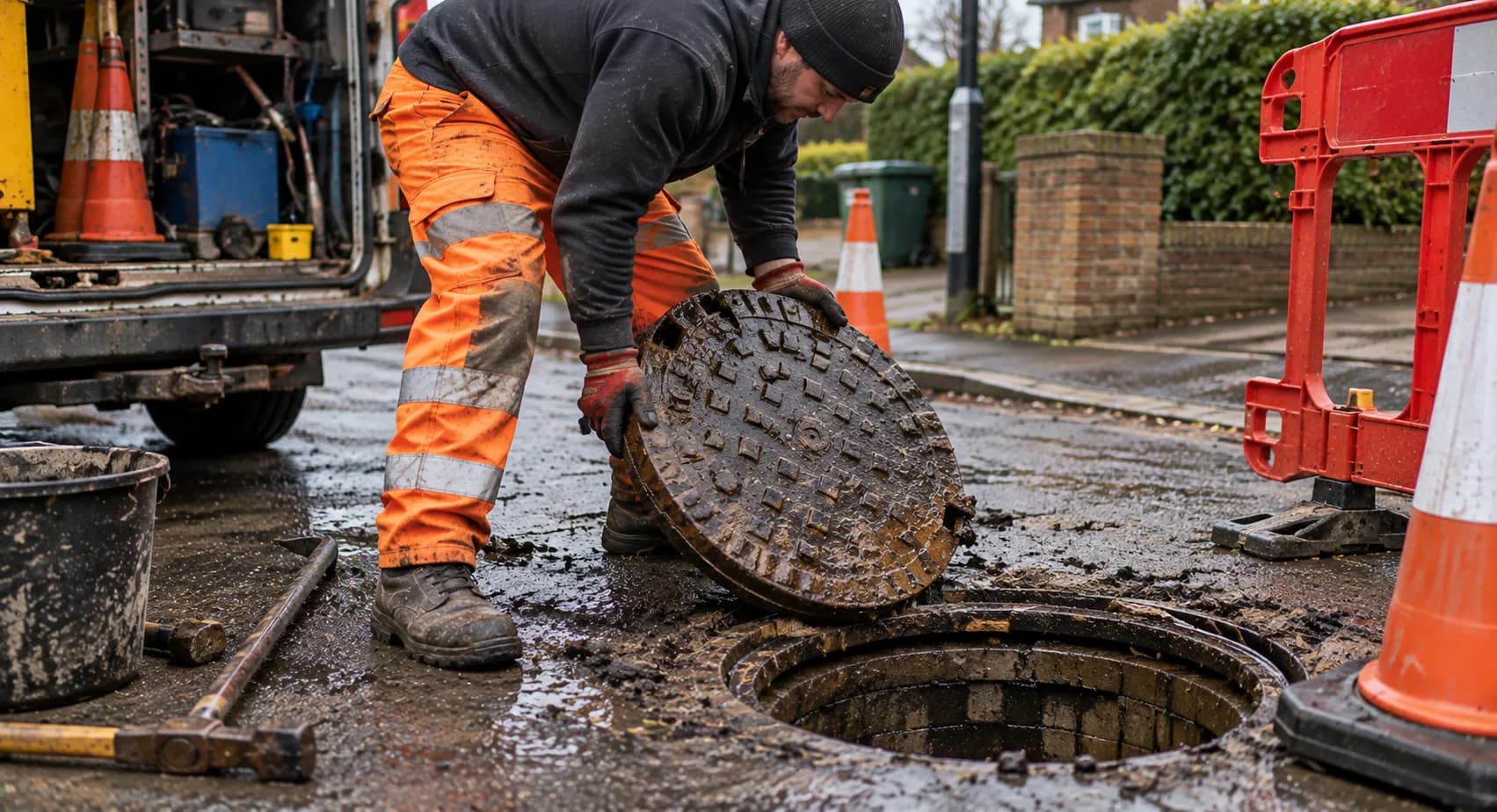
Manhole cover replacement starts with one question: whose is it? If the cover sits on a drain that serves only your property, you replace it. If it sits on a shared sewer, in the road or on the pavement, it almost certainly belongs to the water company, the council or a utility, and your job is to report it. Our drain repairs team replaces covers and frames on private drains across Nottinghamshire and the East Midlands, and this guide covers the rest.
It sets out who owns which cover, what to do about an open or broken one, how to choose the right load class and how a replacement is actually done. For what sits under the lid, read our guide to inspection chambers and manholes.
Is a broken manhole cover dangerous?
Yes. An open, cracked or rocking cover is a fall and trip hazard, and a lid that gives way underfoot can drop someone into a chamber more than a metre deep. Keep people, children and pets away, and put something visible over or around it, such as a wheelie bin or cones. Don't try to lift a broken public cover back into place.
If the cover is on a road or pavement and the hole is open, treat it as an emergency report, not a routine one. Nottinghamshire County Council asks people to phone its Customer Services Centre on 0300 500 80 80 for emergencies rather than use the online form (Nottinghamshire County Council).
Who is responsible for a broken manhole cover?
Responsibility follows the pipe or cable under the cover, not the land it sits on. Use this as a first check:
| Where the cover is | What it usually covers | Who is usually responsible | What to do |
|---|---|---|---|
| Your garden or drive, on a drain serving only your home | Your private drain | You, the owner | Replace it yourself or call a contractor |
| Your garden or drive, on a pipe shared with neighbours | Public sewer (since October 2011) | The water company | Report it to Severn Trent or Anglian Water |
| Road or pavement, marked with a utility name | Water, gas, electricity or telecoms equipment | That utility company | Report it to the utility named on the cover |
| Road or pavement, highway gully or unmarked cover | Highway drainage or a cover the council looks after | The highway authority | Report it to the council |
| Motorway or trunk road | Highway apparatus on the strategic network | National Highways | Report it to National Highways |
The shared-pipe rule comes from the 2011 transfer regulations, which moved most private sewers draining to the public network over to the water companies on 1 October 2011. Warwick District Council, in the Severn Trent area, tells residents to call Severn Trent on 0800 783 4444 about a blocked sewer or a broken manhole cover (Warwick District Council). Anglian Water covers most of Lincolnshire. If you are not sure whether a pipe is shared, our guide on who is responsible for blocked drains explains how to tell.
How do I tell whose manhole cover it is?
Read the lid. Most covers in roads and pavements carry a word or logo. Knowsley Council, for example, says manhole covers, cable boxes and cabinets on roads and footpaths are maintained by the utility companies, not the council, and lists who to call for each (Knowsley Council). Common markings include:
- A water company name, or the word sewer: usually the water company.
- BT, Openreach or PO: telecoms. Openreach takes reports of "loose, cracked or missing manhole covers" and gives 0800 023 2023 for emergencies (Openreach).
- Gas, electricity or cable TV names: report to that network operator.
- No marking, inside your boundary: probably your private drain, but check what the pipe serves before you spend money.
Not every cover in a garden is a drain. Water meters, stop taps and old cable chambers also have lids, so don't lift one you can't identify.
Is it the cover or the frame that has failed?
Look before you buy anything. A cracked lid in a sound frame is a simple swap. A frame that has cracked, worked loose or sunk means the bedding underneath has failed, and a new lid on its own will rock and break again.
| What you see | Likely cause | Usual fix |
|---|---|---|
| Crack across the lid, frame sound | Overloaded or old cover | New cover of the same size and correct class |
| Lid rocks or clanks when driven over | Worn seating, or a lid that doesn't match the frame | Matched cover and frame |
| Frame cracked, or loose in the surface | Failed mortar bedding, wrong class | Lift frame, rebed, new cover and frame |
| Cover sitting below the surface | Chamber or bedding has settled | Reset the frame, possibly rebuild the top courses |
| Gaps or soil showing round the frame | Broken chamber walls or riser | Repair the chamber, then reset the frame |
| Rusted shut or seized | Corrosion, debris in the seating | Free and clean, or replace if damaged |
A common reason for a cracked cover on a driveway is a pedestrian-grade lid that was never meant to take a car. That is worth fixing properly the first time.
Which manhole cover do I need?
Choose by size first (the clear opening of the chamber and the outside of the frame) and then by load class. Covers and frames are tested under BS EN 124, which grades them from A15 to F900 by test load. JDP's guide to BS EN 124 matches each class to where it belongs, and Approved Document H asks for covers that are removable, non-ventilating and "of suitable strength" (Approved Document H, paragraph 2.54).
| Where the cover sits | Minimum class | Test load | Notes |
|---|---|---|---|
| Lawn, flower bed, path or patio, no vehicles | A15 | 15 kN | Lightweight plastic or steel covers are common here |
| Domestic driveway, garage entrance | B125 | 125 kN | The usual choice wherever a car might park or turn |
| Car park or pedestrian area with occasional vehicles | B125 | 125 kN | Step up if vans or delivery lorries use it |
| Yard or forecourt with slow-moving heavier traffic | C250 | 250 kN | Also for covers near the kerb edge of a road |
| Roads and busy parking areas | D400 | 400 kN | Normally a highway or utility cover, not yours to replace |
| Loading bays and docks | E600 or F900 | 600 or 900 kN | Industrial sites only |
Two practical points. Match the class of the cover and the frame, because a strong lid in a weak frame is only as good as the frame. And if a garden path might one day become part of a drive, fit B125 now.
Should I choose a recessed or a solid cover?
It depends on the surface. A solid cover has a plain top in metal, concrete or plastic and suits gravel, lawns and tarmac. A recessed cover is a tray you infill with the same block paving, slabs or resin as the surrounding area, so it blends in.
Recessed trays are popular on block-paved drives, but they need the right class (usually B125 for a drive), a properly bedded frame and a lifting key. Approved Document H also says small lightweight covers should be secured, for example with screws, to deter children (Approved Document H, paragraph 2.54). Inside a building, chambers need mechanically fixed airtight covers.
How is a manhole cover replaced?
On a private drain a straightforward replacement usually goes like this:
- Check ownership so you don't pay to fix a water company or utility cover.
- Measure the clear opening and frame, and note the class and material of the old cover.
- Look inside to check the chamber walls, riser and benching are sound. If the frame has sunk, the chamber may be the real problem.
- Lift the old frame if it is cracked or loose, and break out the old bedding.
- Rebed the new frame level with the finished surface on fresh mortar or a proprietary bedding compound, or fit a matched riser and frame on a plastic chamber.
- Make good the surface around the frame in paving, tarmac or concrete, and let the bedding cure before vehicles go over it.
- Fit and secure the cover, check it sits flat without rocking, and keep the lifting keys somewhere you'll find them.
If the chamber itself is cracked or the pipes into it are damaged, that is a drain repair, and a CCTV drain survey shows what state the pipes are in before you spend money on the top. Our guide to collapsed drain repair costs covers what happens if the problem goes deeper.
When to call a professional
Call a drainage contractor if the frame is cracked, loose or sunk, the chamber walls are broken, the cover is the wrong class for where it sits, or you can't tell whether the drain is private or shared. Call the owner, not a contractor, if it is a water company, council or utility cover.
We replace covers and frames, rebuild chamber tops and repair private drains. Drain repairs start from £250 + VAT, you get a fixed price before work starts, there is no call-out fee and repairs carry a 12-month workmanship guarantee. We are open 7 days, 6am to 8pm, with emergency call-outs 365 days a year, and we work across Nottinghamshire, Derbyshire, Leicestershire and Lincolnshire, including drainage in Nottingham and the rest of Nottinghamshire. Call 07300 600 950 or ask for a quote.
Sources
- Approved Document H: drainage and waste disposal (gov.uk)
- The Water Industry (Schemes for Adoption of Private Sewers) Regulations 2011 (legislation.gov.uk)
- Nottinghamshire County Council: report a road or pavement problem
- Warwick District Council: drainage and sewage (Severn Trent sewer transfer)
- Knowsley Council: damaged utility equipment
- Openreach: report damage, health and safety
- JDP: what is the BS EN 124 classification?
Frequently Asked Questions
Cite this guide: “Manhole Cover Replacement: Who Fixes a Broken Manhole Cover?”, Urgent Drainage Solutions, 6 October 2026. https://urgentdrainagesolutions.co.uk/blog/broken-manhole-cover-replacement

Need A Drainage Engineer?Book Online Today