
Homebuyer Drain Survey: Do You Need One When Buying a House?
Written by the Urgent Drainage Solutions teamPublished Updated 7 min read
Quick answer
You don't legally need a drain survey to buy a house, but it is worth having on older homes, homes near trees and homes with extensions. RICS surveys only look into inspection chambers; a homebuyer drain survey puts a camera through the pipes. Book it after your offer is accepted and before you exchange contracts.
- RICS Level 2 and Level 3 surveyors lift accessible covers and look into chambers, but do not put a camera through the pipes.
- Pitch fibre, cracked clay joints, nearby trees, shared drains and extensions over drains are the main red flags.
- Book the drain survey after your offer is accepted and before exchange, when you can still renegotiate or withdraw.
- MyJobQuote puts a pre-purchase drain survey at £250 to £350 for a standard property.
- Defects in shared pipes are usually the water company's responsibility, so check where each defect sits.
You don't legally need a drain survey to buy a house, but on many properties it is one of the most useful checks you can make. A RICS home survey only looks into the inspection chambers, so cracks, root intrusion, displaced joints and deformed pipes can go unnoticed until after you move in. A homebuyer drain survey puts a camera through each accessible run and gives you a coded report before you exchange contracts.
This guide explains what a normal survey and the conveyancing searches do and don't cover, the red flags that make a drain survey worthwhile, where it fits in the buying timeline, and what to do with the results.
Does a normal house survey check the drains?
Only from the top of the chambers. The RICS Home Survey Standard sets out what each level of survey covers:
| RICS survey level | What happens to the drains |
|---|---|
| Level 1 | The surveyor "will not lift inspection chamber covers to drains or septic tanks" |
| Level 2 | Accessible covers are lifted, where safe, and the chambers are visually inspected |
| Level 3 | Accessible covers are lifted and the surveyor observes "the normal operation of the drains in everyday use" |
None of the three levels includes a camera inspection of the pipes between the chambers, which is where most expensive defects are found. A surveyor who sees standing water or debris in a chamber will often recommend a specialist drainage survey, and that is the report this guide describes.
Do the conveyancing searches tell you about the drains?
They tell you about connections, not condition. Your solicitor's drainage and water search, often called a CON29DW, comes from the water company. It shows whether the property drains to a public sewer and whether public sewers are recorded within the boundary. It says nothing about whether the pipe under the garden is cracked, full of roots or collapsing. Only a camera does that.
What are the red flags that make a drain survey worth it?
The five biggest are pitch fibre pipes, old clay joints, nearby trees, shared drains and extensions built over a drain. Use this checklist at viewings and when you read the seller's property information form:
| Red flag | Why it matters | What to ask or check |
|---|---|---|
| House built between the 1950s and 1970s | Pitch fibre drains were popular in that period, and the Financial Ombudsman Service notes many insurance policies don't cover them | Has the drain ever been surveyed or relined? |
| Older house with clay drains | Clay pipe joints can open or displace as the ground moves, letting in roots and catching debris | Any history of blockages or jetting? |
| Mature trees near the drain runs | Roots seek out open joints and cracks | Where do the drains run relative to the trees? |
| Terraced or semi-detached house | Pipes shared with neighbours are usually public sewers, which affects who pays and whether you can build over them | Which runs are shared? |
| Extension, conservatory or garage near a drain | Building within 3 metres of a sewer is controlled, and a structure can damage the pipe beneath it | Was a build-over agreement or self-certification obtained? |
| Slow drains, smells, damp patches or sunken paving | These are classic signs of a leaking or broken pipe | See our guide to the signs of a blocked or collapsed drain |
| Septic tank, cesspit or treatment plant | Private systems have their own rules and costs | Ask for emptying records and the system's details |
Why do extensions over drains matter to a buyer?
Because an unapproved extension over a public sewer can become the buyer's problem. Approved Document H covers building work within 3 metres of the centreline of a sewer or drain shown on the sewer records. In most of Nottinghamshire, Derbyshire and Leicestershire, the sewerage company is Severn Trent, whose building over sewers guidance explains when owners can self-certify and when a formal build-over agreement is needed. In much of Lincolnshire it is Anglian Water, whose standard build-over criteria exclude pipes made of pitch fibre or asbestos cement. Our guide to building over a drain covers the process in full.
What if the house isn't on mains drainage?
Rural homes may drain to a septic tank or sewage treatment plant. Ask the seller for the system's details and emptying records, and read our guide to the septic tank general binding rules before you commit.
When should you book a drain survey in the conveyancing timeline?
Book it as soon as your offer is accepted, so the report is back well before exchange. The gov.uk guide to buying a home says "exchanging contracts is an official legal commitment" and that if you withdraw after exchange "you may lose your deposit". The RICS consumer guide to house surveys also recommends getting a survey after your offer is accepted by the seller.
| Stage | What happens | Where the drain survey fits |
|---|---|---|
| Offer accepted | Instruct a solicitor or conveyancer | Book the drain survey now; give the estate agent's details for access |
| Searches and mortgage valuation | Local authority and drainage and water searches ordered | Survey carried out; compare its findings with the sewer plan in the search |
| Home survey | RICS Level 2 or 3 inspection | If the surveyor flags the drains, make sure your drain survey covers those runs |
| Enquiries | Solicitor raises questions with the seller | Share the report; ask about repairs, a price reduction or a retention |
| Exchange of contracts | The purchase becomes legally binding | Any drainage issues should be settled before this point |
| Completion | Often around 2 to 4 weeks after exchange, according to gov.uk | Keep the report as a baseline record of the drains |
Tell the drainage company your target exchange date when you book. Report turnaround varies between firms, so ask when you will receive it.
What does a homebuyer drain survey show?
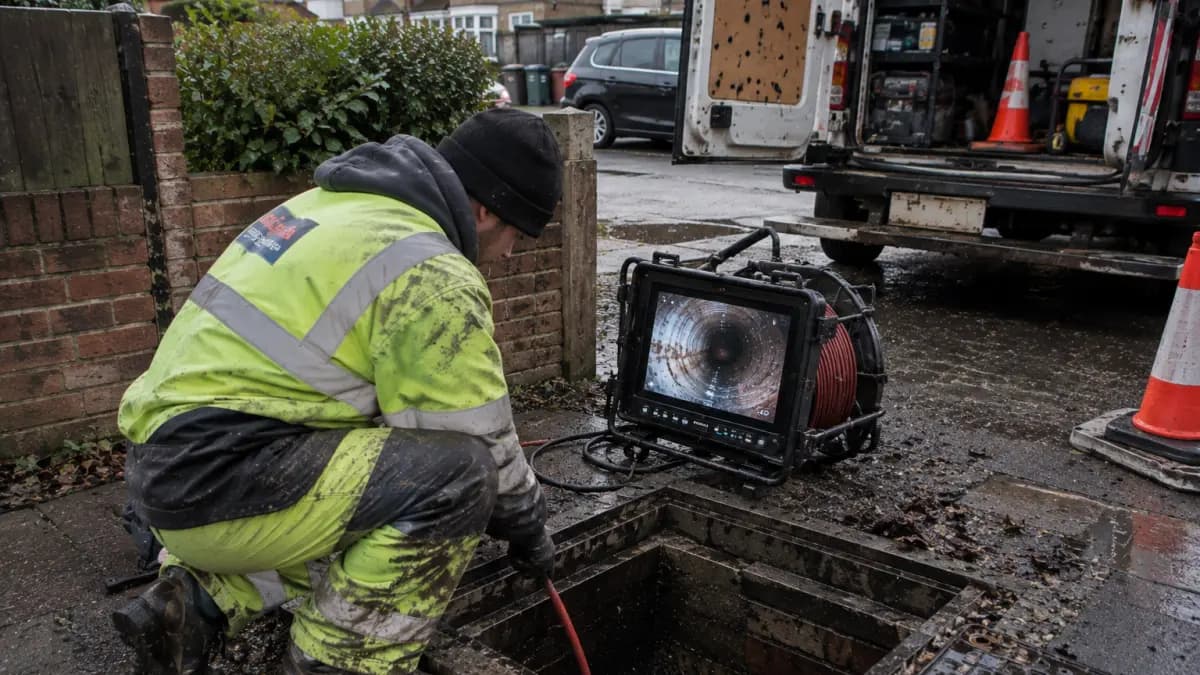
A camera is passed through each accessible run, usually from the inspection chambers, and the footage is recorded and coded. Our report includes:
- a plan of the drain runs, chambers and flow direction;
- the pipe material and size, which is how pitch fibre is identified;
- each defect, coded to WRc's MSCC5 standard, with its distance along the pipe and a grade;
- the footage and stills of each defect;
- plain-English recommendations that separate essential repairs from minor issues.
Our guide to what a CCTV drain survey report shows explains the codes and grades.
How much does a homebuyer drain survey cost?
MyJobQuote's drain survey cost guide (updated 25 August 2026) puts a pre-purchase survey of a standard residential property at £250 to £350, with £100 to £150 extra where the drains need jetting first. Our CCTV drain surveys start from £149 + VAT, and we confirm the price before booking. See our full guide to CCTV drain survey costs.
Compare that with the cost of a repair after you move in. MyJobQuote's drain repair guide puts excavation and replacement at £250 to £650 per metre and a fully collapsed drain at £1,000 to £3,000 or more.
What should you do with the results?
If the report is clear, you have peace of mind and a baseline record. If it finds problems, you have five options:
- Get a repair quote based on the footage, so you know the likely cost.
- Ask your solicitor to raise it with the seller: a price reduction, a repair before completion or a retention.
- Check responsibility. Severn Trent's sewer responsibility guide says pipes shared with neighbours and pipes outside the boundary are the water company's, so a defect there may not affect the price at all.
- Speak to your insurer before you buy if pitch fibre or existing damage is found, because it may affect cover.
- Keep the report. It is useful evidence if problems appear later.
When to call a professional
Book a drain survey if you are buying an older home, a house built between the 1950s and 1970s, a home with trees or an extension near the drains, or anywhere you noticed a warning sign at a viewing. We carry out homebuyer drain surveys across Nottinghamshire, Derbyshire, Leicestershire and Lincolnshire, and can arrange access with the estate agent. Every report is coded to WRc MSCC5, produced in WinCan and explained in plain English so you can talk to your solicitor with confidence.
Call 07300 600 950, book online or ask for a quote.
Sources
- RICS: scope of inspection, Home Survey Level 1
- RICS: scope of inspection, Home Survey Level 2
- RICS: scope of inspection, Home Survey Level 3
- gov.uk: How to buy a home
- gov.uk: Approved Document H, drainage and waste disposal
- Severn Trent: building over or close to sewer pipes
- Anglian Water: standard criteria for building over or near a sewer
- MyJobQuote: drain survey cost guide (updated 25 August 2026)
Frequently Asked Questions
Cite this guide: “Homebuyer Drain Survey: Do You Need One When Buying a House?”, Urgent Drainage Solutions, 1 October 2026. https://urgentdrainagesolutions.co.uk/blog/drain-survey-when-buying-a-house

Need A Drainage Engineer?Book Online Today