
How to Read a CCTV Drain Survey Report: MSCC5 Codes and Grades
Written by the Urgent Drainage Solutions teamPublished Updated 7 min read
Quick answer
A CCTV drain survey report maps each drain run and lists every defect by its distance along the pipe, a WRc MSCC5 code, its size and its clock position. Each run gets a structural grade and a service grade from 1, acceptable, to 5, needing immediate action. Grades 4 and 5 usually need repair soon.
- UK drain reports are coded to MSCC5, the WRc Manual of Sewer Condition Classification, 5th edition (October 2013).
- Every defect line gives a distance, a code, a size or percentage and a clock position around the pipe.
- Structural grades describe the pipe itself; service grades describe how well it flows.
- Grades run from 1 (acceptable) to 5 (immediate action); service defects often clear with jetting, structural ones need repair.
- Always ask for the footage, the drain plan and recommendations ranked by urgency.
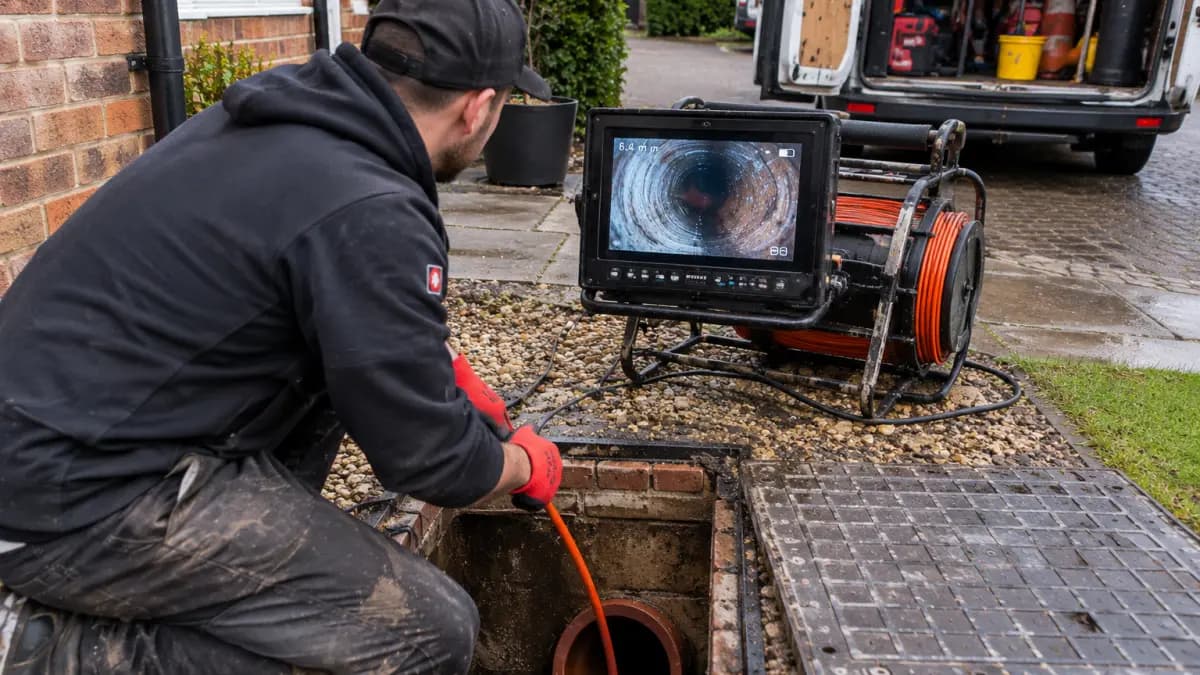
A CCTV drain survey report shows what the camera found inside your pipes: where each drain runs, what it is made of and every defect along the way. Each defect is recorded by its distance from the start point, a standard code from WRc's MSCC5 manual, its size and its position around the pipe, then graded from 1 to 5 so you can see what needs fixing now and what can wait. Our CCTV drain surveys are coded to MSCC5 and produced in WinCan.
This guide explains the standard behind the codes, how to read each line of the defect table, what the common codes mean and what to do at each grade.
What standard are CCTV drain survey reports written to?
In the UK, professional reports are coded to MSCC5, the WRc Manual of Sewer Condition Classification, 5th edition, published in October 2013. WRc says the manual was "extensively updated to reflect amendments to BS EN 13508-2 in 2011" and is used by the water industry to classify defects across more than 500,000 km of public sewers and lateral drains.
Domestic surveys, especially for insurance claims, often also draw on WRc's Drain Repair Book (4th edition, April 2017). WRc produced it with the Association of British Insurers' Property Claims Working Group and says it "is widely used by both insurers and drain repairers". It covers who is responsible for a drain, how it should be inspected and evaluated, and how it should be repaired.
The report itself is produced in survey software such as WinCan, which puts the codes, stills, distances and drain plan into a consistent format.
How do you read each line of the defect table?
Read each line left to right as distance, code, size and clock position. Every defect is a separate entry:
- Distance (metres): how far along the pipe the defect is from the start point, usually an inspection chamber. This is what lets an engineer dig or patch in exactly the right place.
- Code: a short MSCC5 abbreviation for the defect type.
- Size or extent: a percentage for roots, deposits and deformation (how much of the pipe is affected) or a measurement for joint displacement.
- Clock position: where the defect sits around the pipe, read like a clock face in the direction of travel, so 12 is the top and 6 is the invert (bottom).
- Remarks and photo reference: a still image number linking to the defect.
A typical line might read "4.20 m, CL, 12". That means a longitudinal crack 4.2 metres along the pipe, running along the top. Each run also has a header showing the start and finish chamber, the direction of survey, the pipe material and diameter, and the total length surveyed.
What do the common MSCC5 defect codes mean?
These are the codes most often seen on domestic reports. They follow the MSCC5 coding system; exact wording can vary slightly between software packages and between a full MSCC5 survey and a Drain Repair Book domestic survey.
| Code | Meaning | Type | What it usually tells you |
|---|---|---|---|
| CC / CL / CM | Crack: circumferential / longitudinal / multiple | Structural | Early damage; the pipe is still in one piece |
| FC / FL / FM | Fracture: circumferential / longitudinal / multiple | Structural | A visibly open break in the pipe wall |
| B | Broken | Structural | Pieces of pipe wall displaced |
| H | Hole | Structural | Part of the pipe wall missing |
| D | Deformed | Structural | Pipe out of shape, typical of pitch fibre |
| X | Collapse | Structural | The pipe has failed; flow is obstructed |
| JDM / JDL | Joint displaced: medium / large | Structural | Sections out of line; catches debris |
| OJM / OJL | Open joint: medium / large | Structural | Gap between sections; leaks and root entry |
| RF / RT / RM | Roots: fine / tap / mass | Service | Root ingress, from hair roots to a mass filling the pipe |
| DEG | Attached deposits: grease | Service | Fat build-up on the pipe wall |
| DEE | Attached deposits: encrustation | Service | Hard scale or mineral build-up |
| DES / DER | Settled deposits: fine / coarse | Service | Silt, grit or debris lying in the pipe |
| WL | Water level | Service | Standing water, which may point to a dip or blockage |
| SA | Survey abandoned | Note | The camera could not go further; the reason should be stated |
A "survey abandoned" entry is not a failure in itself, but the report should say why, for example a blockage, a collapse or a bend the camera couldn't pass, and what is recommended next. Our guide to pitch fibre pipes explains why D (deformed) is so common on homes built between the 1950s and 1970s.
How do MSCC5 grades 1 to 5 work?
Each run gets two grades on a scale of 1 to 5. The structural grade reflects the physical integrity of the pipe; the service grade reflects how well it carries flow. Individual defects are scored and those scores decide the grade band for the run.
Survey software vendor Geocadra's summary of WRc MSCC5 describes the five bands as below. The "what to do" column is general trade practice, not part of the standard, and your engineer should explain what each grade means for your drain.
| Grade | Label (Geocadra) | Typical meaning | What to do |
|---|---|---|---|
| 1 | Acceptable | No defect of functional significance | Nothing; keep the report as a baseline |
| 2 | Minimal | Slight deterioration or surface wear | Monitor; recheck if symptoms appear |
| 3 | Moderate | Moderate defects, such as a fracture without deformation | Plan a repair, especially if it is causing blockages |
| 4 | Poor | Serious defect, such as a broken pipe or significant deformation | Get a repair quote and act soon |
| 5 | Immediate | Structurally failed, collapsed or fully blocked | Stop heavy use of the drain and repair now |
What does a bad service grade mean compared with a bad structural grade?
A poor service grade is often fixable with cleaning. Grease, silt and fine roots can usually be removed by drain jetting, and the pipe re-surveyed. A poor structural grade needs a repair: a patch liner for a single crack or open joint, full relining for defects spread along a run, or excavation where the pipe has collapsed or lost its shape. Our guide to drain relining vs excavation compares the options.
What should a good drain survey report include?
A good report lets someone who wasn't there understand and act on the findings. The Financial Ombudsman Service says a proper drainage investigation should record the pipe's condition with a diagram, list the problems and their locations, and identify the pipe material. Use this checklist:
- property address, survey date and the name of the engineer;
- a drain plan showing each run between chambers, with flow direction;
- pipe material, diameter and length for each run;
- a defect table for each run, with distances, codes, clock positions and grades;
- still images of every significant defect;
- the recorded footage, so another engineer can check the findings;
- recommendations ranked by urgency, separating essential repairs from optional ones;
- notes on any runs that couldn't be surveyed, and why.
Be cautious about a report that lists defects without distances or images, or recommends expensive work without showing the evidence.
Who is responsible for the defects in the report?
It depends where they are. Severn Trent's sewer responsibility guide says the water company is responsible for pipes shared with neighbours and pipes outside the boundary that connect to its network; the homeowner is responsible for pipes within the boundary that serve only their property. The drain plan and distances in the report show which side of that line each defect falls. Our guide to who is responsible for blocked drains explains the split.
How is a drain survey report used?
The same report serves several purposes:
- Repairs: distances and clock positions let a contractor quote and target the work.
- Buying a house: buyers use it to renegotiate or ask for repairs before exchange. See drain surveys when buying a house.
- Insurance claims: the coded evidence shows the defect, its position and the pipe material.
- Building near a drain: water companies often need to see the condition of a sewer before and after an extension is built over it.
When to call a professional
Ask an engineer to talk you through any report that shows grade 4 or 5 defects, recommends excavation, or doesn't include footage and distances. We carry out CCTV drain surveys from £149 + VAT across Nottinghamshire, Derbyshire, Leicestershire and Lincolnshire, with MSCC5-coded grading, a PDF report produced in WinCan, the footage and stills, and a drain map. If repairs are needed, drain repairs start from £250 + VAT and are quoted separately from the footage. See our guide to CCTV drain survey costs.
Call 07300 600 950 or book online.
Sources
Frequently Asked Questions
Cite this guide: “How to Read a CCTV Drain Survey Report: MSCC5 Codes and Grades”, Urgent Drainage Solutions, 1 October 2026. https://urgentdrainagesolutions.co.uk/blog/cctv-drain-survey-report-explained

Need A Drainage Engineer?Book Online Today