
How to Unblock a Toilet
Written by the Urgent Drainage Solutions teamPublished Updated 8 min read
Quick answer
To unblock a toilet, stop flushing, then use a flange toilet plunger: seal it over the outlet, push gently, then pump firmly 15 to 20 times. No plunger? Try hot (not boiling) water with washing-up liquid, then a toilet auger. If other drains are slow or the outside chamber is full, the blockage is in the drain.
- Use a flange plunger for toilets; a flat cup plunger is made for sinks and seals poorly in a toilet bowl.
- Hot water and washing-up liquid can soften a paper blockage, but never pour boiling water into a ceramic pan.
- Do not use caustic drain cleaners or wire coat hangers in a toilet, and never mix cleaning products.
- If several fittings are slow or an outside gully is backing up, the toilet is fine and the drain is blocked.
- Our blocked drain service starts from £120 + VAT with no call-out fee and a fixed price agreed first.
To unblock a toilet, stop flushing, put on rubber gloves and use a flange toilet plunger to push and pull water through the outlet until it clears. If you have no plunger, hot water and washing-up liquid will soften most paper blockages, and a toilet auger will reach anything the plunger cannot. If the toilet still won't clear, or other drains in the house are slow too, the problem is almost always in the drain rather than the toilet. Our drainage plumbing and blocked drain engineers clear both.
This guide covers each method in order, from gentlest to strongest, plus the mistakes that turn a ten-minute job into a new toilet pan.
What should you do first when a toilet is blocked?
Stop flushing. Each flush adds more water to a bowl that cannot empty, and that is how a blocked toilet becomes a flooded bathroom. Then get ready:
- Put on rubber gloves and old clothes.
- Lay old towels or newspaper around the base of the pan.
- If the bowl is nearly full, bail some water into a bucket so it doesn't splash over when you plunge.
- If the cistern keeps refilling, lift the lid and hold the float up, or turn off the isolation valve on the supply pipe.
- Open a window and keep children and pets out of the room.
Now check whether it is only the toilet. Run the basin tap and the shower for a few seconds. If they drain normally, the blockage is almost certainly in the toilet or the short pipe behind it, and the steps below should work.
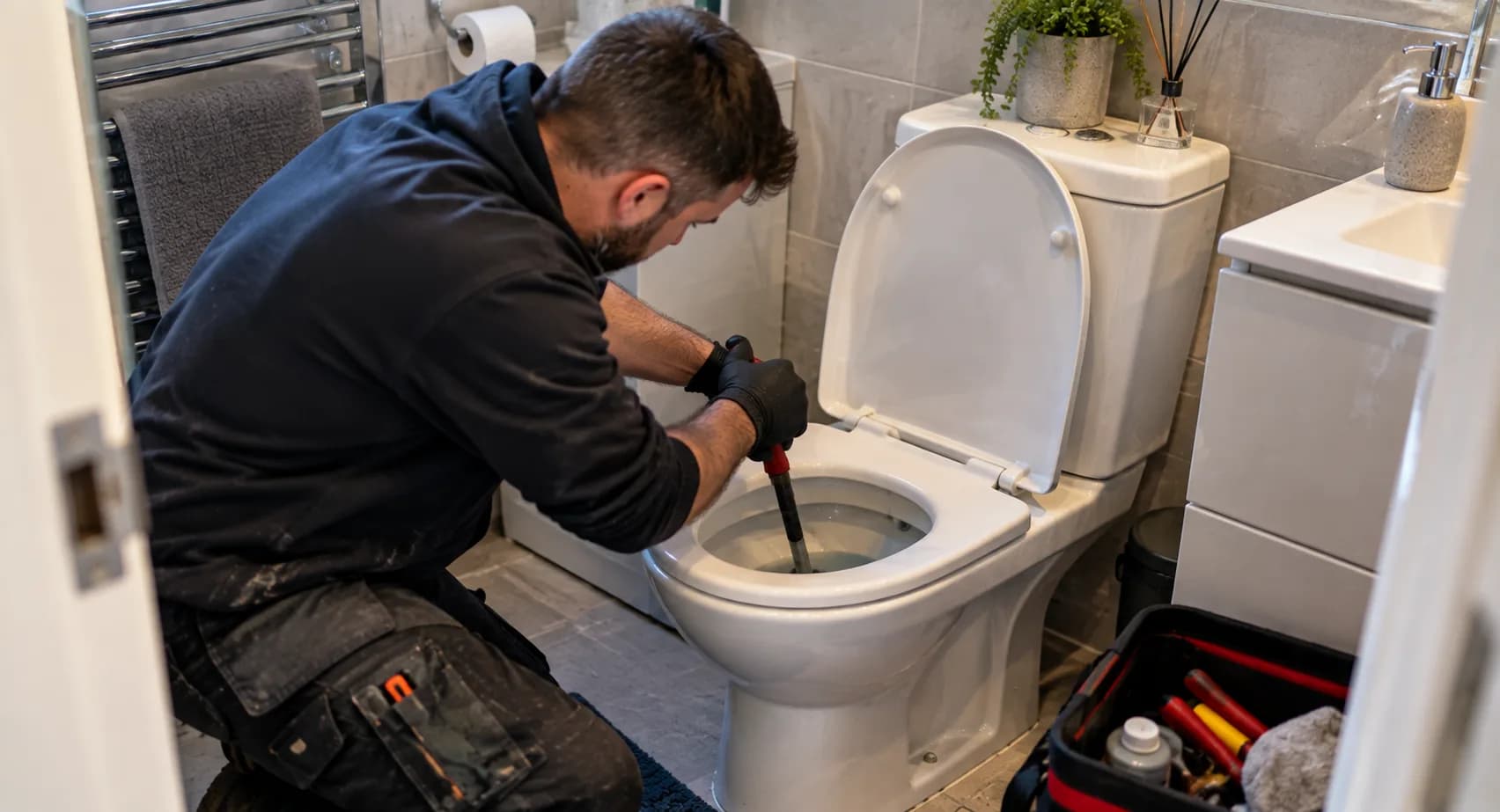
How do you unblock a toilet with a plunger?
Use a flange plunger, not a sink plunger. A flange plunger has a soft rubber sleeve that folds out from the bottom of the cup and fits into the toilet outlet, giving a tight seal. A flat cup plunger is designed for flat surfaces such as sinks and baths, and it lets water escape around the edge in a curved toilet bowl.
- Make sure there is enough water in the bowl to cover the rubber cup. Add some from a jug if needed.
- Put the plunger into the bowl at an angle so the cup fills with water rather than air.
- Fit the flange into the outlet and press down gently to make a seal.
- Pump firmly up and down 15 to 20 times, keeping the seal, then pull the plunger away sharply.
- If the water drops away, pour in a bucket of water to check it flows freely, then flush once.
- If nothing moves, repeat two or three times before trying the next method.
Pushing is only half the job. The pull stroke creates suction that loosens the blockage, which is why pumping works better than one big shove.
How do you unblock a toilet without a plunger?
Try hot water and washing-up liquid first, then a toilet auger. Hot water works on paper and waste blockages but won't shift wipes or objects, which need the auger.
Hot water and washing-up liquid
- Squeeze a generous amount of washing-up liquid into the bowl and leave it for 15 to 20 minutes. It helps lubricate the blockage.
- Heat a kettle and let it stand for a few minutes. You want hot water, not boiling water. Sudden heat can crack a ceramic pan or soften the seal where the pan meets the soil pipe.
- Pour the hot water in from about waist height so its weight adds a little pressure.
- Leave it for another 15 minutes, then try a bucket of cold water poured in steadily.
Bicarbonate of soda and vinegar are often recommended too. An expert quoted by Which? says home remedies may help with the smell of a blocked drain but are "not strong enough to help with a drain that is really clogged", so don't rely on them.
A toilet auger
A toilet auger, sometimes called a closet auger, is a short, cranked drain snake with a rubber or plastic sleeve over the bend that protects the glaze. Feed the head into the outlet, turn the handle clockwise as you push, and it will either break up the blockage or hook it so you can pull it back. They are cheap to buy and worth keeping if your toilet blocks more than once a year.
Which method should you use for which blockage?
| What you see | Likely cause | Best first method | If it fails |
|---|---|---|---|
| Water drains very slowly after flushing | Too much paper | Wait an hour, then plunge | Hot water and washing-up liquid |
| Bowl fills to the rim and stays there | Paper or waste in the trap | Flange plunger | Toilet auger |
| Blocked soon after wipes or pads were flushed | Wipes, sanitary items | Toilet auger to hook them out | Professional rodding |
| Something dropped in (toy, phone, bottle top) | Solid object | Gloved hand or auger to retrieve | Pan removed by a professional |
| Toilet, basin and shower all slow | Blocked drain | Check the outside inspection chamber | Drain unblocking or jetting |
| Toilet bubbles when the bath empties | Blocked or poorly vented drain | Check the outside chamber | CCTV survey |
| Macerator toilet stops pumping or hums | Blade or pump jammed | Power off, check the manual | Manufacturer's engineer |
How do you unblock a badly blocked toilet?
Soften it, then work it from both sides. A toilet that won't budge after plunging is usually packed with paper, or has something solid lodged in the trap. Leave it to soak for a few hours or overnight with washing-up liquid, then plunge again. If that fails, use an auger, which reaches past the trap into the short pipe behind the pan where plungers can't.
If an object is stuck, don't force it further in. Something hard that passes the trap can wedge in the soil pipe or drain, and the only fix then is to take the pan off. A professional can remove the pan, clear the pipe and refit it with a new seal.
How do you unblock a toilet blocked with tissue?
Give it time and water. Toilet paper is designed to break up quickly when wet, so a paper blockage usually softens by itself within an hour or two. Plunge gently, add hot water and washing-up liquid, then plunge again. If kitchen roll or facial tissues were flushed, it may take longer, because they are made to stay strong when wet. Our guide to what not to flush explains why.
How do you unblock a macerator toilet?
Switch off the power first, then follow the manufacturer's instructions. A macerator toilet grinds waste and pumps it through a small pipe, which lets a toilet be fitted where there is no gravity drain. Approved Document G (paragraph 4.25) only allows a WC with a macerator and pump if there is also access to a WC that drains by gravity.
Do not plunge a macerator hard, pour in chemicals or push rods into the unit. Manufacturers typically allow only human waste, toilet paper and household toilet cleaners, and harsh products can damage seals and blades. If the unit hums, cycles constantly or won't pump, isolate it at the fused spur and call the manufacturer's service line or a plumber who works on them.
What should you never do to a blocked toilet?
- Don't use caustic drain cleaners. Many contain sodium hydroxide (caustic soda). The UK Health Security Agency says stronger solutions can burn skin and eyes, and a full bowl can splash it back at you when you plunge.
- Never mix products. Which? warns that bleach can react with acid-based products such as limescale removers and vinegar, risking toxic gas.
- Don't use a wire coat hanger. It scratches the glaze and can snag wipes further in.
- Don't keep flushing to "push it through". You'll only overflow the bowl.
- Don't pour boiling water in. Use hot water from a kettle that has stood for a few minutes.
How do you know if it's the drain, not the toilet?
If more than one fitting is affected, it's the drain. Signs include the basin or shower draining slowly, the toilet bubbling or rising when the bath empties, a smell of sewage, or water coming up from an outside gully. Lift a light inspection chamber cover outside if you can do so safely: if it is full of waste, the blockage is further down the drain and no amount of plunging will clear it. Our guide on how to unblock an outside drain explains how to find it.
If your neighbours are affected too, the blockage may be in a shared pipe or public sewer, which is usually the water company's responsibility. Citizens Advice explains that you are responsible for drains inside your boundary that serve only your property. Severn Trent takes sewer blockage reports on 0800 783 4444. See who is responsible for blocked drains, and if you rent, landlord or tenant: who pays.
How much does it cost to unblock a toilet?
Doing it yourself costs the price of a plunger or auger. Paying a professional varies with the cause and where the blockage is. MyJobQuote (updated 2 September 2026) puts unblocking a toilet at £50 to £60, with call-out charges on top at many firms.
Our blocked drain service starts from £120 + VAT, with no call-out fee. The final price depends on whether the blockage is in the toilet, the soil pipe or the drain outside, and we confirm a fixed price before any work starts. Our guide to drain unblocking cost explains what changes the price.
How do you stop a toilet blocking again?
- Only flush pee, poo and toilet paper. Severn Trent says drains and sewers are only designed to carry human waste, wastewater and loo roll.
- Put a lidded bin in every bathroom for wipes, pads and cotton buds.
- If you use a lot of paper, flush part-way through.
- Keep a flange plunger next to every toilet so it's to hand before the bowl overflows.
- If one toilet blocks repeatedly, get the drain checked with a CCTV drain survey.
When to call a professional
Call a professional if plunging and an auger haven't worked, if an object is stuck past the trap, if more than one fitting is blocked, if sewage is coming up outside, or if the toilet keeps blocking. Stop straight away if waste is overflowing into the house, and see our emergency drainage page for what to do while you wait.
We clear blocked toilets and drains across Nottingham, Nottinghamshire, Derby, Leicester and Lincolnshire, 7 days a week from 6am to 8pm, with emergency call-outs 365 days a year and no call-out fee. Call 07300 600 950 or book online.
Sources
- Approved Document G: Sanitation, hot water safety and water efficiency (gov.uk)
- Sodium hydroxide: general information (UK Health Security Agency)
- Severn Trent: what to do if you have a blocked drain
- Citizens Advice: who is responsible for repairing drains and sewers
- Which?: how to unblock a sink
- MyJobQuote: drain unblocking cost (2 September 2026)
Frequently Asked Questions
Cite this guide: “How to Unblock a Toilet”, Urgent Drainage Solutions, 6 October 2026. https://urgentdrainagesolutions.co.uk/blog/how-to-unblock-a-toilet

Need A Drainage Engineer?Book Online Today