What Not to Flush: Wet Wipes, Flushable Labels and the Plastic Wipes Ban
Written by the Urgent Drainage Solutions teamPublished Updated 6 min read
Quick answer
Only flush the 3 Ps: pee, poo and toilet paper. Everything else, including wet wipes labelled flushable, belongs in the bin. Water UK found that 93% of the material in sewer blockages was wipes. Its Fine to Flush certification ended in March 2024, and wipes containing plastic are being banned in Wales and England.
- Only pee, poo and toilet paper should be flushed; drains and sewers aren't designed for anything else.
- Water UK research found wipes made up 93% of the material in sewer blockages it studied.
- Water UK ended its Fine to Flush certification in March 2024, so bin every wipe whatever the label says.
- The plastic wet wipes ban starts in Wales on 18 December 2026 and England on 19 May 2027, but plastic-free wipes still block drains.
- Putting anything likely to block a sewer down a toilet or sink can be an offence under the Water Industry Act 1991.
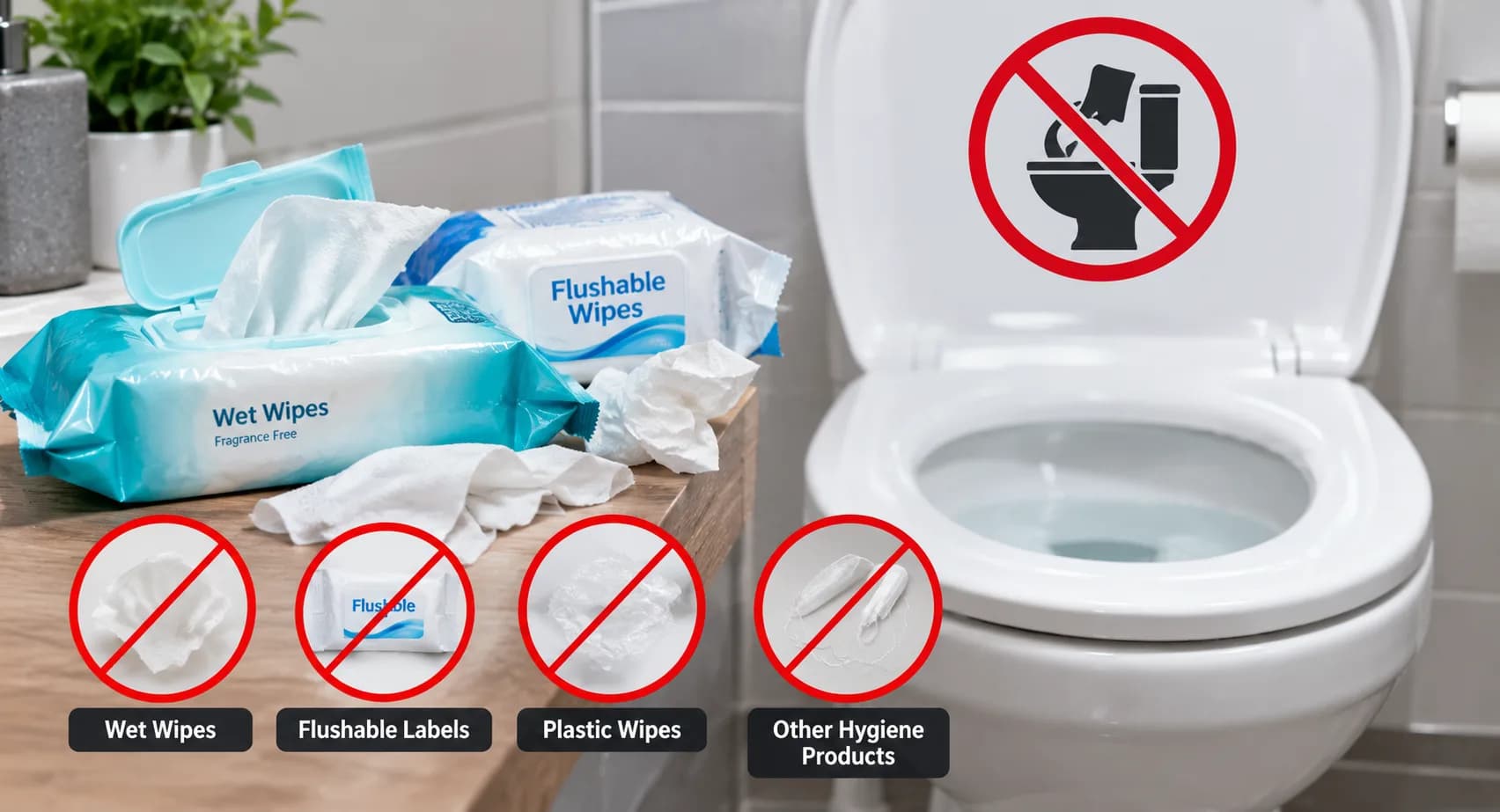
Only flush the 3 Ps: pee, poo and toilet paper. Everything else, including wet wipes labelled "flushable", cotton buds, sanitary products and kitchen roll, belongs in the bin. Wipes don't break up like toilet paper, so they snag, bind with fat and block drains and sewers: Water UK research found that 93% of the material in sewer blockages was wipes. If something has already gone down and your toilet or drain is blocked, our blocked drain engineers can clear it.
This guide covers what you can and can't flush, what happened to the Fine to Flush logo, the plastic wet wipes ban, and what the law says.
What can you safely flush down the toilet?
Only pee, poo and toilet paper. Severn Trent says drains and sewers are only designed to carry human waste, wastewater and loo roll from toilets and the used water from sinks, baths and showers. Toilet paper is made to break up quickly in water. Almost everything else in the bathroom is designed to stay strong when wet, which is exactly why it causes trouble in pipes.
What should you never flush?
Use this as a checklist for your household, your tenants or your guests.
| Item | Why it causes trouble | What to do instead |
|---|---|---|
| Wet wipes of any kind, including "flushable" and "biodegradable" | Don't break up; snag and bind with fat | Bin |
| Sanitary pads, tampons and applicators | Made to absorb and swell | Wrap and bin |
| Nappies and nappy liners | Swell and wedge in pipes | Bin |
| Cotton buds, cotton wool and dental floss | Tangle and catch other waste | Bin |
| Kitchen roll and tissues | Stronger than toilet paper when wet | Bin |
| Condoms | Don't break down | Bin |
| Hair | Forms mats that trap waste | Bin |
| Cooking fat, oil and grease | Sets hard and helps build fatbergs | Cool, scrape and bin |
| Cat litter | Clumps and sets | Bin, following the pack instructions |
| Medicines | Can pollute the water environment | Take back to a pharmacy |
| Contact lenses | Plastic that won't break down | Bin |
If you have a macerator toilet, the list is even stricter, because wipes and hair can jam the blades. Our guide to how to unblock a toilet covers macerators.
Why are wet wipes such a problem?
Because they're built not to fall apart. Wet wipes keep their strength when wet, so instead of breaking up they catch on rough joints, roots and debris, collect fat, and build into solid blockages, first in your own drain and then in the public sewer.
Water UK's blockages factsheet, citing its Wipes in Sewers Blockage Study (12 December 2017), gives these figures:
| Measure | Figure |
|---|---|
| Sewer blockages in the UK each year | 300,000 |
| Cost to the country of clearing sewer blockages | £100 million a year |
| Share of sewer blockage material made up of wipes | 93% |
The factsheet says blockages are most often caused by wet wipes and sanitary products flushed down the toilet, or by leftover cooking fats and oils poured down the sink.
Locally, Severn Trent, the sewerage company for most of Nottinghamshire, Derbyshire and Leicestershire, says it cleared around 30,000 blockages in 2024 and asks customers to "be a binner, not a blocker" (Severn Trent, Unblocktober 2025).
What happened to the Fine to Flush standard?
It ended. Water UK launched Fine to Flush in 2019 as a certification, based on the water industry specification WIS 4-02-06, for wipes that passed tests showing they broke down in sewers and contained no plastic. Water UK ended the certification in March 2024 after concern that the logo was confusing people, some of whom took it to mean any wipe could be flushed. The industry message is now simply to bin the wipe.
So don't rely on the Fine to Flush logo on older packets, or on any "flushable" or "biodegradable" claim. The safe rule is to bin every wipe, whatever the label says.
What is the plastic wet wipes ban?
A ban on supplying wet wipes that contain plastic to consumers. According to gov.uk, the ban starts in England on 19 May 2027. It covers baby wipes, make-up and face wipes, moist toilet tissue, hand wipes and household cleaning wipes. Wipes for medical purposes are exempt, and plastic-free and reusable wipes are still allowed. In Wales the ban starts on 18 December 2026, according to the Welsh Government.
The ban tackles plastic pollution. It won't make wipes flushable. A plastic-free wipe is still made to hold together when it's wet, so it can still block a drain. Keep binning them after the ban comes in.
Is it illegal to flush wipes?
It can be. Section 111 of the Water Industry Act 1991 makes it an offence to throw, empty or pass into a public sewer, or a drain or sewer connected to one, "any matter likely to injure the sewer or drain, to interfere with the free flow of its contents". Prosecutions of households are rare. In practice the bigger cost is closer to home: a blockage in your own drain is yours to pay for, and a blockage in a shared pipe can flood your neighbours too.
What about fatbergs?
A fatberg is a mass of congealed fat, oil and grease bound together with wet wipes. Wipes are the skeleton and fat is the glue, so the two problems feed each other. Fat mostly comes from kitchen sinks, not toilets, and our guide to fat, oil and grease and kitchen sink care covers how fatbergs form and how to stop yours contributing.
Why do older drains block more easily?
Because there's more for wipes to catch on. Many older homes still drain through clay pipes, and over the years their joints can crack, open up or shift, and tree roots can grow in. Each rough edge gives a wipe something to snag, and every snagged wipe traps the next one. That's why a house can flush the same things as its neighbours for years and then suddenly block. If your drain blocks repeatedly, a CCTV drain survey shows whether damage is part of the problem, and our guide to tree roots in drains explains root ingress.
How do you stop wipes being flushed in your home?
- Put a small lidded bin in every bathroom so binning is the easy option.
- Make sure everyone in the house, including children and guests, knows the 3 Ps.
- Buy wipes less often: a reusable cloth does most jobs a wipe does.
- If you use a lot of toilet paper, flush part-way through rather than all at once.
- If you're a landlord, add a short note about wipes to your tenant welcome pack. See landlord or tenant: who pays for blocked drains.
What should you do if wipes have blocked your drain?
- Stop flushing, because each flush adds water that may overflow.
- Put on rubber gloves and lay old towels around the base of the toilet.
- Try a flange toilet plunger, then a toilet auger, which can hook wipes out.
- Don't pour in drain chemicals. They don't dissolve wipes, and mixing products can release toxic gas.
- If you can safely lift a light cover, check the outside inspection chamber. If it's full, the blockage is further down; our guide to unblocking an outside drain explains what to do. Don't lift heavy covers or anything on public land.
- Ask your neighbours whether their drains are slow. If they are, the blockage may be in a shared sewer, which you should report to your water company (Severn Trent: 0800 783 4444). See who is responsible for blocked drains.
When to call a professional
If the toilet won't clear with a plunger or auger, keeps blocking, or the outside chamber is filling up, call a drainage engineer. Wipe blockages beyond the toilet usually need rods or high-pressure drain jetting to clear properly. Our blocked drain service starts from £120 + VAT with no call-out fee, and we confirm a fixed price before any work starts.
We cover Nottingham, Nottinghamshire, Derbyshire, Leicestershire and Lincolnshire, 7 days a week from 6am to 8pm, with emergency call-outs 365 days a year. Book online or call 07300 600 950.
Sources
- Water UK: Cutting through confusion on blockages (factsheet, PDF)
- Water UK: Fine to Flush certification to end
- Plastic wet wipes ban (gov.uk)
- Water Industry Act 1991, section 111 (legislation.gov.uk)
- Severn Trent: what to do if you have a blocked drain
- Severn Trent: be a binner not a blocker for Unblocktober 2025
- Welsh Government: ban on wet wipes containing plastic, guidance for businesses
Frequently Asked Questions
Cite this guide: “What Not to Flush: Wet Wipes, Flushable Labels and the Plastic Wipes Ban”, Urgent Drainage Solutions, 6 October 2026. https://urgentdrainagesolutions.co.uk/blog/what-not-to-flush-wet-wipes-fatbergs

Need A Drainage Engineer?Book Online Today