What Is Drain Jetting and How Does It Work?
Written by the Urgent Drainage Solutions teamPublished 6 min read
Quick answer
Drain jetting cleans a pipe with water pumped through a hose to a nozzle. Rear-facing jets pull the hose along and scour the pipe walls, while a forward jet breaks into the blockage, and the flow carries debris back to the chamber. It clears fat, silt, scale and roots and is safe on sound pipes at a suitable pressure.
- Jetting cleans the full bore of the pipe, where rods usually just punch a hole through the blockage.
- Rear-facing jets drive the nozzle forward and wash debris back towards the access point.
- WRc's Sewer Jetting Code of Practice recommends a maximum of 130 bar where pipe condition is unknown or defective, according to TEPPFA.
- Jetting won't fix a collapsed, displaced or badly deformed pipe; a CCTV survey should come first if one is suspected.
- The Water Jetting Association's Black Code, published in 2026, is the industry code of practice, and we are WJA members.
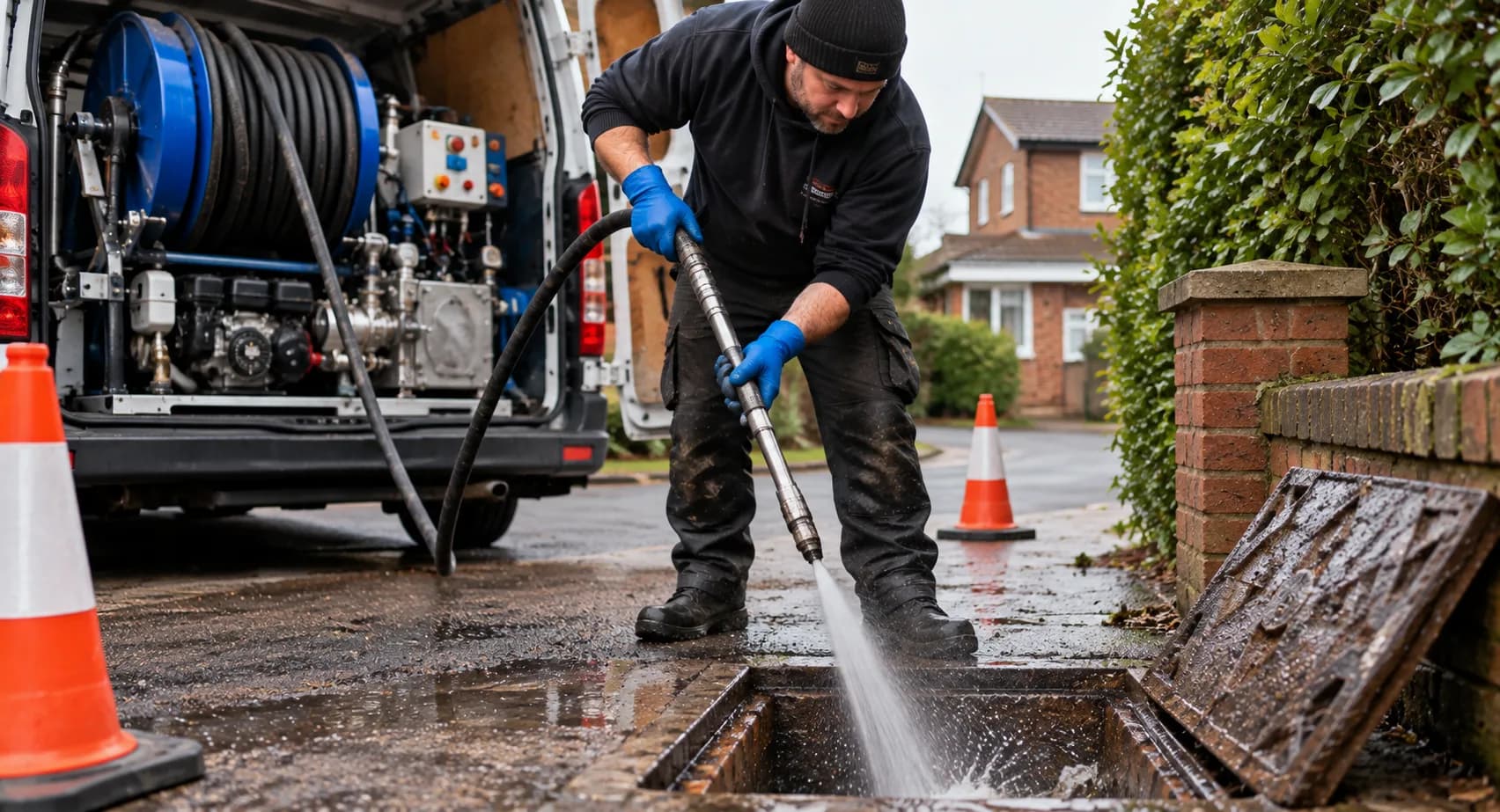
Drain jetting is cleaning a drain with water. A pump on a van or trailer pushes water down a flexible hose to a nozzle, and the jets on that nozzle do three jobs at once: they drive the hose up the pipe, they break into the blockage, and they scour fat, scale and silt off the pipe wall so it all flushes back to the chamber. The pipe ends up clean to its full bore rather than with a hole punched through the middle. That is why our drain jetting service is the usual fix for drains that keep blocking.
This guide explains how jetting works, what it can and can't clear, how safe it is for your pipes and how it compares with rodding.
How does drain jetting work?
It works through the nozzle and the volume of water behind it, not just the pressure. Most drain nozzles have several jets facing backwards and often one facing forwards.
- The rear jets push the nozzle forward, so the hose pulls itself up the pipe. They also spray outwards against the pipe wall, which is what scours off grease and scale.
- The forward jet cuts into the blockage ahead of the nozzle.
- The water flow carries the loosened debris back down to the chamber we started from, where it can be removed.
The engineer feeds the hose in from an inspection chamber or rodding eye, works the nozzle up to and through the blockage, then pulls it back slowly to wash the pipe clean. On most jobs the hose goes in and out several times.
Pressure is measured in bar and flow in litres per minute, and both matter. A TEPPFA bulletin on sewer jetting, written by the European plastic pipe industry, argues that high volume at lower pressure cleans better than low volume at very high pressure, because it covers the whole pipe and has enough water to carry debris away. It calculates that a 2.8mm nozzle at 120 bar delivers around five times the energy of a 1mm nozzle at 340 bar.
Which nozzles are used for drain jetting?
The nozzle is chosen for the job, and swapping it is part of the work. In general trade practice:
| Nozzle type | What it is for |
|---|---|
| Penetrating nozzle (strong forward jet) | Breaking into a full blockage of fat, paper or silt |
| Flushing or scouring nozzle (rear jets only) | Washing grease, scale and silt off the pipe wall and pushing debris back |
| Rotating nozzle | Even cleaning of the full circumference, often for grease |
| Root-cutting or chain-flail head | Cutting roots and hard deposits, used with care on weaker pipes |
What can drain jetting clear?
Jetting is best on soft and loose material that has built up along the pipe. TEPPFA's bulletin reports a Loughborough University survey of UK jetting contractors on what causes sewer blockages: grease 22%, silt 15%, tree roots 14% and solids 12%, with the rest put down to sewage and general causes. Jetting deals with most of these:
- Fat, oil and grease from kitchens, which coats the pipe and sets. Our guide to fat, oil and grease in kitchen sinks covers keeping it out.
- Silt, sand and grit, common in gullies and surface water drains.
- Scale and sludge on the pipe walls.
- Wet wipes and paper, once broken up.
- Fine roots, with the right head, though they will regrow. See our guide to tree roots in drains.
Jetting is also how we clean a drain before a CCTV survey or relining, because the camera and the liner both need a clean pipe.
When is jetting the wrong fix?
When the problem is the pipe itself, not what is in it. Jetting won't help, and can make things worse, if the pipe is:
- collapsed or broken, because debris is coming from the pipe and the jet can disturb more of it;
- badly displaced at a joint, where a lip catches debris and the nozzle can snag;
- deformed pitch fibre, which can blister and flatten. Our guide to pitch fibre pipes explains the problem;
- blocked by hard deposits such as set concrete. TEPPFA reports that clearing cured concrete from clay and concrete pipes in tests needed pressures above the WRc maximum, and that replacing the affected pipe would normally be recommended.
If a drain keeps blocking after jetting, or the engineer sees broken pipe coming out, the next step is a camera survey, not more jetting. Our guide to the signs of a blocked or collapsed drain lists what to look out for.
Is drain jetting safe?
For sound pipes, yes, when the pressure and nozzle are matched to the pipe. The risk comes from too much pressure on a weak or damaged pipe, and from high-pressure water near people.
For your pipes. TEPPFA says the Water Research Centre's Sewer Jetting Code of Practice (second edition, 2005) recommends a maximum of 130 bar, particularly where the pipe's condition is unknown or known to be defective. It also reports laboratory tests in which plastic pipes, new and used, took 50 passes at 120 bar from a 2.8mm nozzle without damage. That is why we check the pipe material and look for signs of damage before choosing the pressure.
For people. High-pressure water can cause injection injuries. An HSE safety alert describes these as the skin being broken by a jet of fluid under pressure, and says prompt medical treatment is essential. The Water Jetting Association has funded research into these injuries and publishes a step-by-step treatment guide for them. The WJA's codes of practice set out how jetting teams should work. In 2026 it combined its Blue, Red and Purple codes into a single WJA Black Code, which covers drain and sewer unblocking and cleaning. The WJA says the HSE recognises its code as defining water jetting standards in the industries it covers.
We are members of the Water Jetting Association and the National Association of Drainage Contractors. That is also the reason we don't recommend DIY jetting with a pressure washer drain attachment.
Drain jetting vs rodding: which is better?
Neither is always better. They suit different blockages, and many jobs use both.
| Drain jetting | Drain rodding | |
|---|---|---|
| How it works | Water through a nozzle cuts, scours and flushes | Flexible rods pushed or turned through the pipe with a tool on the end |
| Best for | Grease, silt, scale, roots, repeat blockages | A simple soft blockage close to an access point |
| What it leaves | A clean pipe wall, debris flushed out | A hole through the blockage; deposits often stay on the wall |
| Reach | Long runs and larger pipes | TEPPFA says rodding typically only suits pipes up to 250mm that are no more than 2m deep |
| Risk to the pipe | Low on sound pipes at suitable pressure; higher on damaged pipes | Rods and cutters can snag displaced joints or damaged pipe |
| Before a survey or relining | Yes, it cleans the pipe for the camera or liner | Not enough on its own |
Our drain unblocking cost guide compares typical prices for both.
When to call a professional
Call a drainage engineer if a drain is blocked and plunging or a garden hose hasn't shifted it, if the same drain blocks more than once, if you have a grease problem from a kitchen, or if you see slow drains, smells or water backing up in a gully. Stop and call us straight away if sewage is coming up inside.
We jet domestic and commercial drains across Nottingham, Nottinghamshire, Derbyshire, Leicestershire and Lincolnshire. Our drain unblocking starts from £120 + VAT, there is no call-out fee and we agree the price before we start. If we think the pipe is damaged, we'll say so and suggest a camera survey rather than keep jetting. We are open 7 days, 6am to 8pm, with emergency call-outs 365 days a year.
Call 07300 600 950, book online or ask for a quote.
Sources
Frequently Asked Questions
Cite this guide: “What Is Drain Jetting and How Does It Work?”, Urgent Drainage Solutions, 6 October 2026. https://urgentdrainagesolutions.co.uk/blog/what-is-drain-jetting

Need A Drainage Engineer?Book Online Today