
Recessed Manhole Covers for Block Paving, Patios and Driveways
Written by the Urgent Drainage Solutions teamPublished 9 min read
Checked by Eren Birinci (Gino), Founder & Lead Drainage Engineer on
Quick answer
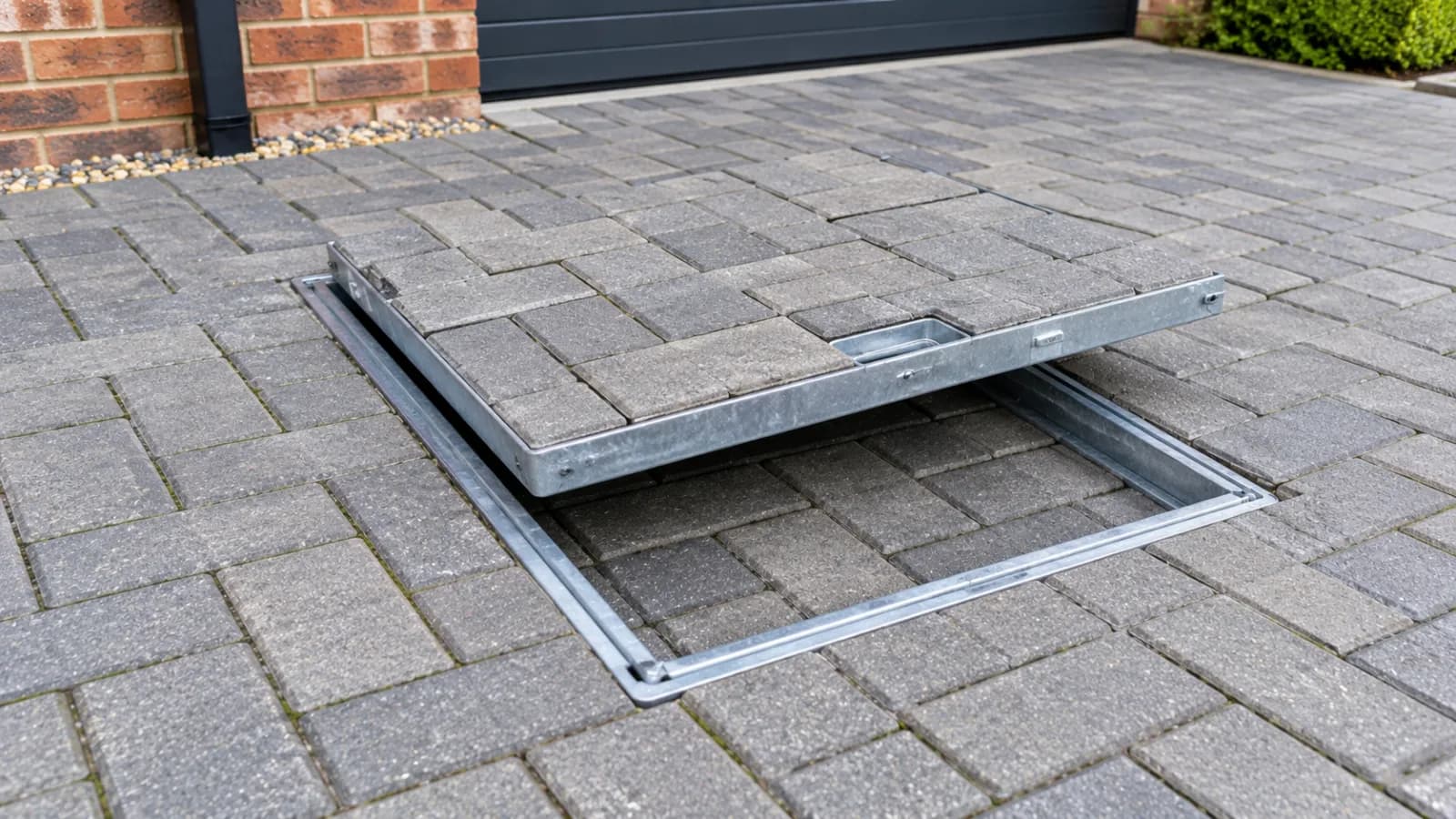
A recessed manhole cover is a steel or plastic tray that sits in a frame over the chamber and is filled with the same paving as the surface around it. Match the tray depth to your paving, such as an 80 mm recess for 60 mm blocks, and choose a driveway-rated cover wherever a car can reach.
- A recessed, inset or tray cover hides a chamber under matching paving while keeping it easy to lift.
- Tray depth has to allow for the paving plus its bedding: manufacturer Wrekin makes 80 mm recesses for 60 mm blocks and 100 mm recesses for 80 mm blocks.
- Use a driveway-rated cover wherever a vehicle can reach; pedestrian-rated trays are for patios and paths only.
- Never pave, deck or turf over a chamber: Approved Document H expects covers to be removable and access points on shared sewers to stay accessible.
- Most rocking and sinking trays come from poor bedding under the frame, not from the tray itself.
A recessed manhole cover is a lift-out tray, filled with the same paving as the surface around it, that sits in a frame over the chamber. It lets block paving, slabs or resin run across an inspection chamber without burying it. Choose it by clear opening, tray depth and load rating, and bed the frame properly. If the chamber itself has to be raised, moved or rebuilt for a new drive or patio, that is part of our drainage groundworks.
This guide covers when a recessed cover is the right answer, which tray depth and load rating to pick, how one is fitted in outline, and the mistakes that leave a tray rocking or sinking.
What is a recessed manhole cover?
It is a cover in two parts: a frame that is bedded over the chamber, and a tray that drops into the frame and holds the paving. The trade also calls it an inset cover, a tray cover or a block paving cover. Lift the tray and you have normal access to the drain.
Paving reference site Pavingexpert describes the usual options:
- Galvanised steel frame and tray. The standard for driveways and public areas.
- Plastic frame with a steel or plastic tray. Sold for light residential use.
- Square-to-round covers. A square tray on a frame made to sit on a round plastic inspection chamber, which makes the paving far easier to cut in.
Trays are lifted with keys or with handles built into the tray. Wrekin, for example, supplies trays with concealed lifting handles so no separate key is needed.
When should you use a recessed cover?
Use one wherever a plain lid would spoil a finished surface and you still need access, which is nearly always. JDP describes the tray as taking "block paving, screed, or other materials", and Drainfast lists block paving, concrete, resin-bound gravel and tiles as common infills.
- Block-paved driveways. The most common use. The pattern carries straight across the cover.
- Patios in slabs, stone or porcelain. The tray is filled with cut pieces of the same slab.
- Resin-bound and tarmac surfaces. Pavingexpert notes trays are used with both.
- Artificial grass. The same idea applies: the tray is filled to a firm, level base and the grass is cut to the tray so it lifts out with it. Ask the installer how they detail it, and do not let them lay the grass straight over a plain lid.
- Indoors. Where a chamber ends up inside an extension or garage, a sealed recessed cover takes floor tiles or screed. Our guide to manhole cover sizes and load classes explains the sealing rules.
A recessed cover is not worth it on gravel, a lawn or a planted border, where a solid cover set at the right level does the job.
What tray depth do you need for your paving?
The tray has to be deeper than the paving, to leave room for the bedding underneath. That is why an "80 mm" tray is not for 80 mm blocks. Wrekin states that its block infill trays have a recess of "80/100 mm for use with 60/80 mm blocks".
| Surface | Typical infill | Tray to look for | Notes |
|---|---|---|---|
| Block paving, 60 mm blocks | Blocks on a mortar or grit bed | 80 mm recess | Wrekin: 80 mm recess for 60 mm blocks |
| Block paving, 80 mm blocks | Blocks on a mortar or grit bed | 100 mm recess | Wrekin: 100 mm recess for 80 mm blocks |
| Slabs, stone or porcelain | Cut slabs on mortar | Deep enough for slab plus mortar | For thin slabs in a deep tray, Pavingexpert suggests stiff concrete under the mortar bed |
| Resin, screed, tiles | Screed or resin laid in the tray | Shallow screed tray | Drainfast lists a 46 mm screed tray alongside 80 mm and 100 mm block trays |
| Gravel or permeable infill | Loose grit bed on a geotextile | Tray with drainage holes | Pavingexpert warns that a tray with no way out for water stays wet |
Measure the thickness of the actual block or slab before ordering. Then check the clear opening, which is the size of the chamber opening and not the outside of the frame. Common recessed sizes include 450 x 450 mm, 600 x 450 mm and 600 x 600 mm, and Pavingexpert gives 450 x 600 mm as the most common domestic size.
What load rating does a driveway or patio need?
A driveway needs a vehicle-rated cover and frame; a patio that no vehicle can reach can take a pedestrian-rated one. Two rating systems are in use, which causes confusion.
Cast and ductile iron covers carry a BS EN 124 class. Fabricated steel trays are often sold with a FACTA class or a tonne rating instead. Pavingexpert points out that FACTA classes are "NOT the same as EN 124", so compare like with like.
| Where the cover sits | BS EN 124 class (JDP) | Fabricated steel trays (Pavingexpert) |
|---|---|---|
| Patio, path or garden with foot traffic only | A15 | FACTA grade A |
| Domestic driveway for cars | B125 | At least FACTA grade AA, with a safe working load of 1.5 tonnes or more |
| Driveway used by vans or large 4x4s | B125 or higher | Consider FACTA class B |
| Yards with lorries, or anywhere traffic moves fast | C250 or D400 | Not suitable: JDP says steel recessed covers are only for speeds up to 20mph |
Drainfast's recessed range runs from 3.5 tonnes to 10 tonnes. JDP's advice is to allow for the heaviest vehicle that might ever cross, including caravans, motorhomes and delivery vans, and to go for the higher rating if in doubt.
How is a recessed manhole cover fitted?
The frame is bedded solidly on the chamber at the finished paving level, the tray is dropped in, and the paving is laid in the tray to match. This outline follows Pavingexpert's method.
- Set the level. A string line gives the finished paving level. The frame is set 3 to 6 mm below it, so paving sits slightly proud of the ironwork.
- Take off the old cover and frame. Leave the old lid on while digging round it, to keep spoil out of the chamber.
- Bring the chamber to height. Brick chambers are built up or taken down; plastic chambers use risers. Pavingexpert allows a mortar bed of up to about 15 mm and says anything more needs solid masonry such as engineering brick, never timber packing.
- Bed the frame. The frame goes on a full bed of strong mortar, is checked for level in several directions, and is haunched round the outside. On a plastic chamber the gap between frame and chamber is sealed with mortar.
- Clear the chamber. Mortar and debris dropped into the channel must come out, or they start the next blockage.
- Let it cure. Pavingexpert gives at least 24 hours before paving up to the frame, and 48 to 72 hours where masonry has been built up, before any compaction nearby.
- Fill the tray. Blocks or slabs are bedded in the tray, on mortar for a rigid finish, with cuts lined up with the pattern outside.
- Protect the joint. The edges of the tray and the inside of the frame are coated with a non-setting grease such as petroleum jelly, so jointing sand does not lock the tray in.
Why should you never pave over a manhole?
Because you, or the next owner, will need to get into it. A chamber is the access point for rodding, jetting and camera surveys. Bury it and a simple blockage becomes a search and a dig.
Approved Document H says inspection chambers and manholes should have removable covers (paragraph 2.54). On a sewer serving more than one property, it says access points should be "accessible and apparent for use in an emergency", and that buildings and extensions should not be built over them (Requirement H4, paragraph 1.3).
If the chamber is on a shared pipe, it is probably a public sewer. Water UK describes sewers carrying wastewater from two or more houses as pipes the water company owns and looks after, and in the East Midlands that company is usually Severn Trent or Anglian Water. Under section 159 of the Water Industry Act 1991 a sewerage undertaker has the power to "inspect, maintain, adjust, repair or alter" its pipes in private land, after reasonable notice. Water UK's guide for homeowners warns against any work that makes it "harder for water companies to access and maintain their sewers". A recessed tray keeps that access. Paving or decking over the lid removes it, and anything you lay over the chamber may have to come up when access is needed.
So ask the water company before altering a chamber on a shared sewer. Our guide to build over agreements covers the rules for extensions, and our guide to finding drainage plans explains how to check which pipes are shared.
Why do recessed covers rock or sink?
Nearly always because of what is under the frame. The tray gets the blame, but the bedding is usually at fault.
| What you see | Likely cause | What to do |
|---|---|---|
| Tray rocks or clunks when driven over | Frame bedded out of level, or mortar or grit on the seating | Lift the tray, clean the seating; rebed the frame if it is twisted |
| Frame and tray have sunk below the paving | Frame bedded on thin mortar over loose backfill, thick mortar beds or timber packing | Lift the frame and rebed on solid masonry or concrete |
| Paving round the frame has dipped | Compacted too soon, or poor backfill round the chamber | Lift and relay the surround on a sound base |
| Blocks loose in the tray | Bedding too weak, washed out or laid without mortar | Empty the tray and rebed the infill |
| Tray will not lift | Jointing sand packed between tray and frame | Free it carefully; grease the edges when refitting |
| Tray bent or lid cracked | Pedestrian-rated cover under vehicles | Replace cover and frame with the right rating |
| Tray holds water | No drainage through the tray | Fit a tray with drainage holes and re-lay the infill |
Pavingexpert is firm on the main cause. Bedding a frame on about 20 mm of mortar over uncertain backfill is, it says, unacceptable: the weak ground should be dug out to 100 to 150 mm and replaced with concrete. It also warns that heavy concrete haunching over a flexible sub-base can cause differential settlement, so the surround drops while the chamber stays put.
Looks matter too. A tray reads as an obvious patch when its blocks are out of line with the pattern, when a border course is run round it, or when the infill is a different stone. Line the tray up with the paving before the frame is bedded.
When to call a professional
Call a drainage contractor if the chamber has to be raised, lowered or moved to suit a new drive or patio, if the chamber walls are crumbling when the old frame comes off, if a cover has sunk or keeps rocking, or if you are not sure whether the chamber is on a shared sewer. It is also the moment to check the drain itself. A CCTV drain survey from £149 + VAT before the paving goes down finds a damaged pipe while it is still easy to reach, not after the new drive is laid over it.
Our groundworks team installs, raises and rebuilds manholes and inspection chambers, lays new drain runs and fits channel drains for driveways. Drainage groundworks start from £500 + VAT, and chamber rebuilds are priced as drain repairs from £250 + VAT, with a fixed quote before work starts and no call-out fee. The paving itself is a job for your paving contractor. Ask us whether fitting the recessed frame can be part of the chamber work on your job.
We are open 7 days a week, 6am to 8pm, with emergency call-outs 365 days a year, across Nottinghamshire, Derbyshire, Leicestershire and Lincolnshire, including Nottingham. Call 07300 600 950 or ask for a quote. If a cover is already broken, see our guide to manhole cover replacement.
Sources
- Pavingexpert: Recess tray covers
- Pavingexpert: Installing a recess tray cover
- Pavingexpert: Fitting paving to a recess tray
- Wrekin Products: Recessed trays for block infill
- JDP: How to choose the right manhole or access cover
- Drainfast: Recessed manhole covers
- Approved Document H: Drainage and waste disposal (gov.uk)
- Water Industry Act 1991, section 159 (legislation.gov.uk)
- Water UK: Build over guide for homeowners
Frequently Asked Questions
Cite this guide: “Recessed Manhole Covers for Block Paving, Patios and Driveways”, Urgent Drainage Solutions, 13 November 2026. https://urgentdrainagesolutions.co.uk/blog/recessed-manhole-covers