
Drainage and Water Search (CON29DW): What It Tells You When Buying a Home
Written by the Urgent Drainage Solutions teamPublished 8 min read
Quick answer
A drainage and water search, the CON29DW, is a desk report from the water company's records. It shows public sewer and water main maps, whether the home is connected, any recorded build-over approval, adoption agreements and the sewer flooding register. It does not show the condition or route of your private drains. Only a camera survey does that.
- The CON29DW is a Law Society form answered from the water company's maps, billing records and registers, not from a site visit.
- It shows public sewers and water mains near the property, connection status, build-over records, adoption agreements and sewer flooding risk.
- Connection answers are based on billing records, and most sewers transferred in 2011 are not drawn on the map.
- It says nothing about cracks, roots, pitch fibre or the route of your own drains.
- Severn Trent Searches lists its residential CON29DW at £63.50 + VAT for electronic delivery.
A drainage and water search, known in conveyancing as the CON29DW, is a desk report built from the water company's records. It tells you whether the home is connected to the public sewer and mains water, where the public pipes run, whether any build-over approval is on file and whether the property is on the sewer flooding register. What it cannot tell you is whether the drains under the garden are cracked, full of roots or collapsing. That is the job of a homebuyer drain survey, which puts a camera through the pipes before you exchange.
This guide goes through what each part of the search shows, how to read the answers that matter for drains, what the search leaves out, and how to decide whether to follow it with a survey.
What is a drainage and water search?
It is a standard set of questions, owned by the Law Society, that your conveyancer sends to the water company serving the property. The Law Society publishes two versions: the CON29DW Residential drainage and water enquiries (2016) and a commercial version (2021). In most of the East Midlands the answers come from Severn Trent or Anglian Water records, either directly or through a search provider.
Severn Trent Searches lists its residential CON29DW at £63.50 + VAT for electronic delivery and £65.00 + VAT for a search sourced from Anglian Water. Your conveyancer usually orders it with the local authority search.
Its own sample report lists the records it checks: the map of public sewers, the map of waterworks, water and sewer billing records, sewer adoption records, building-over records, the register of properties subject to internal foul flooding, the low water pressure register and the drinking water register. Nobody visits the property.
What does a CON29DW show?
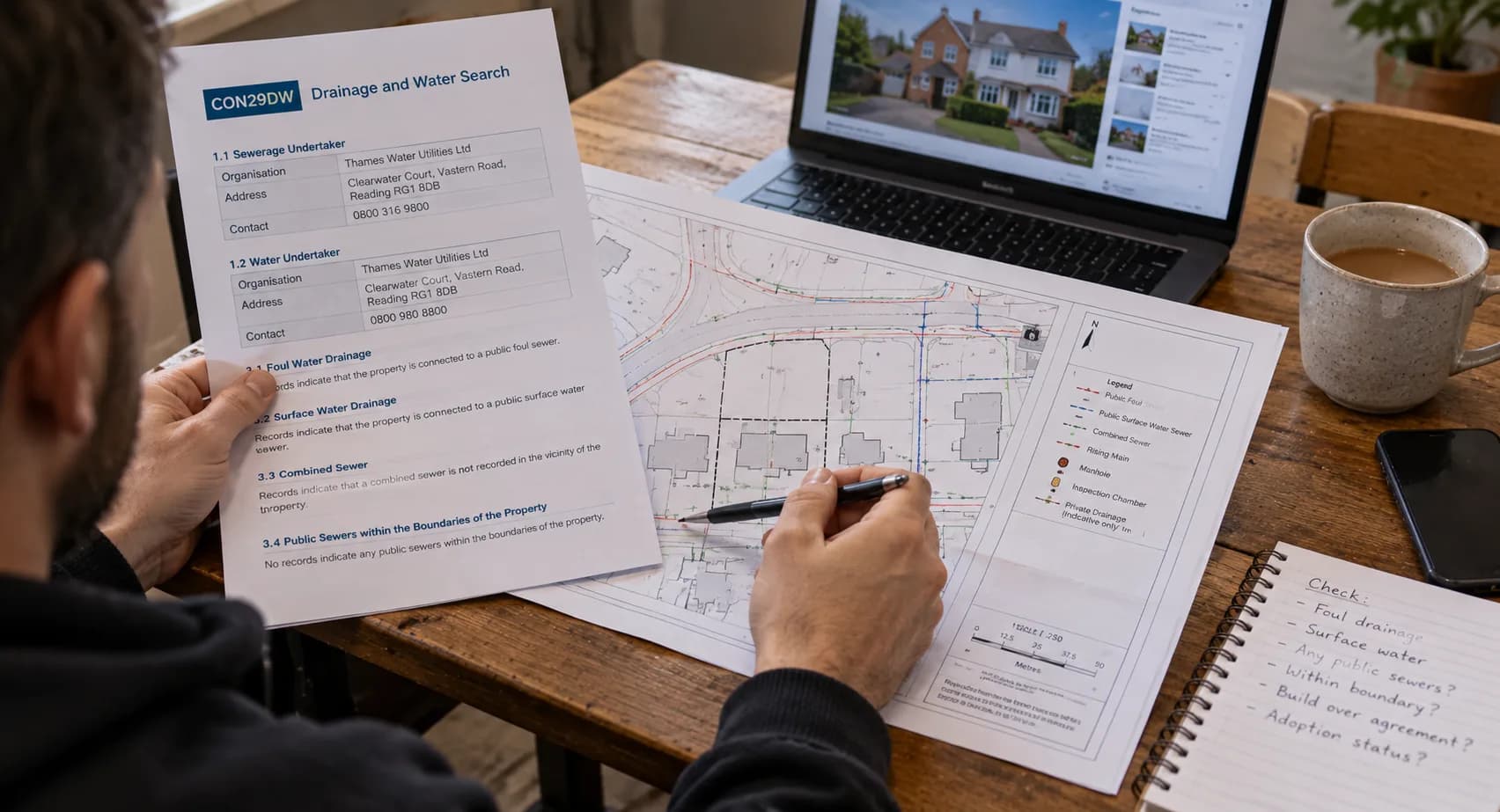
It is split into maps, drainage, water and charges. Severn Trent's sample report numbers the questions like this:
| Section | Questions | What you learn |
|---|---|---|
| Maps | 1.1 and 1.2 | An extract of the public sewer map and the water main map around the property |
| Drainage | 2.1 to 2.3 | Whether foul water and surface water drain to a public sewer, and whether a surface water charge is payable |
| Drainage | 2.4 to 2.5.1 | Whether a public sewer or pumping station is shown within the boundary, a public sewer within 30.48 metres (100 feet) of a building, or a pumping station within 50 metres |
| Drainage | 2.6 and 2.7 | Any sewer adoption agreement, and whether the water company has approved or been consulted on building over or near a public sewer |
| Drainage | 2.8 and 2.9 | Whether the property is recorded as at risk of internal flooding from overloaded public sewers, and the distance to the nearest sewage treatment works |
| Water | 3.1 to 3.6 | Mains connection, water mains within or near the boundary, adoption, low pressure risk, water hardness and meter location |
| Charges | 4.1 to 4.5 | Who the water and sewerage companies are, who bills the property and on what basis |
How do you read the drainage answers that matter?
Read questions 2.1, 2.4, 2.7 and 2.8 carefully, and read the guidance notes under each answer, because the caveats are where the useful information sits.
Connection (2.1 and 2.2). A "Yes" here comes from billing records. The sample report says the answer is "based on a review of the relevant water company's billing records". It confirms the house is billed as connected. It doesn't trace the pipe.
Public sewer within the boundary (2.4). If the map shows one, the water company is responsible for it and has a legal right of access. It may also restrict building, because you need the company's approval to build close to a public sewer. The sample notes that there may be other public pipes within the boundary that are not drawn at all, because of the private sewer transfer of 1 October 2011.
Build-over (2.7). A "No" means no approval or consultation is on record. It doesn't mean nothing was built over a sewer. The sample report says the water company "might not be aware of a building or extension that has been built over or close to a public sewer asset". It also says Severn Trent became directly responsible for build-over approval on 1 November 2004, and is unlikely to hold records of domestic build-overs from before then. If the house has an extension near a drain and 2.7 says "No", ask the seller what consent was obtained. Our guide to building over a drain explains the rules.
Sewer flooding (2.8). This refers to the water company's register of properties at risk of internal flooding from overloaded public sewers. It does not include flooding caused by blockages, silt or collapses, and if a private sewer flooded a home before it became public in 2011, the property isn't added to the register unless it floods again. A "No" is good news, but it isn't a guarantee.
Public sewer within 30.48 metres (2.5). This matters most for homes on a septic tank or cesspit. The report explains that the local authority can require a connection to the public sewer if a private system is causing an environmental problem and a sewer is within that distance.
What does a drainage and water search not tell you?
It tells you what the records say, not what is in the ground. Things it won't show:
- The condition of any pipe. Cracks, fractures, displaced joints, root ingress and deformation are invisible to a desk search.
- The route of your private drains. The sample report says the water company "has no records of these connecting pipes" if they are not on the map.
- Most of the sewers transferred in 2011. The report says these are mostly not shown, because the company has no record of where they run. If you need the exact layout within the boundary, it says you may need your own on-site survey.
- Pipe material. It won't flag pitch fibre pipes, which were common in homes of the 1950s to 1970s.
- Whether a structure actually sits on a drain. The map is a general guide, and extensions put up without consent won't appear in the records.
- The state of a septic tank or treatment plant. Private systems are outside the water company's records.
Searches vs survey: which answers which question?
The search and the survey do different jobs, and most buyers need both on an older house. This is how we explain the difference to buyers:
| Question you want answered | CON29DW search | CCTV homebuyer drain survey |
|---|---|---|
| Is the house connected to the public sewer? | Yes, from billing records | Shows where the pipes go, but not the billing status |
| Where do the public sewers run? | Yes, from the water company map | Can locate and trace runs on site, including unmapped ones |
| Where do my private drains run? | No | Yes, a drain plan of runs, chambers and flow direction |
| Are the pipes cracked, rooted or collapsed? | No | Yes, each defect coded to WRc MSCC5 with its position |
| Are the drains pitch fibre? | No | Yes, the camera shows the pipe material |
| Was build-over approval recorded? | Yes, if the water company holds a record | No, but it shows whether a pipe runs under the structure |
| Is the property on the sewer flooding register? | Yes | No |
| Who bills for water and sewerage? | Yes | No |
| Typical cost | £63.50 + VAT (Severn Trent Searches, electronic) | Our CCTV surveys start from £149 + VAT |
When should a buyer follow the search with a drain survey?
When the search raises a question the records can't answer, or the house has the usual risk factors. We'd book a camera survey before exchange if:
- 2.4 shows a public sewer within the boundary and there is an extension, conservatory or garage near its line;
- 2.7 says "No" but the house has an extension that looks like it sits over a drain;
- it is an older house, particularly one built in the 1950s to 1970s when pitch fibre drains were common;
- there are mature trees near the drain runs;
- the seller's property information form mentions blockages, jetting or drain repairs;
- you noticed slow drains, smells or sunken paving at the viewing.
Our main guide on whether you need a drain survey when buying a house covers the red flags, the RICS survey levels and where the survey fits in the timeline, so we won't repeat that here.
Buyer's checklist: drainage before you exchange
- Ask your conveyancer for the full search report, not just the summary page, and read the guidance notes under each answer.
- Open the sewer map extract (1.1). Mark any public sewer near the house, extension or outbuildings.
- Check 2.4 and 2.7 together. A public sewer in the boundary plus no recorded build-over approval, with an extension nearby, is a question for the seller.
- Check 2.8. If the property is on the flooding register, ask the seller and the water company what has been done.
- Look at 2.5 if the house isn't on mains drainage. Ask for emptying and maintenance records for the septic tank or treatment plant.
- Lift the covers if you can, or ask your surveyor what they saw. Standing water or debris in a chamber is a reason to survey.
- Book a CCTV survey on older houses and give the drainage firm your target exchange date.
- Work out who owns any defect. Citizens Advice explains that you are responsible for drains inside your boundary serving only your home, while the water company is responsible for lateral drains and sewers. Our guide on who is responsible for blocked drains sets out the split.
- Send the survey report to your conveyancer so they can raise it before exchange.
When to call a professional
If the search and the house don't match up, get the drains looked at before you commit. That means an extension near a mapped sewer, an older house with no history of drain work, trees close to the runs or any sign of trouble at the viewing. A desk search can't settle any of those.
We carry out homebuyer drain surveys across Nottingham and the rest of Nottinghamshire, Derbyshire, Leicestershire and Lincolnshire. Every survey comes with the footage, photos, a written report coded to WRc MSCC5 and a drain map, and our CCTV surveys start from £149 + VAT. There is no call-out fee, and we agree the price before we start. Our guide to reading a CCTV drain survey report explains what the codes mean once you have it.
Call 07300 600 950, book online or ask for a quote. We are open 7 days, 6am to 8pm.
Sources
- The Law Society: CON29 forms, including CON29DW Residential (2016) and Commercial (2021)
- Severn Trent Searches: CON29DW drainage and water enquiry, prices and product details
- Severn Trent Searches: residential CON29DW sample report (September 2026)
- Citizens Advice: who is responsible for repairing drains and sewers
Frequently Asked Questions
Cite this guide: “Drainage and Water Search (CON29DW): What It Tells You When Buying a Home”, Urgent Drainage Solutions, 6 October 2026. https://urgentdrainagesolutions.co.uk/blog/drainage-and-water-search-con29dw

Need A Drainage Engineer?Book Online Today