
How to Get Rid of Drain Flies
Written by the Urgent Drainage Solutions teamPublished 9 min read
Quick answer
To get rid of drain flies, find the drain they breed in and physically remove the slimy film inside it. Tape over each plughole overnight to see which one they come from, scrub the waste and trap with a stiff brush, and use an enzyme drain cleaner to keep it clean. Bleach and fly sprays rarely work on their own.
- Drain flies are moth flies (family Psychodidae) whose larvae live in the slimy film lining drains, traps and overflows.
- A strip of clear tape over each plughole overnight shows which drain the flies are coming from.
- Scrubbing out the film with a brush and using an enzyme cleaner works; Ohio State says the larvae are surprisingly resistant to bleach.
- Boiling water is no cure: larvae shelter under the film, and plastic waste pipes are only rated for short bursts at that temperature.
- Flies that keep coming back after every drain is clean, especially with a sewage smell, can point to a broken drain that needs a camera survey.
To get rid of drain flies, you have to find the drain they are breeding in and physically remove the slimy film that lines it. Spraying the adults does nothing to the larvae in the pipe. Tape over each plughole overnight to see which one the flies come from, scrub that waste, trap and overflow with a stiff brush, then keep it clean with an enzyme drain cleaner. If the flies keep coming back, or there is a sewage smell or a slow drain as well, the problem may be further down the pipe, and our blocked drains service can clear and check it from £120 + VAT.
This guide explains how to tell drain flies from other small flies, where they breed, a simple test to find the source, what works and what doesn't, and when flies point to a broken drain.
What are drain flies?
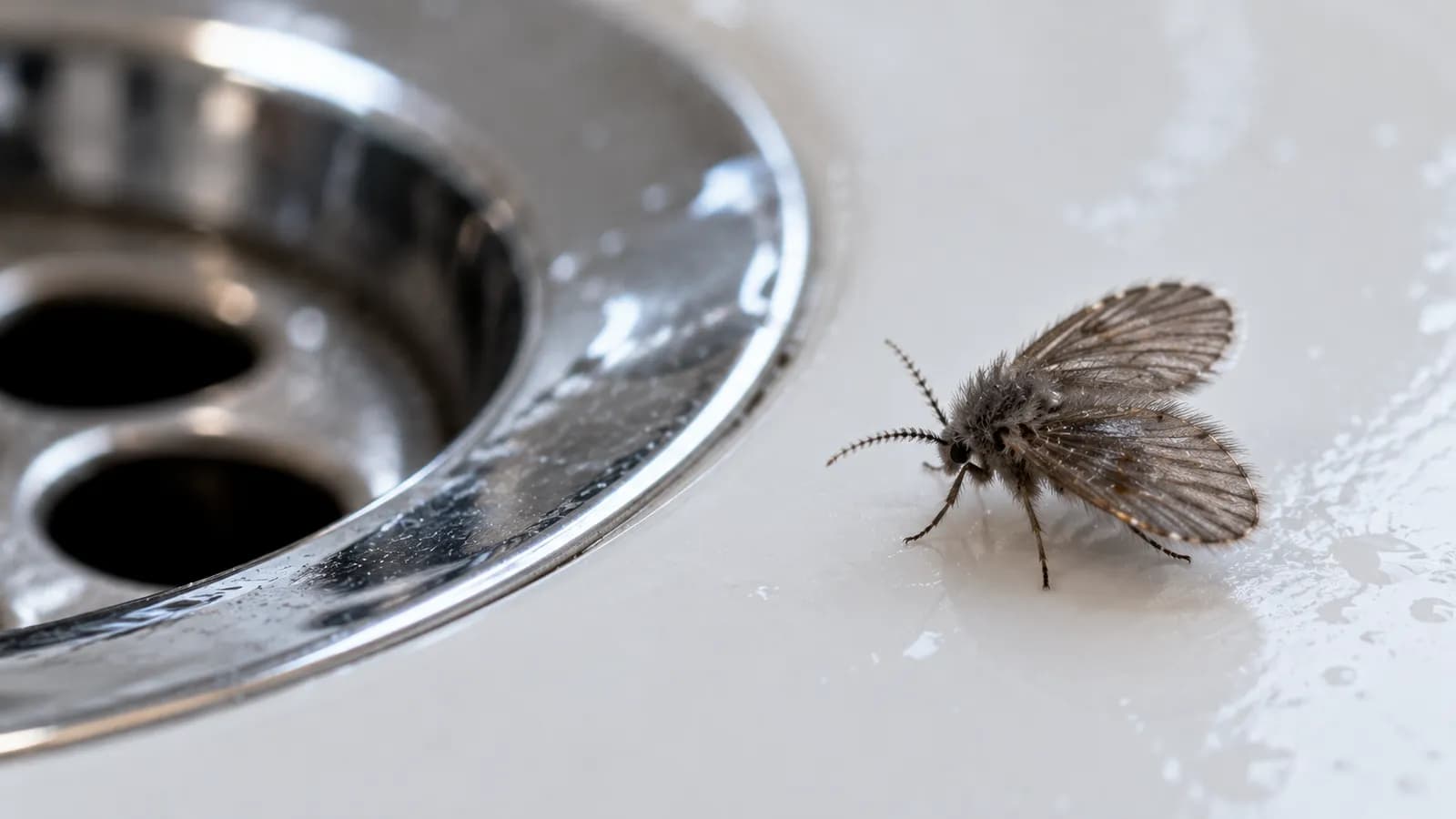
Drain flies are moth flies, small fuzzy flies in the family Psychodidae that breed in the slime inside drains. Ohio State University's fact sheet describes the adults as 1/5 to 1/6 of an inch long (about 4 to 5 mm), dark or greyish, with hairy wings held roof-like over the body. They tend to sit on walls and tiles near sinks, baths and showers, and are most active in the evening.
The UK has plenty of them: the NatureSpot species database lists 99 UK species in the Psychodidae family, also known as owl midges. Only a few species turn up in homes. They do not bite, and Washington State University describes most species as a nuisance rather than a health pest. The real point is what they tell you: somewhere in your pipework there is enough organic sludge for them to breed in.
How do you tell drain flies from fruit flies and fungus gnats?
| Fly | What it looks like | Where it breeds | Clue |
|---|---|---|---|
| Drain fly (moth fly) | Fuzzy, grey-brown, moth-like wings held over the body | Slime inside drains, traps and overflows | Sits still on bathroom walls; flutters short distances |
| Fruit fly | Smooth tan body, often large red eyes | Rotting fruit, bins, food waste | Hangs around the fruit bowl and kitchen bin |
| Fungus gnat | Slim, dark, long legs, like a tiny mosquito | Damp compost in house plants | Rises from plant pots when you water them |
| Phorid (scuttle) fly | Humpbacked, runs across surfaces | Wet decaying matter, including leaking sewage | Large numbers can mean a broken drain, says a Pacific Northwest school pest leaflet |
Where do drain flies breed?
Drain flies breed in the gelatinous film of bacteria, hair, soap and food waste that builds up inside waste pipes. Ohio State says the eggs, larvae and pupae are all found in this "bacterial muck", with egg masses of 10 to 200 eggs, and that the cycle from egg to adult takes one to three weeks. Adults live about two weeks.
The usual places in a house are:
- the waste and trap under a kitchen sink, where grease and food scraps collect;
- shower trays and bath wastes, where hair and soap build up;
- basin and bath overflows, which almost never get cleaned;
- the trap of a sink, shower or floor drain that is rarely used and has started to dry out;
- utility room wastes, washing machine standpipes and the damp lint behind appliances;
- outside gullies close to a door or airbrick;
- a cracked or leaking drain under a ground floor, where wet soil and sewage give larvae somewhere to live.
Utah State University's Extension notes that drain flies can breed around broken pipes or drains beneath slabs and get into buildings through cracks in the floor. That last case is rare, but it is the one that cleaning alone will never fix.
How do you find which drain the flies are coming from?
Use a tape test: stick a strip of clear packing tape over each plughole at night, sticky side down, and check the underside in the morning. Flies stuck to the tape show you which drain they are emerging from. Leave a small gap at one edge so the drain is not completely sealed, and do it when nobody needs that sink or shower.
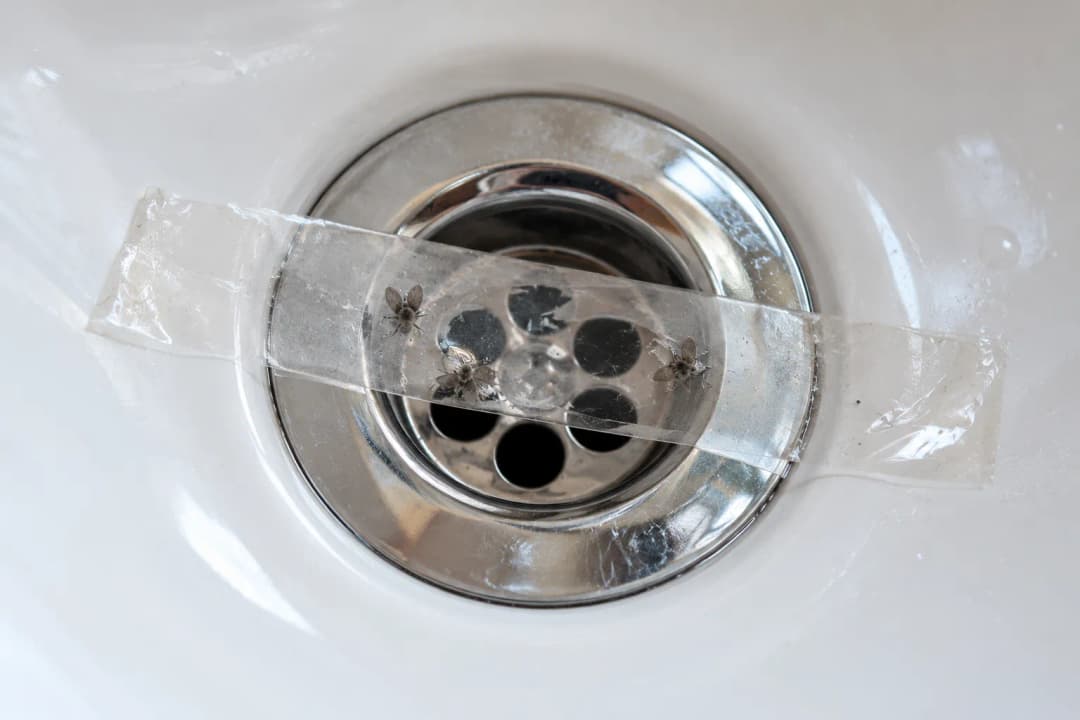
Ohio State's version uses a clear plastic container with glue boards taped inside, upturned over the drain overnight or for a few days. Either way, test every drain in the room, including the overflow on a basin or bath (tape over the overflow slot as well) and any floor drain. Repeat for two or three nights, because adults do not emerge every night.
If no drain catches flies but they keep appearing, look for standing water elsewhere: a drip tray under the fridge, a leaking washing machine hose, a dirty bin, or a damp patch on the floor.
How do you get rid of drain flies for good?
Clean the breeding film out of the drain physically, then stop it building up again. In order:
- Remove the plug, strainer or pop-up waste and clean it. Hair and slime collect underneath.
- Scrub the inside of the waste pipe as far as you can reach with a long, stiff drain brush. Utah State recommends a hard bristle brush; Ohio State suggests a stiff, long-handled brush or a brush-tipped snake.
- Unscrew the trap under the sink or basin (with a bucket under it), empty it and scrub it out. Our guide to unblocking a sink shows how to take a trap off and refit it.
- Brush out the overflow channel with a bottle brush, and flush it with hot water.
- Rinse the loosened material away with plenty of hot tap water.
- Use an enzyme or biological drain cleaner, following the label, to break down the film you could not reach. Ohio State and Washington State both recommend enzyme or biological cleaners over harsh chemicals.
- Repeat the tape test a week later. Some adults will still emerge from eggs already laid, so give it two to three weeks before deciding it hasn't worked.
Sticky fly traps catch adults while you do this, but on their own they will not clear the problem. Ohio State says fly papers and traps catch some flies but won't eliminate an infestation, and indoor sprays only knock down adults.
Does boiling water kill drain flies?
Boiling water rarely clears drain flies, because the larvae shelter under the film. Utah State University says the larvae hide behind the scum, which makes treatments with boiling water, pesticides or other chemicals ineffective. Ohio State suggests flushing with hot water only after the scum has been scrubbed out.
There is also your pipework to consider. Most modern waste pipes are plastic, and they are rated for short bursts at high temperature, not repeated floods of boiling water. FloPlast's technical sheet for its ABS solvent weld waste system gives a maximum of 76°C for continuous flow, with intermittent discharges of up to 100°C allowed for less than two minutes. A kettle now and then is within that, but pan after pan of boiling water poured to "cook" the larvae can soften joints over time. Hot tap water, or a kettle left to cool for a few minutes, does the rinsing job safely.
Why doesn't bleach get rid of drain flies?
Bleach runs straight past the film the larvae live in. Ohio State's fact sheet says bleach "does not seem to rid pipes of the scum" and that drain fly larvae are "surprisingly resistant" to it. A Pacific Northwest school pest leaflet adds that the larvae retreat into the scum layer to escape harsh cleaners, and that once established, the layer usually needs removing by scrubbing.
Never mix bleach with caustic drain unblockers: Ohio State warns that the combination can produce chlorine gas in the drain line. Our guide to whether bleach unblocks drains covers the other reasons it is a poor drain cleaner.
Can drain flies mean a broken or leaking drain?
They can, when flies keep coming back after every drain in the house has been cleaned. A cracked or displaced pipe under a ground floor leaks sewage into the soil around it, which gives larvae a breeding ground you cannot reach with a brush. Utah State notes that drain flies can breed around broken pipes beneath slabs and enter through floor cracks.
Signs that point below the floor rather than to a single plughole:
- flies emerging near skirting boards, floor tiles or a ground-floor toilet rather than from a plughole;
- a sewage smell that comes and goes, especially after the drains have been used;
- a damp patch, lifting floor tiles or sunken ground near a drain run;
- gurgling, slow or repeatedly blocked drains as well as the flies.
Our guide to why drains smell helps separate a dry trap from a drain defect, and the signs of a blocked or collapsed drain covers the warning signs in more detail. In practice, the way to confirm a broken drain is a CCTV drain survey, which records the inside of the pipe and shows any cracks, open joints or root intrusion.
Drain fly source-and-fix checklist
Work through this list from the top. Most cases are solved in the first three rows.
| Possible source | How to check | Fix |
|---|---|---|
| Kitchen sink waste and trap | Tape test; look for grey slime in the trap | Remove and scrub trap, brush the waste, enzyme cleaner |
| Shower or bath waste | Tape test; lift the waste cover | Remove hair, scrub the waste and trap, enzyme cleaner |
| Basin or bath overflow | Tape over the overflow slot overnight | Bottle brush and hot water down the overflow |
| Little-used sink, shower or floor drain | Trap smells or looks dry | Run water for a minute every week to refill the seal |
| Washing machine standpipe or utility waste | Tape test; check for lint and standing water | Clean the standpipe trap and floor behind the machine |
| Outside gully by a door or airbrick | Flies on outside walls near it; leaves and silt in the gully | Clear the gully and grate; see our outside drain guide |
| Leaks, bins and drip trays | Look under appliances and in bins | Fix the leak, dry and clean the area |
| Broken drain under the floor | Flies persist after all the above; smell; damp floor | CCTV drain survey, then repair |
How do you stop drain flies coming back?
Keep the film from building up again. Fit hair catchers in showers and baths and strainers in sinks, and empty them often. Scrape plates into the bin rather than the sink, and keep fat out of the drain (our fat, oil and grease guide explains why). Brush out wastes and overflows every few weeks, and use an enzyme drain cleaner regularly: Utah State recommends one to keep drains free of organic film. Run water through spare bathrooms and floor drains weekly so the traps never dry out.
When to call a professional
Call us if the flies keep returning after you have cleaned every trap, waste and overflow, if they appear from the floor rather than a plughole, or if you also have a sewage smell, gurgling or slow drains. Those point to a build-up further along the pipe, or a cracked drain, that you cannot reach from the plughole.
Our blocked drains service starts from £120 + VAT with a fixed price agreed before we start. We can jet out the pipe to remove the build-up and, where a defect is suspected, carry out a CCTV drain survey to find it. We cover Nottingham, Nottinghamshire and the East Midlands, 7 days a week from 6am to 8pm, with emergency call-outs 365 days a year. Call 07300 600 950 or book online.
Sources
- Ohio State University (CFAES): Drain Flies (Moth Flies) fact sheet, W. F. Lyon, revised by D. Shetlar
- Utah State University Extension: Drain (Moth) Fly
- Washington State University Pestsense: Moth flies (drain flies)
- Pacific Northwest School IPM: PNW Pest Press, Drain Flies (WSU Extension)
- NatureSpot: Moth Flies (Psychodidae)
- FloPlast: ABS solvent weld waste system technical sheet (hosted by Wickes)
Frequently Asked Questions
Cite this guide: “How to Get Rid of Drain Flies”, Urgent Drainage Solutions, 16 October 2026. https://urgentdrainagesolutions.co.uk/blog/how-to-get-rid-of-drain-flies

Need A Drainage Engineer?Book Online Today