Toilet Backing Up? What to Do When Sewage Comes Up in the House
Written by the Urgent Drainage Solutions teamPublished 6 min read
Quick answer
A toilet backing up with sewage means the pipe below it is full, because your drain is blocked or the public sewer is overloaded or blocked. Stop using all water straight away, keep people away from the waste, and check whether neighbours are affected. If they are, call the water company; if not, the blockage is probably in your drain.
- Stop all water use the moment a toilet backs up: every flush, tap and appliance adds to the flood.
- If neighbours are affected too, the problem is probably in a shared drain or the public sewer, which is the water company's to clear.
- UKHSA advises rubber boots, waterproof gloves and an apron for clean-up, and handwashing with soap and warm water.
- In England, sewage from the company's sewer entering your home triggers a payment equal to your annual sewerage charge, from £300 up to £2,000.
- Where the sewer surcharges in heavy rain, Approved Document H recommends an anti-flooding valve.
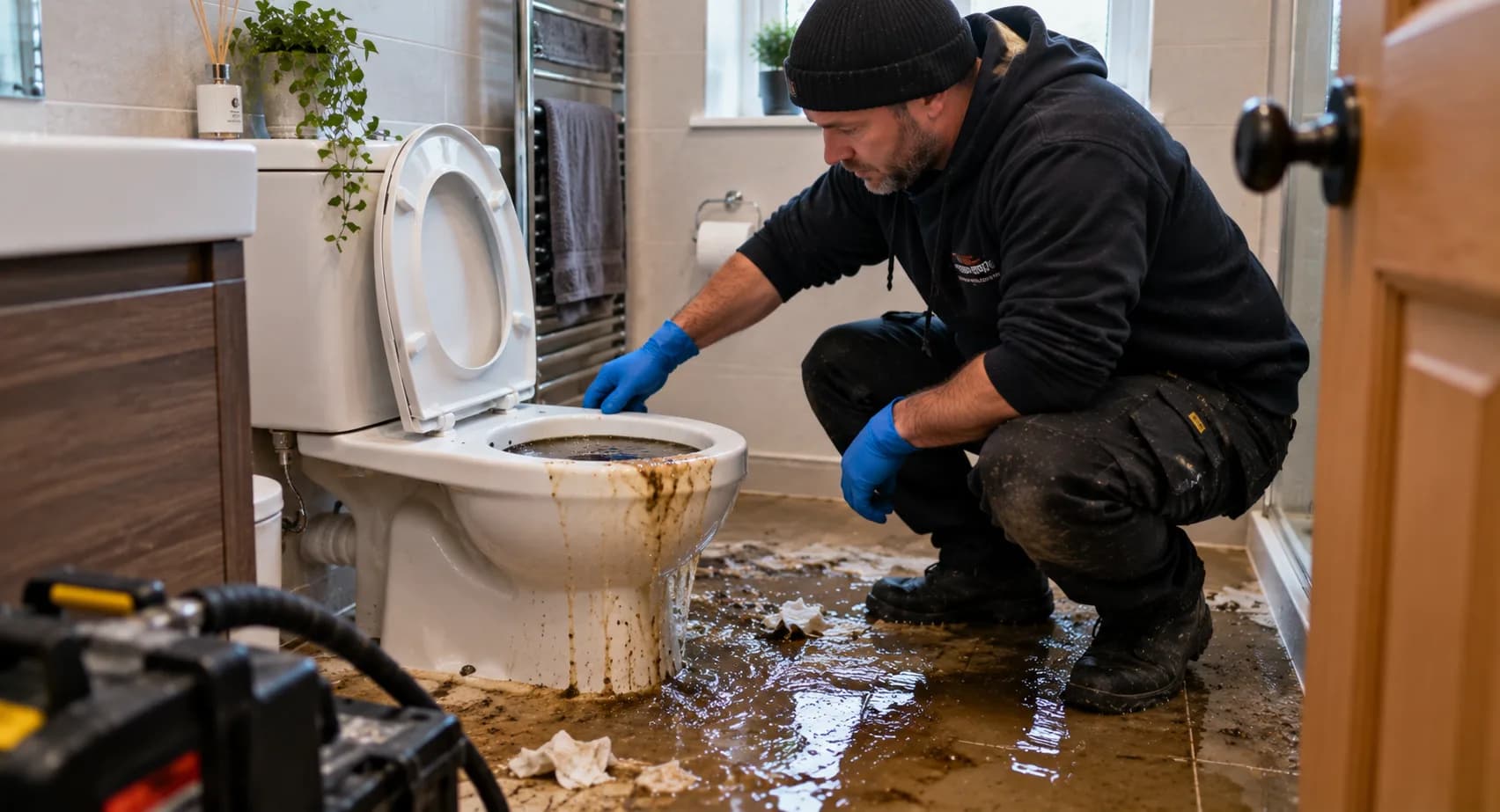
A toilet backing up with sewage means the pipe below it is full. Either your own drain is blocked between the house and the sewer, or the shared drain or public sewer is blocked or overloaded, which often happens in heavy rain. Stop using water straight away, keep everyone away from the waste, and find out whether your neighbours have the same problem. If it's your drain, our blocked drain engineers will clear it, and our emergency drainage page covers what to do while you wait. If it's the sewer, the water company has to deal with it.
This guide covers the first hour, how to work out whose problem it is, and what you can claim.
Why is my toilet backing up with sewage?
Because waste can't get past a point further down, so it rises to the lowest open fitting. That's usually a downstairs toilet, a shower tray or a floor gully. There are three common reasons:
- A blockage in your own drain. Wipes, fat, paper or roots stop the flow between your house and the boundary. This is the most common cause when only one house is affected.
- A blockage in a shared drain or the public sewer. Everything upstream of the blockage backs up, so several houses can be affected at once.
- The sewer is overloaded in heavy rain. Approved Document H (paragraph 2.8) says combined and rainwater sewers are designed to surcharge in heavy rainfall, meaning the water in the manhole rises above the top of the pipe, and some foul sewers that take rainwater surcharge too. Low-lying houses and basements are most at risk.
If the toilet is slow or blocked but nothing is coming back up, see how to unblock a toilet instead.
What should you do in the first hour?
Stop the flow, protect people, then find the cause. Work through these steps in order.
| Step | What to do | Why |
|---|---|---|
| 1 | Stop all water use: no flushing, taps, showers, washing machine or dishwasher | Every litre you use goes into the same blocked pipe |
| 2 | Keep children and pets out and shut the door | UKHSA says floodwater can carry harmful contaminants |
| 3 | Don't touch electrics or gas appliances that may be wet | UKHSA advises having them checked first |
| 4 | Put on rubber gloves, boots and an apron or old clothes | UKHSA's clean-up advice for floodwater |
| 5 | Take photos and video of the waste and any damage | Your insurer and the water company may ask for them |
| 6 | Check whether neighbours are affected | This decides who you call |
| 7 | Lift your outside inspection chamber covers if safe | Shows where the blockage is |
| 8 | Call the water company or a drainage engineer | See below |
Open windows if you can do so without walking through the waste. Don't try to plunge a toilet that's backing up from the drain: you'll only push sewage around the bowl.
How do you clean up safely after sewage comes into the house?
Treat anything it touched as contaminated. The UK Health Security Agency's flooding and health advice says floodwater can carry harmful contaminants, and recommends:
- rubber boots, waterproof gloves and a plastic apron while cleaning;
- a face mask if scrubbing or hosing splashes water about, and eye protection such as goggles;
- washing your hands thoroughly with warm water and soap after each session, and covering cuts with waterproof plasters;
- washing clothes worn for cleaning on a separate cycle;
- hot water and detergent on all hard surfaces, including walls and floors;
- not turning on gas or electrics that may have got wet until a qualified person has checked them.
Bag up soaked items that can't be cleaned. Carpets and underlay that have had raw sewage on them are usually not worth saving, but check with your insurer before you throw anything away. Our guide to whether home insurance covers drain damage explains what insurers usually ask for.
Is it my drain or the water company's sewer?
Ask your neighbours first. If houses either side are also backing up, or the manhole in the road is overflowing, the problem is almost certainly in a shared drain or the public sewer. That's the water company's job.
Since 1 October 2011, privately owned sewers and lateral drains that connected to a public sewer on 1 July 2011 have belonged to the sewerage companies, according to Defra's private sewers transfer guidance. Citizens Advice puts it simply: you're usually responsible for drains inside your boundary that serve only your property, and not for lateral drains you share with neighbours.
Your inspection chambers tell you the rest:
- Chamber nearest the house full, the next one down empty: the blockage is between them, in your drain.
- Every chamber on your property full: the blockage is at or beyond your boundary, which is usually the water company's.
- No chambers, or you can't lift them: go by the neighbours and call either us or the water company.
Severn Trent covers most of Nottinghamshire, Derbyshire and Leicestershire and takes sewer reports on 0800 783 4444. Anglian Water covers much of Lincolnshire. There's more on this in who is responsible for blocked drains and inspection chambers and manholes explained.
Can you get compensation for sewage flooding?
Yes, if the sewage came from the water company's sewer. The Guaranteed Standards Scheme sets payments companies must make when they fail. The Consumer Council for Water sets out the current figures for England:
| Type of sewer flooding (England) | Payment | Minimum | Maximum | Repeat within 12 months |
|---|---|---|---|---|
| Inside your property | Your annual sewerage charge | £300 | £2,000 | Minimum +£100, maximum +£500 each time |
| Outside, on your land | 50% of your annual sewerage charge | £150 | £1,000 | Minimum +£50, maximum +£250 each time |
The government doubled these limits from 2 July 2025, according to Defra's announcement, Customers to receive up to £2000 for water service failures.
CCW says claims must be made within three months, and that no payment is due where the flooding was caused by a defect, inadequacy or blockage in your own drains, by your own actions, or by abnormal conditions the company couldn't have foreseen or prevented with all due care. That's another reason to find out exactly where the blockage was. If our engineers clear a drain and find the problem is in the sewer, we'll tell you.
How do you stop sewage backing up again?
Fix the cause first, then protect the house if the sewer is the problem.
- If your drain blocked: get it cleared and, if it has blocked before, surveyed. A CCTV drain survey from £149 + VAT shows whether a displaced joint, roots or a dip is catching waste. See why does my toilet keep blocking.
- If the sewer surcharges in heavy rain: Approved Document H (paragraphs 2.9 to 2.11) recommends an anti-flooding valve where the risk is low enough not to need pumping. It says these valves should preferably be the double valve type, suitable for foul water, with a manual closure, and that a notice inside the building should say the drainage runs through one.
- Keep spare capacity: keep gullies clear and don't connect extra roof water to the foul drain. Our guide to preparing drains for winter and heavy rain covers the rest.
We fit non-return valves and rat blockers. A valve only works with regular checks, because a flap held open by debris does nothing, so ask about maintenance when you have one fitted.
When to call a professional
Call straight away if sewage is coming into the house and only your property is affected. That points to your own drain, and the water company won't clear it. If neighbours are affected, call the water company first, then call us if they find the problem is on your side.
We clear blocked drains from £120 + VAT with no call-out fee, and agree the price before we start. We work 7 days a week from 6am to 8pm, with emergency call-outs 365 days a year, across Nottingham, Newark, Nottinghamshire, Derbyshire, Leicestershire and Lincolnshire. Call 07300 600 950 or see our emergency drainage page.
Sources
- UKHSA: Flooding and health, advice for the public (gov.uk)
- Consumer Council for Water: what standards are guaranteed by water and sewerage companies?
- Defra: Customers to receive up to £2000 for water service failures (2 July 2025)
- Approved Document H: Drainage and waste disposal (gov.uk)
- Defra: guidance on the private sewers transfer regulations (PDF)
- Citizens Advice: who is responsible for repairing drains and sewers
Frequently Asked Questions
Cite this guide: “Toilet Backing Up? What to Do When Sewage Comes Up in the House”, Urgent Drainage Solutions, 6 October 2026. https://urgentdrainagesolutions.co.uk/blog/toilet-backing-up-sewage-in-house

Need A Drainage Engineer?Book Online Today