
What Is a Septic Tank and How Does It Work?
Written by the Urgent Drainage Solutions teamPublished Updated 8 min read
Quick answer
A septic tank is an underground tank that treats household sewage where there is no mains sewer. Waste flows in, solids sink as sludge, fats float as scum, and bacteria partly break them down. The settled liquid flows out to a drainage field, where the soil finishes the treatment. Sludge is pumped out at least once a year.
- A septic tank is only half the system: the drainage field in the soil completes the treatment.
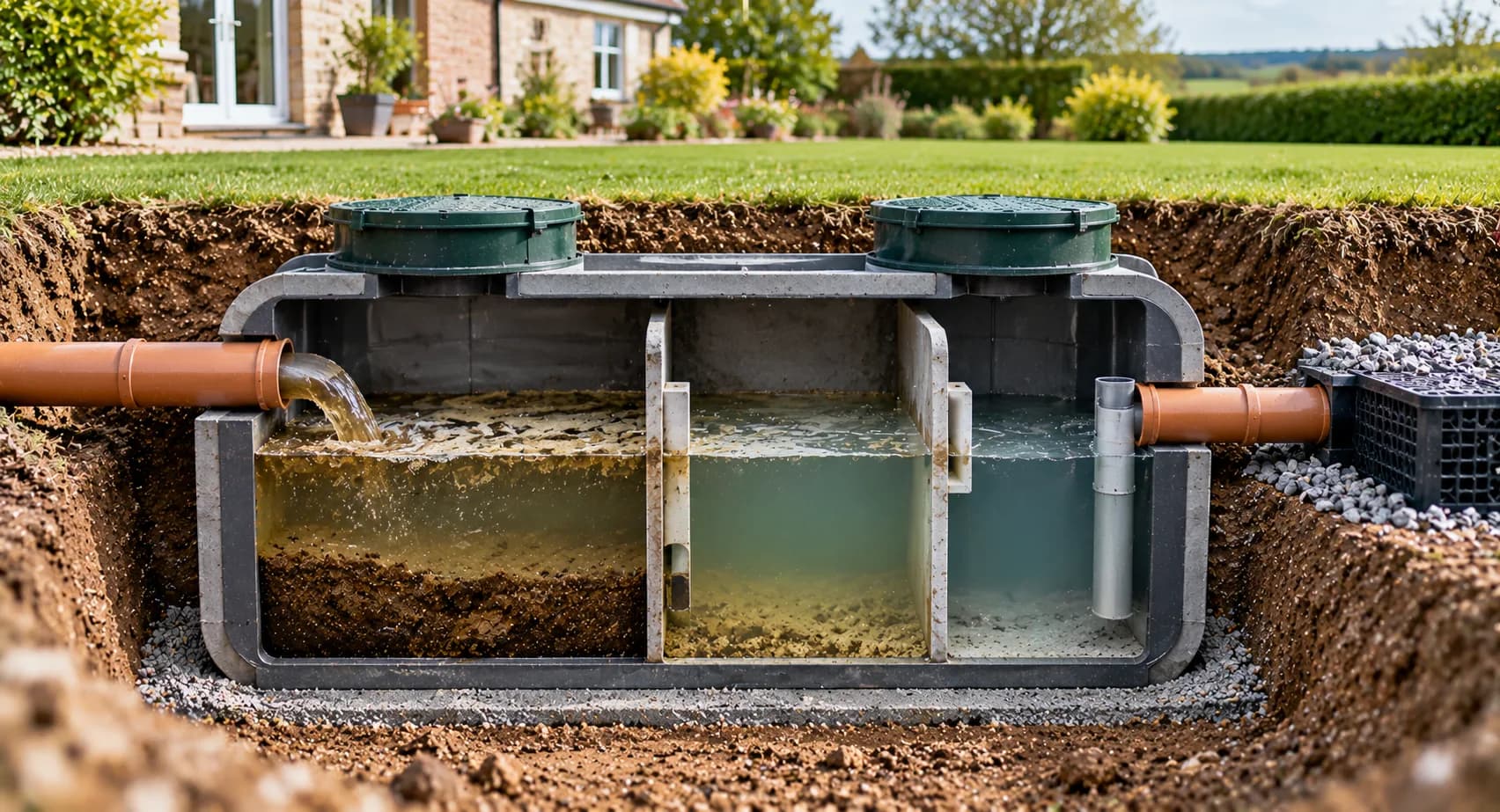
- Inside the tank, waste separates into sludge at the bottom, scum on top and liquid effluent in between.
- It works by gravity and natural bacteria, with no power needed.
- Gov.uk says sludge should be removed at least once a year or as the manufacturer says, by a registered waste carrier.
- In England, septic tank effluent must not go straight to a ditch or stream.
A septic tank is an underground tank that treats the sewage from a property with no mains sewer. Waste flows in, solids sink to form sludge, fats and oils float to form scum, and natural bacteria partly break the waste down. The settled liquid then flows out to a drainage field, where the soil finishes the treatment, and the sludge is pumped out regularly. If you need a tank installed or replaced, see our septic tank installation and replacement service.
Below is how the whole system works in the UK, step by step, and how often it should be emptied.
What is a septic tank?
A septic tank is a watertight settlement tank, usually buried in the garden, that separates household sewage into solids and liquid. Gov.uk describes it as "an underground tank where the solids sink to the bottom, forming a sludge, and the waste water flows out to a drainage field".
Approved Document H, the Building Regulations guidance on drainage, says septic tanks provide "settlement, storage and partial decomposition of solids which need to be removed at regular intervals". It adds that the discharge "can, however, still be harmful and will require further treatment" from a drainage field, drainage mound or constructed wetland.
That is the key point: a septic tank is only half of the system. The drainage field does the rest. Modern tanks are factory-made in plastic or glass-reinforced plastic; older ones are often brick or concrete. Approved Document H says factory-made tanks should meet BS EN 12566-1.
How does a septic tank work, step by step?
A septic tank works by gravity and bacteria, with no pumps or power. Here is the flow from house to soil:
- Inlet. Everything from the toilets, sinks, showers, bath and washing machine runs down the foul drain into the first chamber. Approved Document H says the inlet should be designed not to disturb the scum or settled sludge, and on a narrow tank the inlet should be a dip pipe.
- First chamber. The flow slows right down. Heavy solids sink to the bottom as sludge; fats, oils and grease rise to form a crust of scum. NetRegs describes the solids that "settle to the bottom of the tank" and the oils and grease that "float to the top and form a scum layer".
- Bacteria at work. Bacteria that live without oxygen digest part of the sludge. NetRegs says septic tanks work "by allowing bacteria to naturally break down potentially harmful substances".
- Second chamber. The partly clarified liquid passes through to a second chamber, where more fine solids settle. Approved Document H says septic tanks should have at least two chambers or compartments working in series.
- Outlet. Each time waste flows in, the same volume of liquid, called effluent, leaves through the outlet. The outlet is designed to stop sludge and scum going with it.
- Inspection chamber. Approved Document H says an inspection chamber should sit between the tank and the drainage field, so you can see whether the effluent is running clear.
- Drainage field. The effluent spreads through perforated pipes laid in gravel trenches and seeps into the soil. Approved Document H says "biological treatment takes place naturally in the aerated layers of soil".
- Desludging. Sludge builds up over time and has to be pumped out by a tanker before it reaches the outlet.
What is a drainage field and why does it matter?
A drainage field is a network of perforated pipes in gravel trenches that lets septic tank effluent soak into the ground, where soil bacteria finish treating it. Without one, the effluent is still harmful. Gov.uk calls it a series of pipes with holes placed in trenches so that waste water can trickle through the ground.
Approved Document H sets out how drainage fields should be built:
| Feature | Approved Document H guidance |
|---|---|
| Pipe gradient | Perforated pipe in trenches no steeper than 1:200 |
| Bedding | A 300 mm layer of clean shingle or broken stone, 20 mm to 50 mm |
| Depth | Distribution pipes at least 500 mm below the surface |
| Trench width | 300 mm to 900 mm, with 2 m of undisturbed ground between trenches |
| Soil suitability | Average percolation value (Vp) between 12 and 100 |
| Floor area | Number of people x Vp x 0.25, in square metres |
| Distances | At least 15 m from any building, 10 m from a watercourse, 50 m from a groundwater abstraction point |
The soil has to be right. Approved Document H lists sand, gravel, chalk, sandy loam and clay loam as subsoils with good percolation, and sandy clay, silty clay and clay as poor. A trial hole and percolation test show which you have. Where the ground won't take a drainage field, a sewage treatment plant is usually the answer. Our guide to soakaways explains why a rainwater soakaway is not the same thing.
How does a septic tank work in the UK compared with elsewhere?
The principle is the same everywhere, but in England the Environment Agency's general binding rules decide where the effluent can go. The most important UK-specific rule is that septic tank effluent must not be discharged to a watercourse. It has to go to a drainage field, or the tank has to be replaced with a treatment plant or connected to the sewer.
The rules also cap discharges to ground at 2 cubic metres a day, require regular emptying by a registered waste carrier, and require you to tell a buyer about the system when you sell. Our guide to septic tank regulations covers them in full.
How often should a septic tank be emptied?
At least once a year, unless the manufacturer says otherwise. Gov.uk says you must get the sludge removed "before it goes beyond the maximum capacity" and that "you should do this at least once a year or in line with the manufacturer's instructions".
Approved Document H agrees: "The septic tank should be emptied at least once a year." It also recommends that "not all sludge is removed as it can act as an anaerobic seed", which means leaving a little behind helps the bacteria restart.
| Source | What it says about emptying |
|---|---|
| Gov.uk general binding rules | Before sludge exceeds capacity; at least once a year or as the manufacturer says |
| Approved Document H, maintenance guidance | At least once a year; leave some sludge as a seed |
| Approved Document H, example notice | Monthly check of the outlet; empty at least once every 12 months by a licensed contractor |
| Your tank's manual | Follow the manufacturer's interval, which may depend on tank size and household |
How quickly sludge builds up depends on the number of people, the tank's size and what goes down the drains, so a large household on a small tank may need more frequent visits. The company that takes the sludge away must be a registered waste carrier. We don't empty tanks; you can check a carrier on the gov.uk waste carrier register.
What happens if a septic tank isn't emptied?
Sludge and scum build up until solids are carried out of the tank into the drainage field. Approved Document H warns that sediment can "block the pores in the soil", forcing early replacement of the drainage field, and occasionally making the site unsuitable for one at all. That is usually the most expensive way for a septic system to fail.
How big should a septic tank be?
Approved Document H says a septic tank should hold at least 2,700 litres below the inlet for up to four users, plus 180 litres for each additional user. Gov.uk adds that anyone installing a new tank, plant or drainage field should check with the installer that it meets British Water's Flows and Loads sizing guidance.
Siting matters too. Approved Document H says the tank should be at least 7 m from any habitable part of a building and, if it will be emptied by tanker, within 30 m of vehicle access.
How is a septic tank different from a treatment plant or cesspit?
| System | What it does | Where the liquid goes | Power |
|---|---|---|---|
| Septic tank | Settles solids; partial treatment | Drainage field in the ground | No |
| Sewage treatment plant | Treats sewage to a higher standard using mechanical parts | Drainage field, or a flowing watercourse where the rules allow | Yes |
| Cesspit (cesspool) | Stores all sewage; no treatment | Nowhere; it is emptied by tanker | No |
Our guide to cesspits and septic tanks compares them in more detail.
How do you look after a septic tank?
A few habits keep a septic system working:
- Check the outlet monthly. Approved Document H says the effluent in the outlet should be "free-flowing and clear".
- Check the drainage field monthly. It should not be waterlogged, and effluent should not be backing up towards the tank.
- Keep it free of harmful waste. Wipes, fats and harsh chemicals upset the bacteria or block pipes; see what not to flush.
- Keep vehicles off. Approved Document H says no access roads, driveways or paved areas should be built over the disposal area.
- Use a competent person. Gov.uk says anyone maintaining your system must be competent, such as a British Water accredited service engineer.
Gov.uk lists leaks, cracked tank walls or pipes, blocked pipes and signs that the waste water isn't draining properly as reasons to repair or replace a system. Slow toilets and bad smells can also point to a blockage in the pipe to the tank; see why do my drains smell.
When to call a professional
Call a specialist if the ground over the drainage field stays wet or smells, waste backs up into the lowest toilet or gully, the tank needs emptying far more often than it used to, or its outfall runs to a ditch or stream. We install and replace septic tanks and drainage fields, and our groundworks team (from £500 + VAT) handles the excavation. If the pipe between the house and the tank keeps blocking, a CCTV drain survey from £149 + VAT shows why.
Emptying must be done by a registered waste carrier; it isn't a service we offer. We cover Nottingham and the wider East Midlands; see our areas. Call 07300 600 950 or ask us for a quote.
Sources
Frequently Asked Questions
Cite this guide: “What Is a Septic Tank and How Does It Work?”, Urgent Drainage Solutions, 6 October 2026. https://urgentdrainagesolutions.co.uk/blog/how-does-a-septic-tank-work

Need A Drainage Engineer?Book Online Today