
Cesspit vs Septic Tank: What's the Difference?
Written by the Urgent Drainage Solutions teamPublished Updated 7 min read
Quick answer
A cesspit is a sealed tank that only stores sewage, so a tanker must empty it often, typically monthly. A septic tank settles solids and sends partly treated liquid to a drainage field, and is emptied about yearly. A sewage treatment plant uses power to treat sewage further and can discharge to a flowing watercourse.
- A cesspit stores sewage with no treatment and no outlet; a septic tank settles and partly treats it.
- Approved Document H sizes a cesspit at 18,000 litres for two users, against 2,700 litres for a septic tank serving up to four.
- Cesspits typically need emptying monthly; septic tanks at least once a year.
- A sewage treatment plant treats to a higher standard and is the usual answer on clay or where the only outfall is a stream.
- The Building Regulations treat a cesspit as the last resort.
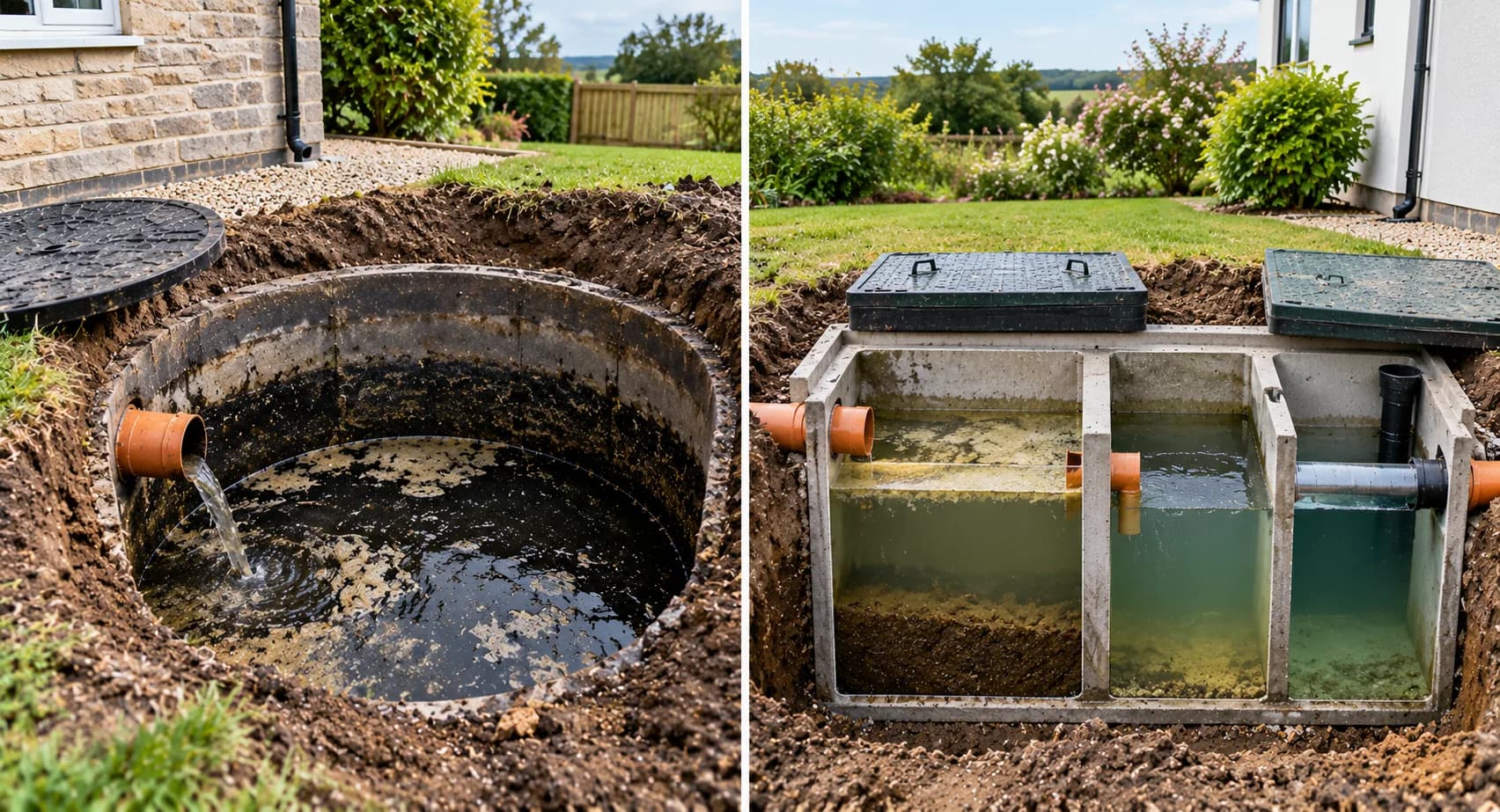
A cesspit (also called a cesspool) is a sealed underground tank that stores all of a property's sewage with no treatment, so a tanker has to empty it often. A septic tank separates the solids and lets partly treated liquid drain into the ground through a drainage field. A sewage treatment plant goes further, using power and mechanical parts to treat the sewage to a standard that can, where the rules allow, go to a flowing stream. Each suits different ground, budgets and sites.
Here's how the three compare, which rules apply to each, and how to choose.
What is a cesspit?
A cesspit is a watertight holding tank with no outlet. Approved Document H defines a cesspool as "a watertight tank, installed underground, for the storage of sewage. No treatment is involved." Everything that goes down the toilets, sinks and showers stays in the tank until a tanker pumps it out.
Because nothing leaves, a cesspit has to be large. Approved Document H and gov.uk both give a minimum capacity of 18,000 litres for two users, plus 6,800 litres for each extra user. Approved Document H suggests estimating how quickly it fills by assuming 150 litres per person per day.
What is a septic tank?
A septic tank is a settlement tank with an outlet. Solids sink to form sludge, fats float as scum, and bacteria partly digest the waste. The liquid in between flows out to a drainage field, where the soil completes the treatment. Approved Document H says a septic tank should hold at least 2,700 litres for up to four users, plus 180 litres per extra user. Our guide to how a septic tank works explains the process step by step.
What is a sewage treatment plant?
A sewage treatment plant is a septic tank's more advanced cousin. Gov.uk says it "works in a similar way to a septic tank" but "uses mechanical parts to treat the waste water to a higher standard".
Approved Document H says packaged treatment works "treat effluent to a higher standard than septic tank systems and this normally allows direct discharge to a watercourse". It also says a plant that needs power should keep working without power for up to six hours, or have an uninterruptible power supply, and that plants should be type-tested to BS 7781 or by a notified body.
How do cesspits, septic tanks and treatment plants compare?
This matrix pulls the key figures into one place.
| Cesspit (cesspool) | Septic tank | Sewage treatment plant | |
|---|---|---|---|
| What it does | Stores sewage; no treatment | Settles solids; partial treatment | Treats sewage to a higher standard |
| Outlet | None; sealed | To a drainage field | To a drainage field or a flowing watercourse |
| Minimum size (Approved Document H) | 18,000 litres for 2 users, plus 6,800 litres per extra user | 2,700 litres for up to 4 users, plus 180 litres per extra user | Sized to the load, using British Water's Flows and Loads |
| Typical emptying | Monthly (Approved Document H) | At least once a year (gov.uk) | At least once a year or as the manufacturer says (gov.uk) |
| Needs electricity? | No | No | Yes, usually |
| Needs suitable soil? | No | Yes, for the drainage field | Only if it discharges to ground |
| General binding rules | Do not apply | Apply | Apply |
| Distance from habitable rooms | At least 7 m | At least 7 m | Discharge at least 10 m from buildings |
| Vehicle access for emptying | Within 30 m | Within 30 m if emptied by tanker | Access for desludging needed |
| Place in the Building Regulations | Last resort | With secondary treatment | Alternative treatment system |
Cesspit vs septic tank: which costs more to run?
A cesspit is usually cheaper to build around than to run, because it has to be emptied so often. With a capacity of 18,000 litres for two people and a fill rate of 150 litres per person per day (Approved Document H's planning figure), a two-person cesspit would be full in about two months; a larger household fills it faster. Every one of those visits is a tanker charge. A septic tank, emptied about once a year, has much lower running costs but depends on a working drainage field. We don't publish emptying prices, because we don't offer tank or cesspit emptying.
For installation figures from national price guides, see septic tank installation cost.
Septic tank vs sewage treatment plant: which should you choose?
Choose a septic tank where the soil drains well and there's room for a drainage field at the right distances; choose a treatment plant where it doesn't, or where the only outfall is a stream. Approved Document H says septic tanks with secondary treatment are normally the most economic option for small developments of one to three dwellings.
A treatment plant is usually the better fit where:
- the ground is too heavy for a drainage field (Approved Document H lists clay, silty clay and sandy clay as poor);
- there isn't room for a drainage field 15 m from any building and 10 m from a watercourse;
- a septic tank currently discharges to a ditch or stream, which the rules don't allow;
- the property is in a groundwater source protection zone 1, where drainage fields aren't permitted.
A plant costs more to buy, needs power and needs servicing to the manufacturer's schedule, so it isn't automatically "better". The right answer comes from a site survey and a percolation test.
Which rules apply to each system?
Cesspits follow a short set of rules; septic tanks and treatment plants follow the Environment Agency's general binding rules.
Gov.uk says that if you have a cesspool, you must make sure it is "emptied regularly (for example once a month) by a registered waste carrier" and "does not leak or overflow". You don't need a permit "unless the Environment Agency tells you that you do", but "you are breaking the law if your cesspool causes pollution". A new cesspool needs planning permission and building regulations approval.
Gov.uk also makes a useful distinction: "If your system releases sewage into the ground or surface water then it is not a cesspool", whatever it's called locally.
Septic tanks and treatment plants must meet the general binding rules or have a permit. Key points include a limit of 2 cubic metres a day to ground and 5 cubic metres a day to surface water, no septic tank discharges to watercourses, annual desludging by a registered waste carrier, and written disclosure when you sell. Our guide to septic tank regulations covers the rules in full.
Which system does the law prefer?
The Building Regulations set an order of priority. Requirement H1 says foul water should go to:
- a public sewer; or, where that is not reasonably practicable,
- a private sewer connected to a public sewer; or, where that is not reasonably practicable,
- a septic tank with appropriate secondary treatment, or another wastewater treatment system; or, where that is not reasonably practicable,
- a cesspool.
So a cesspit is the last resort. Approved Document H says one "may be acceptable" only "where no other option is feasible". If the mains sewer is within reach, connecting is usually the first thing to look at; for a single home with a discharge that started since 2015, gov.uk says you can't meet the general binding rules if a public foul sewer is within 30 metres of any boundary. See our sewer connections service.
Can you convert a cesspit to a septic tank or treatment plant?
Yes, in many cases. The usual routes are:
- Septic tank and drainage field, if a percolation test shows the ground drains well enough.
- Sewage treatment plant, where the soil is poor, space is tight or the outfall is a stream.
- Mains connection, if a public sewer is close enough.
The old tank has to be emptied and made safe. For septic tanks and treatment plants, gov.uk says you must remove anything that could cause pollution, such as remaining sludge, when you stop using the system. A new system needs building regulations approval.
When to call a professional
Get advice if your cesspit needs emptying more and more often, it's leaking or overflowing, you're not sure what system you actually have, or you're buying or extending a property off mains drainage. We survey the site, test the ground, and install septic tanks, sewage treatment plants and drainage fields, with our groundworks team (from £500 + VAT) handling the excavation. Every installation is quoted in writing after a survey.
We don't empty cesspits or septic tanks; that's a job for a registered waste carrier, which you can check on the gov.uk waste carrier register. We cover Nottingham and the wider East Midlands; see our areas. Call 07300 600 950 or ask us for a quote.
Sources
Frequently Asked Questions
Cite this guide: “Cesspit vs Septic Tank: What's the Difference?”, Urgent Drainage Solutions, 6 October 2026. https://urgentdrainagesolutions.co.uk/blog/cesspit-vs-septic-tank

Need A Drainage Engineer?Book Online Today