
Commercial Gutter Cleaning: Cost, Frequency and Access Methods
Written by the Urgent Drainage Solutions teamPublished 9 min read
Checked by Eren Birinci (Gino), Founder & Lead Drainage Engineer on
Quick answer
Commercial gutter cleaning is priced per site, by gutter length, height, access and how blocked the gutters are. Tradespeople on MyJobQuote in 2026 quoted roughly £4 to £12 per linear metre. Most sites are cleaned twice a year. The contractor must avoid work at height where reasonably practicable, so ground-based vacuum systems come first and platforms second.
- Commercial gutter cleaning is quoted per site: length, height, access equipment and the type of gutter set the price.
- Tradespeople answering on MyJobQuote in 2026 gave around £4 to £12 per linear metre for commercial and block work.
- The Work at Height Regulations 2005 require work at height to be avoided where it is reasonably practicable to do the job safely another way.
- The duties cover those who control the work as well as employers, and HSE names facilities managers and building owners as examples.
- GOV.UK says a business lease should state who handles repairs and maintenance, and anything it leaves out usually falls to the tenant.
Commercial gutter cleaning means clearing the gutters, outlets and downpipes on offices, shops, schools, blocks of flats, warehouses and industrial units. It is priced per site, because the length of gutter, the height, the access equipment and the type of gutter vary far more than they do on houses. Most sites need it twice a year. Our gutter cleaning service covers commercial buildings as well as homes, and we quote each commercial site individually.
This guide covers what it costs, how often to book it, how contractors reach high gutters within the law, who pays under a lease, what a report should contain and what happens when gutters are left.
How much does commercial gutter cleaning cost?
There is no standard price, because no two sites are alike, but published 2026 figures give a feel for the range. They are other people's figures, not ours.
| Source | Figure | Applies to |
|---|---|---|
| Tradespeople's answers on MyJobQuote (August to October 2026) | Around £4–£12 per linear metre; one answer gave £5–£12 per metre for commercial and block work | A small block of flats |
| Tradespeople's answers on MyJobQuote (August to September 2026) | From £20–£35 an hour; one answer gave £25–£35 an hour plus VAT | Labour only |
| Trade2Base guide for contractors (8 June 2026) | £1.50–£3 per metre of gutter, or £250–£500 a day for a one- or two-person team | Commercial contracts |
| Trade2Base guide for contractors (8 June 2026) | £150–£400 a day for MEWP hire, charged on top or built into the day rate | Access equipment |
Sources: MyJobQuote question page; Trade2Base. The per-metre, hourly and day-rate figures are different ways of pricing, so they are not directly comparable.
Our domestic gutter cleaning starts from £120 + VAT. Commercial buildings are quoted per site once we know the building, with a fixed price before work starts and no call-out fee. For house prices by type, see our gutter cleaning cost guide.
What affects the price of commercial gutter cleaning?
Access is the biggest factor, followed by length and gutter type. A contractor should ask about each of these before pricing.
| Factor | Why it matters |
|---|---|
| Length of gutter | Long warehouse and retail-park runs take more time and produce more waste |
| Height | Higher eaves need longer-reach equipment or a platform |
| Access around the building | Parked vehicles, loading bays, soft ground and neighbouring land limit where equipment can stand |
| Type of gutter | Eaves gutters can often be reached from outside; valley, box and parapet gutters sit within the roof |
| Roof construction | Fragile sheets and rooflights beside a gutter change how the job has to be done |
| Condition | Silt, moss and plants that have built up over years take longer than a routine clean |
| Site rules | Out-of-hours working, permits, inductions and keeping the public clear all add time |
| Reporting | Photo reports and defect lists are quick to produce but should be agreed up front |
| One-off or contract | A gutter that is cleaned regularly takes less time than one left for years |
How often should commercial gutters be cleaned?
Twice a year is the usual starting point: once in spring and once after the autumn leaf fall. No regulation fixes the number. Most of the tradespeople who answered the MyJobQuote question recommended a one-off deep clean followed by regular visits, often twice a year in spring and autumn.
For new metal gutters on industrial buildings, a guide in BFM Magazine by the managing director of HD Sharman reports that the Metal Gutter Manufacturers Association recommends inspecting them at least four times in their first year, to set the maintenance plan that follows.
Some sites need more than two visits:
- buildings under or near trees;
- roofs with internal valley or box gutters, where an overflow goes into the building;
- sites where dust or process waste settles on the roof;
- buildings that have leaked before.
Check the gutters in the first heavy rain after each clean. If they are overflowing again within a few months, shorten the interval. Our guide on how often gutters should be cleaned has a frequency table that works for smaller commercial premises too.
How do contractors reach commercial gutters safely?
By choosing the method that keeps people off ladders and roofs wherever that is reasonably practicable. Regulation 6 of the Work at Height Regulations 2005 says every employer must ensure work is not carried out at height where it is reasonably practicable to carry it out safely another way. Where it cannot be avoided, the employer must prevent falls, and then minimise the distance and consequences of any fall.
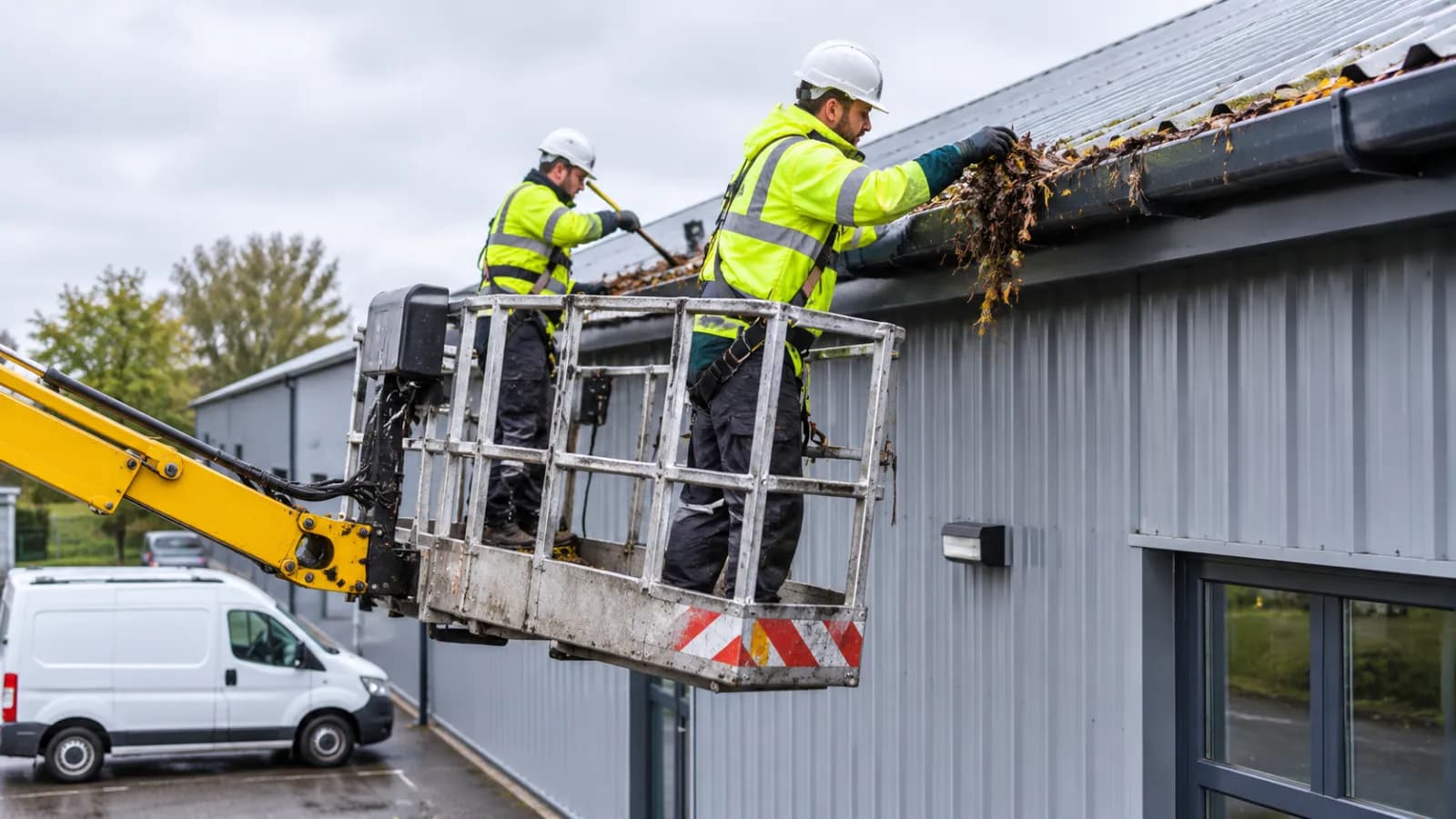
HSE's step-by-step guide gives "using extendable tools from ground level to remove the need to climb a ladder" as its first example of avoiding work at height, and lists mobile elevating work platforms (MEWPs), tower scaffolds and scaffolds as equipment that prevents falls. In gutter cleaning that hierarchy looks like this:
| Method | Where it sits in the hierarchy | Suits | Limits |
|---|---|---|---|
| Gutter vacuum with poles and a camera, used from the ground | Avoids work at height | Eaves gutters within reach of the poles | Cannot reach internal gutters; repairs still need access |
| MEWP (scissor lift or cherry picker) | Prevents falls | High eaves, long runs, gutters beside fragile roofs | Needs firm ground, space and a trained operator |
| Tower scaffold or fixed scaffold | Prevents falls | Awkward corners, repairs that take time | Slower and dearer to set up |
| Access onto the roof with edge protection or restraint | Prevents or limits falls | Valley, box and parapet gutters | Needs a roof that is confirmed safe to walk on |
| Ladder | Last choice | Short, low-risk tasks only | HSE suggests other equipment for tasks that take more than 30 minutes at a time |
If a MEWP is used, HSE's work at height FAQs say to check that the people using it are "trained, competent and fit to do so" and that the machine has been examined, inspected and maintained.
Why are fragile roofs a particular risk?
Because many warehouse and factory gutters run beside fibre cement sheets and rooflights that will not take a person's weight. HSE's leaflet Fragile roofs: Safe working practices says that on average 7 people are killed each year after falling through a fragile roof or rooflight, usually on factories, warehouses and farm buildings during repair or cleaning. It says the deaths occur mainly in small, short-term maintenance and cleaning jobs, and one of its examples of safe practice is using a MEWP to clean a gutter.
Regulation 9 of the same regulations says nobody should pass across or work on or near a fragile surface where the work can reasonably be done safely another way. HSE's fragile surfaces guidance adds that all roofs should be treated as fragile until a competent person has confirmed they are not. Tell your contractor what the roof is made of before they quote.
Who is responsible for gutter cleaning, the landlord or the tenant?
The lease decides. GOV.UK's guidance for business tenants says "Your lease should say who is responsible for repairs and maintenance of the property", and warns that "Any responsibility that is not mentioned in the lease will usually be yours as the tenant." It also notes that tenants may have to pay for repairs when they leave, known as dilapidations.
In general terms:
- a tenant who leases a whole building on full repairing terms usually maintains the gutters;
- in a multi-let building or estate, the landlord or managing agent often maintains the roof and gutters and recovers the cost through the service charge;
- either way, read the repair clauses, because the wording varies from lease to lease.
Safety duties sit separately from the lease. HSE's work at height FAQs say the Work at Height Regulations place duties on employers and on those who control any work at height, and give "facilities managers or building owners who may contract others to work at height" as examples. Whoever orders the clean should check the contractor has planned it properly. Rented homes work differently; our guide to who pays for a blocked drain in a rented home covers that side.
What should a commercial gutter survey or report include?
Enough for someone who was not on site to see what was done and what needs doing next. A useful report has:
- the date, the building and a simple plan or list of each gutter run and downpipe;
- before-and-after photos of each run and outlet;
- what was removed, such as leaves, moss, silt or plants;
- the result of flushing each downpipe, and whether the drain or gully below took the water;
- defects with their location: leaking joints, corrosion, cracked or lifting linings, sagging runs, standing water, damaged outlets;
- anything that could not be reached, and why;
- recommended repairs, in order of urgency;
- a suggested date for the next visit.
Keep the reports. They show a landlord, tenant, insurer or buyer that the building has been looked after.
What happens if commercial gutters are not cleaned?
Water goes where it should not. On a pitched roof with eaves gutters, an overflow runs down the outside wall, stains the cladding or brickwork and soaks the ground at the base. Internal gutters are worse. A valley or box gutter sits within the roof, so when its outlet blocks, the water level rises until it spills over the gutter edge into the building, onto stock, machinery, ceilings and electrics.
Other problems follow from the same cause:
- silt holds water against metal gutters and speeds up corrosion;
- plants root into joints and linings;
- the weight of wet debris strains brackets and fixings;
- blocked downpipes back up, and silt washes into the drains below.
If a downpipe still backs up after the gutter is clear, the fault is at ground level. Our guide to a blocked downpipe explains how to tell, and our commercial drainage service covers the drains themselves.
What should you ask a commercial gutter cleaning contractor?
- How will you reach each gutter, and why that method?
- Will you provide a risk assessment and method statement for this site?
- Who will do the work, and what training do they hold for the equipment?
- What insurance do you carry?
- Does the price include downpipes, outlets, waste removal and a photo report?
- Will you tell us about defects before repairing them, with a price?
- Can you work around our opening hours?
When to call a professional
Commercial gutter cleaning is rarely a job for a caretaker with a ladder. Book a contractor if water is overflowing or coming through a ceiling in rain, plants are growing in the gutters, the gutters have not been cleaned for a year or more, or you are taking on or handing back a lease and need a record of their condition.
We clean gutters, downpipes and hoppers on commercial buildings, flush each downpipe, clear the drain it discharges into, and photograph and quote for anything that needs repairing; gutter repairs start from £230 + VAT. Tell us the building type and height and we will confirm the right access equipment and a fixed price for the site. We can set up a planned schedule with records of every visit, and we hold CHAS and CSCS. We cover Nottingham and the wider East Midlands, 7 days a week from 6am to 8pm, with emergency call-outs 365 days a year. Call 07300 600 950 or get a quote.
Sources
- Work at Height Regulations 2005, regulation 6: Avoidance of risks from work at height (legislation.gov.uk)
- Work at Height Regulations 2005, regulation 9: Fragile surfaces (legislation.gov.uk)
- Health and Safety Executive: Work at height, step by step guide
- Health and Safety Executive: Work at height, frequently asked questions
- Health and Safety Executive: Fragile roofs, safe working practices (GEIS5)
- Health and Safety Executive: Fragile surfaces
- GOV.UK: Renting a business property, tenant responsibilities
- MyJobQuote: Commercial gutter cleaning cost? Tradespeople's answers (August to October 2026)
- Trade2Base: Gutter cleaning costs UK, what to charge for domestic and commercial gutter cleaning (8 June 2026)
- BFM Magazine: Guide to gutter maintenance, by the managing director of HD Sharman
Frequently Asked Questions
Cite this guide: “Commercial Gutter Cleaning: Cost, Frequency and Access Methods”, Urgent Drainage Solutions, 13 November 2026. https://urgentdrainagesolutions.co.uk/blog/commercial-gutter-cleaning