
Grease Traps for Commercial Kitchens: UK Rules and Maintenance
Written by the Urgent Drainage Solutions teamPublished Updated 7 min read
Quick answer
A grease trap is a tank fitted to a commercial kitchen's waste pipe that slows wastewater so fat, oil and grease float and are held back before reaching the sewer. In the UK it is an offence to let grease block a public sewer, and Building Regulations guidance expects commercial hot-food kitchens to have a grease separator or equivalent.
- A grease trap holds back fat, oil and grease so it doesn't reach the public sewer.
- Section 111 of the Water Industry Act 1991 makes it an offence to put anything into a sewer that interferes with its flow.
- Approved Document H paragraph 2.21 expects commercial hot-food kitchens to have a BS EN 1825 grease separator or another effective means of grease removal.
- A trap only works if it is emptied on schedule and the waste goes to a registered carrier with a transfer note.
- Severn Trent and Anglian Water both run FOG inspection programmes for food businesses in the East Midlands.
A grease trap is a tank fitted to the drainage from a commercial kitchen that slows the wastewater down so fat, oil and grease (FOG) float to the top and are held back, letting cleaner water continue to the sewer. For restaurants, takeaways, pubs, cafés, schools and care homes, a working grease trap is the main defence against blocked drains, sewer flooding and prosecution. Our commercial drainage team clears and maintains kitchen drainage for food businesses across Nottinghamshire, Derbyshire, Leicestershire and Lincolnshire.
This guide explains how grease traps work, what the UK rules actually say, how the main options compare and how often each needs attention. It is general guidance, not legal advice.
What is a grease trap and how does it work?
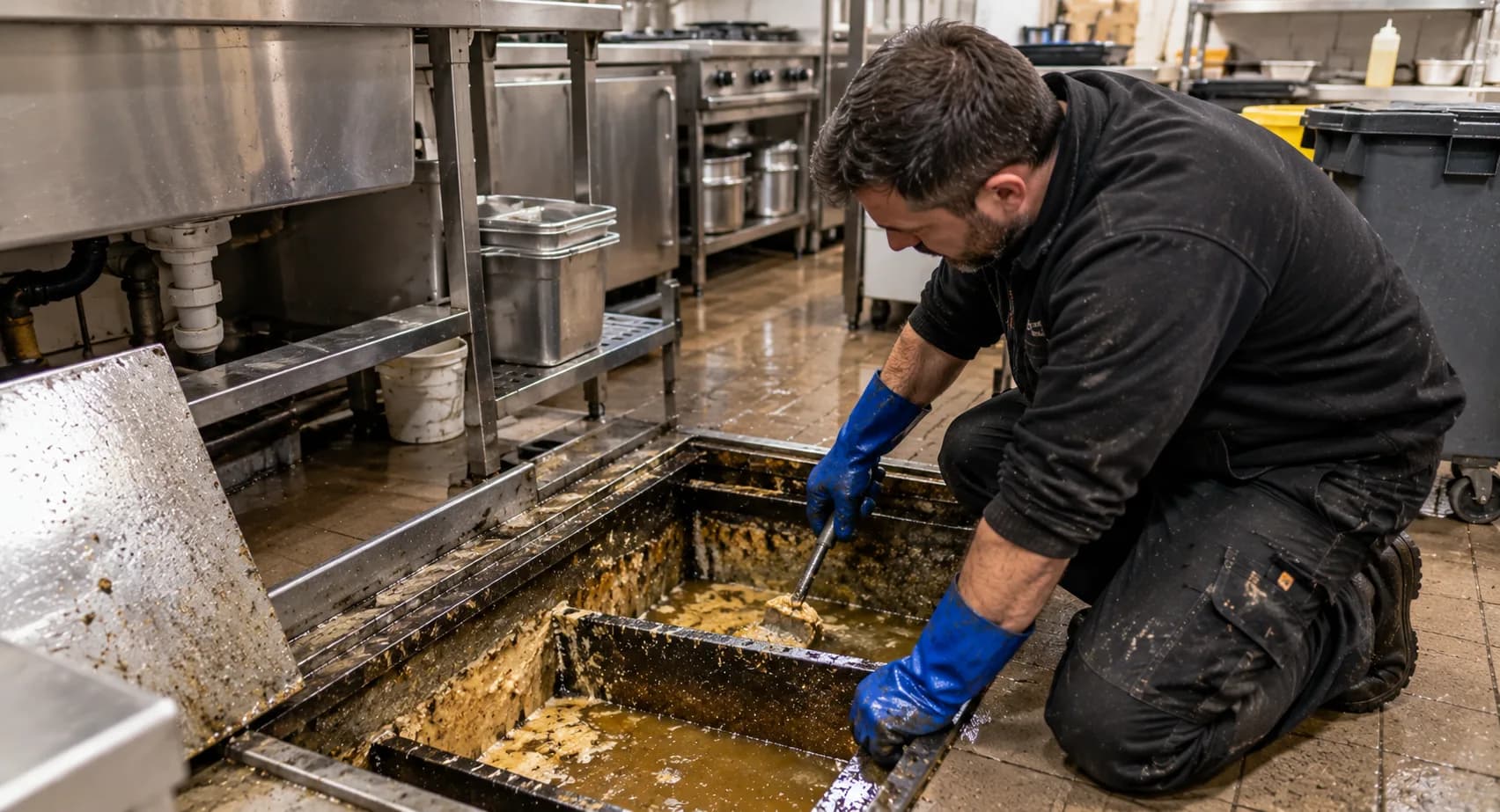
A grease trap is an interceptor between your sinks and the drain. Warm, greasy water enters a chamber, slows down and cools. Because fat is lighter than water it rises and forms a layer on top, while heavier food solids sink to the bottom. Baffles keep that layer in place, and water leaves from the middle of the tank to the drain.
The trap doesn't destroy grease; it stores it. Once the fat and solid layers fill the tank, grease starts escaping into the drain, so a trap that isn't emptied can be almost as bad as having no trap at all.
What are the grease trap regulations in the UK?
There isn't one "grease trap law" in England. Instead, several rules work together:
| Rule | What it says | Who it applies to |
|---|---|---|
| Water Industry Act 1991, section 111 | No one may put anything into a public sewer, or a drain connected to one, "likely to… interfere with the free flow of its contents" | Everyone, including food businesses |
| Building Regulations, Approved Document H, paragraph 2.21 | Drainage serving kitchens in commercial hot-food premises "should be fitted with a grease separator complying with BS EN 1825-1:2004 and designed in accordance with BS EN 1825-2:2002 or other effective means of grease removal" | New builds, fit-outs and drainage alterations needing building control |
| BS EN 1825 | Part 1 covers design, performance and testing of grease separators; Part 2 covers sizing, installation and maintenance | Designers, installers and operators |
| Environmental Protection Act 1990, section 34, and the waste duty of care code of practice | Businesses must store waste safely, pass it only to authorised persons and keep transfer records | Any business producing grease trap waste or used cooking oil |
The section 111 offence is the one with teeth. On summary conviction it carries a fine and a further daily fine while the offence continues, and on indictment up to two years' imprisonment, a fine or both. Water companies can also recover the cost of clearing blockages.
Planning conditions, leases and your local authority's environmental health team may add requirements of their own, so check those too.
How do water companies in the East Midlands enforce FOG rules?
Both local sewerage companies inspect food businesses and expect suitable grease management equipment.
Severn Trent covers Nottinghamshire, Derbyshire and most of Leicestershire. Its fats, oils and grease page for businesses says business owners are responsible for stopping FOG entering the public sewer, and that it can recover costs from businesses that misuse the sewer under section 111. It works with its partner ECAS, whose officers visit food outlets to check grease trapping equipment and procedures. In 2016 Severn Trent brought its first prosecution of this kind, against a restaurant in Codsall, Staffordshire, which was ordered to pay £5,495 including costs after refusing to fit a grease trap (Severn Trent).
Anglian Water covers most of Lincolnshire and parts of Leicestershire. Its grease traps guidance and FOG management guide, produced with the FOGwise group, describe the options below and put the number of eating places in its region at more than 44,500.
Grease trap vs grease separator vs GRU vs enzyme dosing: which is right?
The right choice depends on your menu, how many covers you serve, the space available and your water company's advice. This comparison summarises the main options described in water company guidance:
| Option | Where it sits | How it works | Maintenance burden | Best suited to |
|---|---|---|---|---|
| Passive under-sink grease trap | Under or beside the sink | Gravity: grease floats and is held back | High: frequent manual emptying | Small cafés and low-volume kitchens |
| Grease separator to BS EN 1825 | Usually below ground outside, or in a plant room | Gravity, sized to the kitchen's flow | Planned emptying by tanker | Restaurants, pubs, hotels and new builds |
| Grease removal unit (GRU) | Near the sink or dishwasher | Heats and skims grease into a collection pot automatically | Daily pot emptying, periodic servicing | Busy kitchens with limited space |
| Biological or enzyme dosing | Dosed into pipes or a trap | Microbes or enzymes help break grease down | Refills and a working pump | Supplementing a trap, not replacing it |
A few practical points apply whichever you choose. Units must be sized for peak flow, not average flow. Dishwashers and combi ovens often discharge hot water with detergent, which can push grease through an undersized trap. And any unit needs clear access, because a separator buried under kitchen equipment rarely gets emptied.
How often should a grease trap be emptied?
As often as the manufacturer's instructions and your usage require, and before the fat and solids layers take up so much of the tank that grease escapes. Small under-sink traps may need emptying daily or weekly; larger separators are normally emptied on a planned schedule by a tanker contractor. BS EN 1825-2 sets out maintenance guidance for separators, so agree a written emptying schedule with your contractor and keep the records.
Use this checklist as a starting point and adjust it to your equipment:
| When | Task |
|---|---|
| Every service | Scrape plates and pans into the food waste bin before washing |
| Daily | Empty sink strainers; empty the GRU collection pot if you have one |
| Daily or weekly | Check and empty small under-sink traps as the manufacturer advises |
| Weekly | Check the dosing unit has fluid and is running; look for slow-draining sinks |
| Monthly | Inspect the separator's grease and sludge levels and log them |
| Planned (often quarterly) | Separator emptied and cleaned by a registered carrier; keep the waste transfer note |
| Yearly | Jet the kitchen branch drains and review whether the trap is still big enough |
| Every visit | Record date, contractor, volume removed and any faults in a FOG log |
Keep the log and transfer notes together. They are the first things a water company inspector or environmental health officer will ask to see.
What other kitchen habits keep grease out of the sewer?
Equipment only works alongside good habits:
- Train every member of staff to dry-wipe and scrape before washing, including new starters.
- Collect used cooking oil in sealed containers for a registered collector; never pour it into a sink or outside drain.
- Fit strainers on every sink and floor gully.
- Don't use hot water or strong detergents to "wash grease through"; it simply sets further down.
- Keep bins and oil storage away from drain gullies.
For the background on how kitchen grease turns into sewer blockages, read our guide to what a fatberg is.
What are the signs a grease trap isn't working?
- Sinks and floor gullies drain slowly or back up during busy service.
- Bad smells in the kitchen or around external manholes.
- Grease visible in the inspection chamber after the trap.
- The trap fills much faster than it used to.
- Neighbouring businesses report blockages or smells.
Any of these suggests the trap is undersized, overdue for emptying, or being bypassed. A CCTV drain survey shows how much grease has built up in the pipes beyond it.
When to call a professional
Call a drainage contractor if drains are backing up, grease is showing downstream of the trap, or you've had a letter or visit from your water company's FOG team. Clearing the grease already in the pipes is the first step, usually with high-pressure drain jetting, followed by a camera survey to check the pipes are sound.
We jet commercial kitchen drains and interceptors, carry out CCTV surveys, fit grease traps through our drainage plumbing service and set up planned maintenance plans for food businesses, all quoted before we start. We're open 7 days, 6am to 8pm, with emergency call-outs 365 days a year. Ask for a quote or call 07300 600 950, and see our commercial services page for landlords and businesses.
Sources
- Water Industry Act 1991, section 111 (legislation.gov.uk)
- Approved Document H: drainage and waste disposal (gov.uk)
- BSI: BS EN 1825-1 grease separators
- Severn Trent: fats, oils and grease for businesses
- Severn Trent: Codsall restaurant convicted for blocking sewers
- Anglian Water: grease traps
- Anglian Water: FOG management guide (PDF)
- gov.uk: waste duty of care code of practice
Frequently Asked Questions
Cite this guide: “Grease Traps for Commercial Kitchens: UK Rules and Maintenance”, Urgent Drainage Solutions, 6 October 2026. https://urgentdrainagesolutions.co.uk/blog/grease-traps-commercial-kitchens

Need A Drainage Engineer?Book Online Today