
Pumping Station Maintenance: How Often Should a Sewage Pump Be Serviced?
Written by the Urgent Drainage Solutions teamPublished 8 min read
Quick answer
Pumping station maintenance means a competent engineer servicing the pumps, floats, alarm, valves and chamber at set intervals. Manufacturers citing EN 12056 give at least once a year for a single house, every six months for flats and every three months for commercial premises, with the owner checking it runs properly each month.
- A private pumping station is the owner's responsibility until a water company adopts it.
- Manufacturer guidance under EN 12056 sets service intervals of 12 months for a house, 6 months for flats and 3 months for commercial premises.
- Approved Document H asks for the receiving chamber to hold 24 hours of inflow, at least 150 litres per person per day for homes.
- Wet wipes, rags and fat are behind most pump blockages and float faults.
- A station serving one property inside its own boundary did not transfer to the water company in 2016.
Pumping station maintenance is the routine servicing that keeps a private sewage pump working: the pumps, float switches, alarm, non-return valves and the chamber itself checked and cleaned by a competent engineer at set intervals. Get it wrong and sewage has nowhere to go but back up into the lowest toilet, shower or gully in the building. We install packaged sewage pumping stations with twin pumps and high-level alarms across the East Midlands, and this guide explains what owners need to keep on top of once one is in.
It covers what a private pumping station is, how often it should be serviced, what a service visit should check, what the alarm and emergency storage are for, and who is responsible when a station serves more than one home.
What is a private sewage pumping station?
A private sewage pumping station is a chamber that collects foul water from a building that can't drain to the sewer by gravity, then pumps it up through a pressurised pipe called a rising main to a point where it can flow on. Approved Document H says a pumping installation is needed where gravity drainage is impracticable, or where protection against flooding from a surcharged sewer is required (paragraph 2.36).
You find them at basement flats, barn conversions, homes below road level and small developments on low ground. Inside a building, Approved Document H expects package units to conform to BS EN 12050 and be designed to BS EN 12056-4 (Approved Document H, paragraph 2.37).
Why does a pumping station need regular maintenance?
Because unlike a gravity drain, it has moving parts and electrics, and it fails suddenly rather than slowly. A gravity drain that partly blocks usually drains slowly for a while first. A pump that stops leaves the chamber filling with nothing taking it away.
The faults drainage engineers see most often are:
- Rag and wipes. Wet wipes, sanitary products and cloths wrap around the impeller and jam it, or catch in the non-return valve. Our guide to what not to flush explains why "flushable" wipes still cause trouble.
- Fat. Grease from kitchens sets on the chamber walls and coats the float switches, so they stick and the pump runs dry or doesn't start. See our guide to fat, oil and grease.
- Float switch faults. Floats tangle with each other, with cables or with debris, so the pump cuts in at the wrong level or not at all.
- Worn or failing pumps. Bearings, seals and impellers wear, and a pump that is overworked by a fault on the other pump wears faster.
- Non-return valve faults. A valve that sticks open lets the rising main drain back into the chamber, so the pump keeps re-pumping the same water.
- Electrical faults. A tripped circuit, damp in the control panel or a failed alarm battery can leave you with no warning at all.
None of these is unusual, and most are caught by a routine service before they become a flood.
How often should a pumping station be serviced?
At least once a year for a single house, every six months for flats and every three months for commercial premises. Pump manufacturer Sulzer gives exactly those intervals for maintenance "in accordance with EN 12056", and recommends the owner inspects the station and checks its function monthly (Sulzer). Kessel gives the same intervals and says the monthly owner check should watch at least two pump cycles (Kessel).
| Type of property | Owner check | Service by a competent engineer |
|---|---|---|
| Single house | Monthly: watch two pump cycles, test the alarm | At least every 12 months |
| Block of flats or several homes | Monthly, by the managing agent or a nominated person | At least every 6 months |
| Commercial premises | Monthly, logged | At least every 3 months |
Treat these as maximum intervals. A station taking kitchen waste, serving a busy commercial site or with a history of blockages may need visits more often, and your station's own manual takes priority if it asks for more.
What does a pumping station service check?
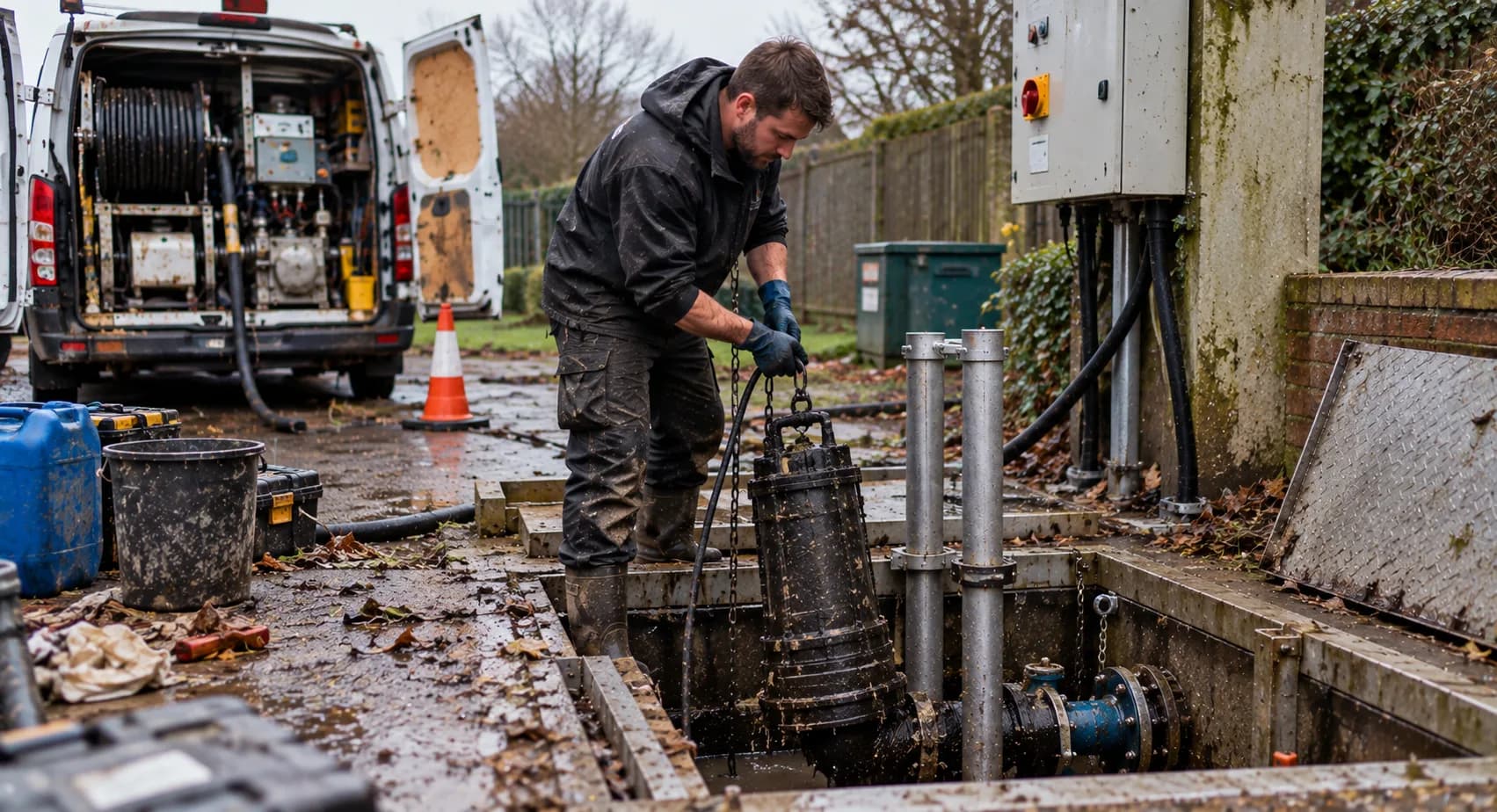
A proper service is more than a look in the lid. Based on the tasks Kessel lists for EN 12056 maintenance, plus the alarm and float checks any engineer should make, a visit should cover:
| Item | What is checked |
|---|---|
| Pumps | Lifted on their guide rails, impeller and bearings checked, rag and debris cleared |
| Oil chamber | Oil level checked, topped up or changed where the pump has one |
| Float switches or level sensors | Clean, free to move, cutting in and out at the right levels |
| High-level alarm | Tested from the float to the panel and any beacon or remote alert; battery checked |
| Non-return and gate valves | Opened, cleaned, checked for free movement and a tight seal |
| Chamber | Fat, silt and rag removed; walls, inlets and benching inspected |
| Control panel and electrics | Visual check for damp, damage and tripped circuits |
| Pipework and connections | Joints around the station checked for leaks |
| Test run | Pumps run through full cycles, with duty and standby alternating |
| Report | Written record of the work done, readings and any defects found |
Kessel also says defects that can't be put right on the day should be reported to the owner in writing. Keep every report. It is the first thing a buyer's solicitor, a managing agent or an insurer will want to see.
Never climb into a pumping station chamber. It is a confined space that can hold sewer gas, and the pumps are electrical. Servicing that needs entry is a job for trained people with the right equipment.
What should happen when the alarm goes off?
The high-level alarm tells you the chamber is filling above its normal working level, which means the pumps are not keeping up or not running. Do these things in order:
- Stop using water. No baths, showers, washing machines or dishwashers.
- Check whether the power is on and whether the pump circuit or residual current device has tripped. Reset it once only.
- If the alarm clears and the pumps run, book a service anyway, because something caused it.
- If it doesn't clear, call an engineer. Don't lift the lid to look, and don't reach in.
A muted alarm that has been left is one of the warning signs listed on our pumping stations page. An alarm only helps if someone acts on it.
How much emergency storage should a pumping station have?
Approved Document H says the receiving chamber of a foul pumping station "should be sized to contain 24-hour inflow to allow for disruption in service", taking at least 150 litres per head per day for domestic use (Approved Document H, paragraph 2.39). For a household of four that works out at 600 litres of storage as a minimum. Other buildings are sized on their calculated daily water demand.
That storage is what buys time during a power cut or a pump failure. It is not a reason to put off a call-out, because once it is full the only place left for sewage is back up the pipes. If you don't know how much storage yours has, ask at the next service.
Will the water company adopt my pumping station?
Sometimes. Under the 2011 private sewer transfer regulations, private pumping stations on sewers that drained to the public network were to vest in the water companies no later than 1 October 2016. Warwick District Council confirms that in the Severn Trent area, privately owned pumping stations meeting the criteria were adopted on 1 October 2016 (Warwick District Council).
Defra's guidance on the transfer sets out what did not move over (Defra, paragraphs 2 and 24):
| Situation | Transferred to the water company? |
|---|---|
| Station and rising main serving one property, inside its own boundary | No, it stays with the owner |
| Station inside the boundary, rising main runs outside it as a lateral | The rising main section outside transfers |
| Station and rising main serving more than one property | Yes, by 1 October 2016 |
| Station that did not drain to a public sewer on 1 July 2011 | No |
Stations built since then are not adopted automatically. A developer can offer a new sewer, including a pumping station, for adoption under an agreement with the water company under section 104 of the Water Industry Act 1991, but only if it is built to the terms of that agreement. Until it is adopted, it stays private.
Who is responsible for a shared pumping station on an estate?
If it has not been adopted, the owners it serves are. On newer estates that usually means a management company collects a service charge and arranges the servicing, or the deeds say how owners share the cost. Check your title documents and any management agreement, and ask the developer whether a section 104 adoption is still in progress, because adoption is not automatic.
For the wider picture of who owns which pipe, see who is responsible for blocked drains.
When to call a professional
Call an engineer if the alarm won't clear, sewage is backing up, a pump runs constantly or cuts in far more often than it used to, there are smells from the chamber between cycles, or the station hasn't been serviced in over a year. These are the faults that end in a flooded basement if they are left.
We design and install packaged pumping stations with twin pumps, high-level alarms and correctly sized rising mains, and hand over servicing guidance when we finish. If your station or the drains feeding it are blocked, drain jetting clears fat and rag from the pipework, and a CCTV drain survey from £149 + VAT shows what is going on upstream. There is no call-out fee, the price is agreed before work starts, and we are open 7 days, 6am to 8pm, with emergency call-outs 365 days a year. We cover Nottinghamshire, Derbyshire, Leicestershire and Lincolnshire. Call 07300 600 950 or ask for a quote.
Sources
- Approved Document H: drainage and waste disposal (gov.uk)
- Sulzer: Synconta 801 lifting station installation and operating instructions (PDF)
- Kessel: inspection and maintenance of pumping equipment
- The Water Industry (Schemes for Adoption of Private Sewers) Regulations 2011 (legislation.gov.uk)
- Defra: guidance on the private sewers transfer regulations (PDF)
- Water Industry Act 1991, section 104 (legislation.gov.uk)
- Warwick District Council: drainage and sewage (Severn Trent sewer transfer)
Frequently Asked Questions
Cite this guide: “Pumping Station Maintenance: How Often Should a Sewage Pump Be Serviced?”, Urgent Drainage Solutions, 6 October 2026. https://urgentdrainagesolutions.co.uk/blog/sewage-pumping-station-maintenance

Need A Drainage Engineer?Book Online Today